- Animals
- ›Chordates
- ›Vertebrates
- ›Ray-finned Fishes
- ›Salmons, Pikes and Mudminnows
- ›Salmons, Trouts, and Whitefishes
- ›Salmons, Trouts, and Whitefishes
- ›Whitefishes
- ›Coregonus
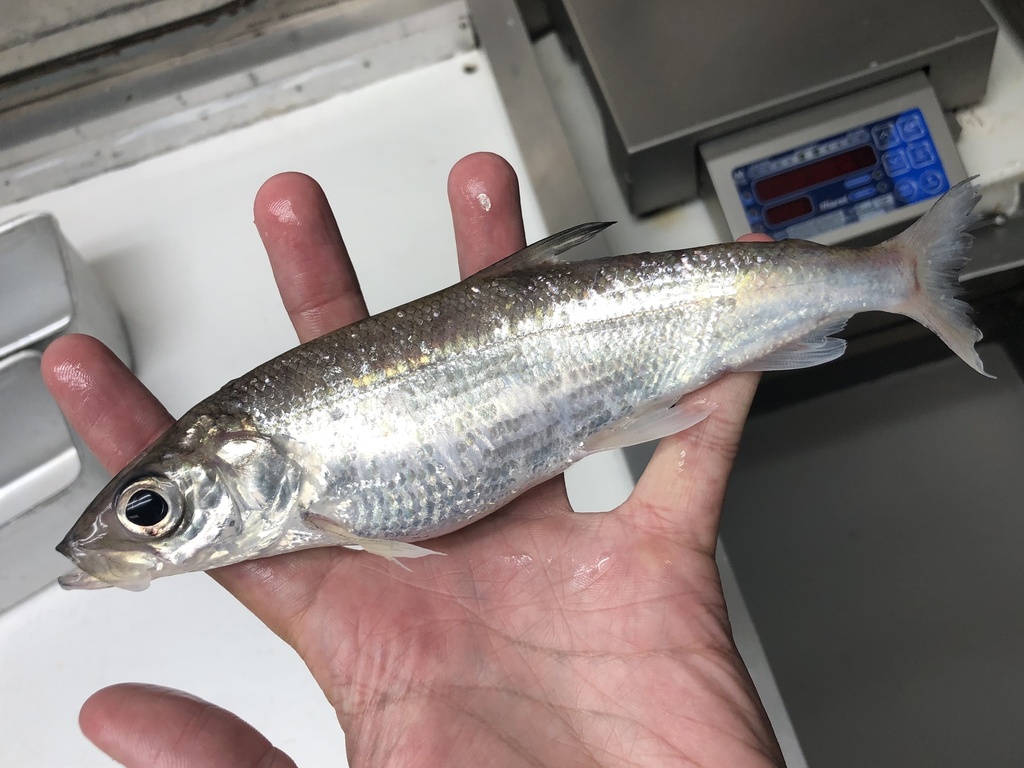
Kiyi
Coregonus kiyi
The kiyi (Coregonus kiyi) is a species of freshwater whitefish, a deepwater cisco, endemic to the Great Lakes of North America. It previously inhabited Lake Superior, Lake Michigan, Lake Huron and Lake Ontario, but is now believed to persist only in Lake Superior where it is common. The various deepwater ciscos are also called chubs (not to be confused with the various species of Cyprinidae also called chubs). The kiyi is part of the large group of related northern ciscos known as the Coregonus artedi complex.
From the article Kiyi on Wikipedia (CC BY-SA), quoted section by section
Description
The kiyi is one of the smaller ciscos. Adult kiyi average approximately 250 millimetres (9.8 in) in total length and 170 grams (6.0 oz) in weight. Individuals can reach more than 280 millimetres (11 in). They are silvery pink or purple iridescence, darker on the back and white on the belly. They may have a dark tip on the lower jaw. They have a large head and a conspicuous, large eye.
What it does
The kiyi is reportedly most abundant at depths greater than 80 metres (260 ft) over its range, with Lake Superior kiyi said to be abundant at depths of 180 metres (590 ft). Females are known to grow larger and live longer (10 years) than males (8 years). Age at maturity is believed to be 2 to 3 years. The minimum size at maturity is reported as 132 millimetres (5.2 in) in Lake Superior. Spawning takes place in autumn or early winter, and has been reported in depths of 106–165 metres (348–541 ft). Ciscoes are known to exhibit large fluctuations in reproductive success and will produce several years of strong year classes followed by several years of poor reproductive success. Although not the preferred chub species owing to their relatively small size, kiyi were a substantial component of the Great Lakes chub fisheries at one time, particularly in Lake Ontario. They, along with other deepwater chubs, have been negatively affected by a combination of factors, including the invasion of the Great Lakes by several non-native species that prey on various life stages of the chubs or compete with them. …
Wikipedia: “Ecology and behavior”
Where it lives
Recorded sightings
—
geo-referenced records in GBIF, from museums, herbaria and field observers.
Drag the globe to turn it. Dots are where records exist, not a range map; darker means more records.
In the stacks
Searching the stacks…
Every page naming Coregonus kiyi in the Biodiversity Heritage Library →
This page is assembled live from iNaturalist, GBIF, Wikipedia, the Source Library and the Internet Archive. It is not yet part of the hand-edited codex. iNaturalist taxon 98459.