- Animals
- ›Chordates
- ›Vertebrates
- ›Ray-finned Fishes
- ›Salmons, Pikes and Mudminnows
- ›Salmons, Trouts, and Whitefishes
- ›Salmons, Trouts, and Whitefishes
- ›Whitefishes
- ›Coregonus
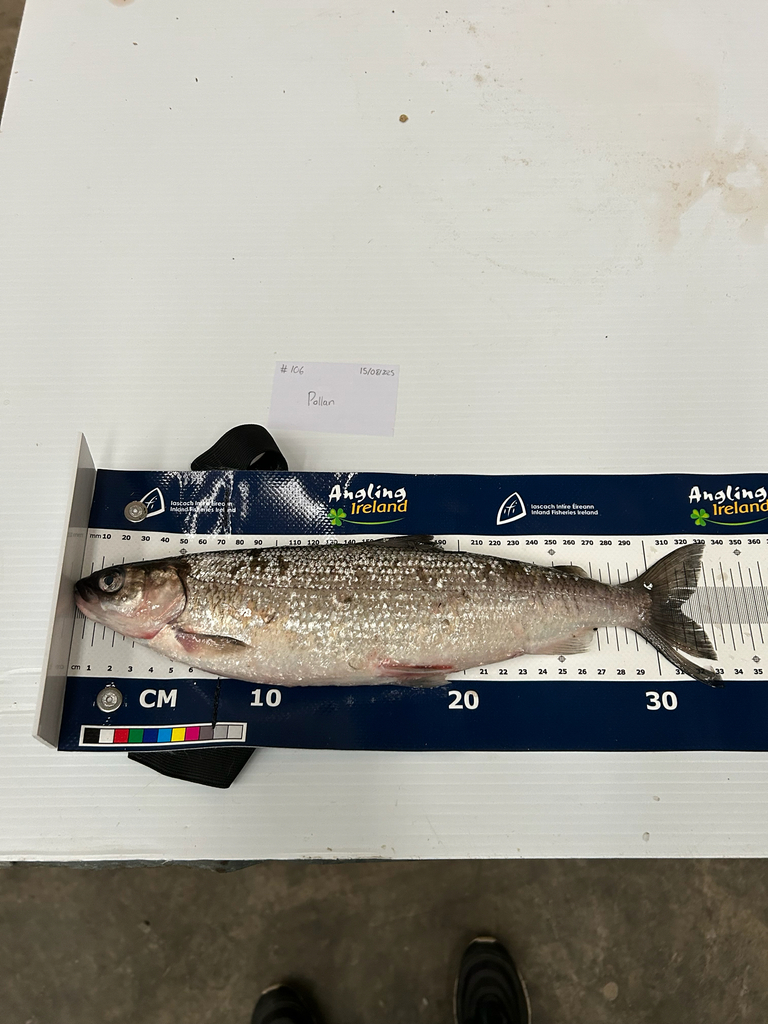
Pollan
Coregonus pollan
The pollan or Irish pollan (Coregonus pollan or Coregonus autumnalis) is a freshwater whitefish known only from five Irish lakes, Lough Neagh, Lower Lough Erne, Lough Ree, Lough Derg and Lough Allen. The pollan faces competition from introduced species such as pike, roach and zebra mussel, and the populations rely on restocking for survival.
From the article Pollan (fish) on Wikipedia (CC BY-SA), quoted section by section
Description
The Irish pollan and other members of the Coregonus genus are very like herrings in appearance but the presence of an adipose fin distinguishes them. The mouth is relatively small and the teeth are deciduous and very small. The scales are of moderate size, the dorsal fin is of moderate length and the tail fin deeply forked. The different species are difficult to tell apart unless the lake from which they originated is known. This species grows to an average length of 9 to 10 in (22.9 to 25.4 cm) and a weight of 6 ounces (170 g).
What it does
The Irish pollan is a shoaling species. The diet consists small crustaceans and insect larvae. Breeding takes place in November and December, with spawning taking place over hard ground in deep water.
Wikipedia: “Ecology”
Where it lives
Recorded sightings
—
geo-referenced records in GBIF, from museums, herbaria and field observers.
Drag the globe to turn it. Dots are where records exist, not a range map; darker means more records.
In the stacks
Searching the stacks…
Every page naming Coregonus pollan in the Biodiversity Heritage Library →
This page is assembled live from iNaturalist, GBIF, Wikipedia, the Source Library and the Internet Archive. It is not yet part of the hand-edited codex. iNaturalist taxon 98479.