- Animals
- ›Chordates
- ›Vertebrates
- ›Cartilaginous Fishes
- ›Sharks and Rays
- ›Rays
- ›Stingrays
- ›Whiptail Stingrays
- ›Common Whiptail Stingrays
- ›Dasyatis
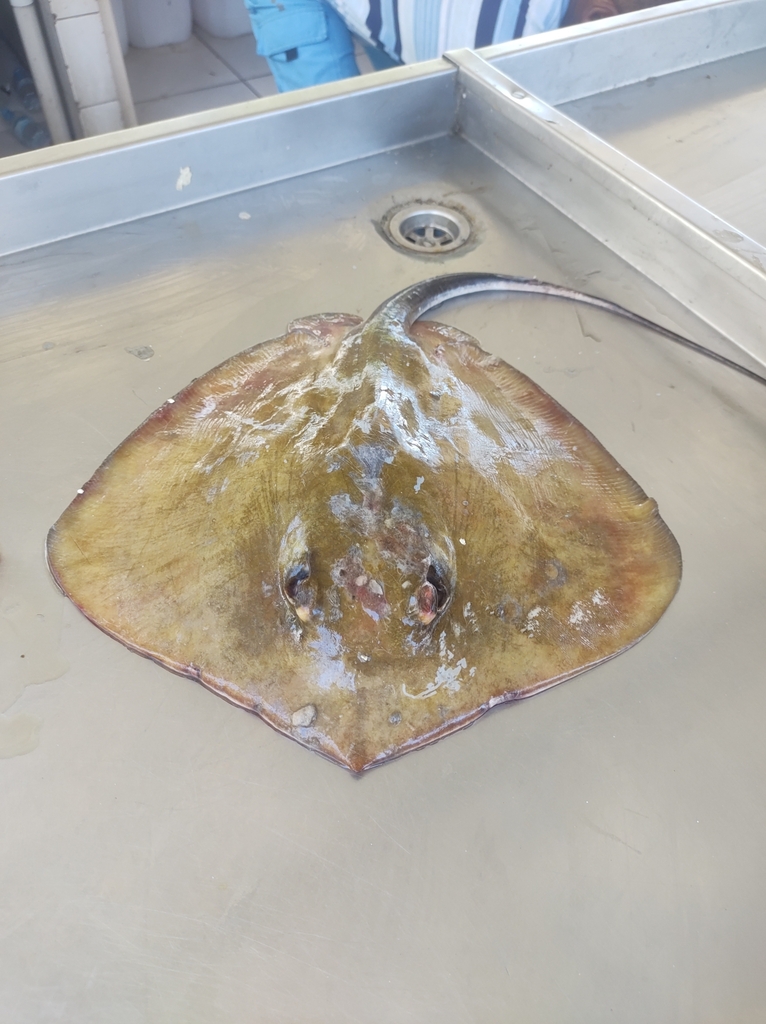
Groovebelly stingray
Dasyatis hypostigma
The groovebelly stingray (Dasyatis hypostigma), referred to as the butter stingray by fishery workers, is a species of stingray in the family Dasyatidae. It is found over sandy or muddy bottoms in shallow coastal waters off southern Brazil, and probably Uruguay and Argentina. The groovebelly stingray can be distinguished by a prominent W-shaped furrow on its underside behind the last pair of gill slits, as well as completely smooth skin in all but the largest individuals. It reaches a maximum known width of 65 cm (26 in). This species is aplacental viviparous, with one observed female gestating two young. The main threat to its population is likely bycatch mortality from shrimp trawlers, although habitat degradation is also a concern.
From the article Groovebelly stingray on Wikipedia (CC BY-SA), quoted section by section
Description
The groovebelly stingray has a diamond-shaped pectoral fin disk slightly wider than long, with nearly straight front margins and a barely projecting snout tip. The eyes are large and protruding, and are immediately followed by wide, angular spiracles. There is a flap of skin between the nares with rounded corners and a fringed posterior margin. The mouth is small and the lower jaw is strongly bow-shaped. There are 37–46 upper and 43–50 lower tooth rows, with a quincunx arrangement. The teeth are blunt in juveniles and females, while in adult males the central teeth are slender and sharp. Adults have 3, 5, or 7 papillae in a row across the floor of the mouth. There is a distinctive W-shaped furrow on the underside behind the fifth pair of gill slits; only one other stingray, the pitted stingray (D. matsubarai), shares this feature. The pelvic fins are pointed with slightly curving trailing margins, and extend just past the disk margin. The whip-like tail measures up to around one and a half times the disk length, with 1 (occasionally 2) serrated stinging spine positioned on top past the first third of the tail. There are fin folds running along the dorsal and ventral sides of the tail behind the spine; the upper fold is fleshier and less than half as long as the lower fold. …
Range & habitat
The groovebelly stingray is found along the coast of southern Brazil from Espírito Santo to Rio Grande do Sul, though it likely occurs as far north as Bahia and as far south as Mar del Plata, Argentina. It inhabits inshore waters at depths of 5–40 m (16–131 ft), though it has been reported from as far down as 80 m (260 ft). This benthic species favors sandy or muddy substrates, and may also enter estuaries.
Wikipedia: “Distribution and habitat”
What it does
Older biological information available on the groovebelly stingray is confounded by its historical confusion with other species. Like other stingrays, the groovebelly stingray is aplacental viviparous: the embryos hatch inside the mother's uterus and are sustained by yolk, later supplemented by histotroph ("uterine milk") delivered by the mother into the embryos' spiracles via trophonemata (villi-like structures). Females have a single functional uterus (on the left). The only pregnant female thus far examined contained two embryos 55–56 mm (2.2–2.2 in) long, which were in an early stage of development.
Wikipedia: “Biology and ecology”
Where it lives
Recorded sightings
—
geo-referenced records in GBIF, from museums, herbaria and field observers.
Drag the globe to turn it. Dots are where records exist, not a range map; darker means more records.
In the stacks
Searching the stacks…
Every page naming Dasyatis hypostigma in the Biodiversity Heritage Library →
This page is assembled live from iNaturalist, GBIF, Wikipedia, the Source Library and the Internet Archive. It is not yet part of the hand-edited codex. iNaturalist taxon 99102.