- Animals
- ›Chordates
- ›Vertebrates
- ›Cartilaginous Fishes
- ›Sharks and Rays
- ›Rays
- ›Stingrays
- ›Whiptail Stingrays
- ›Common Whiptail Stingrays
- ›Dasyatis
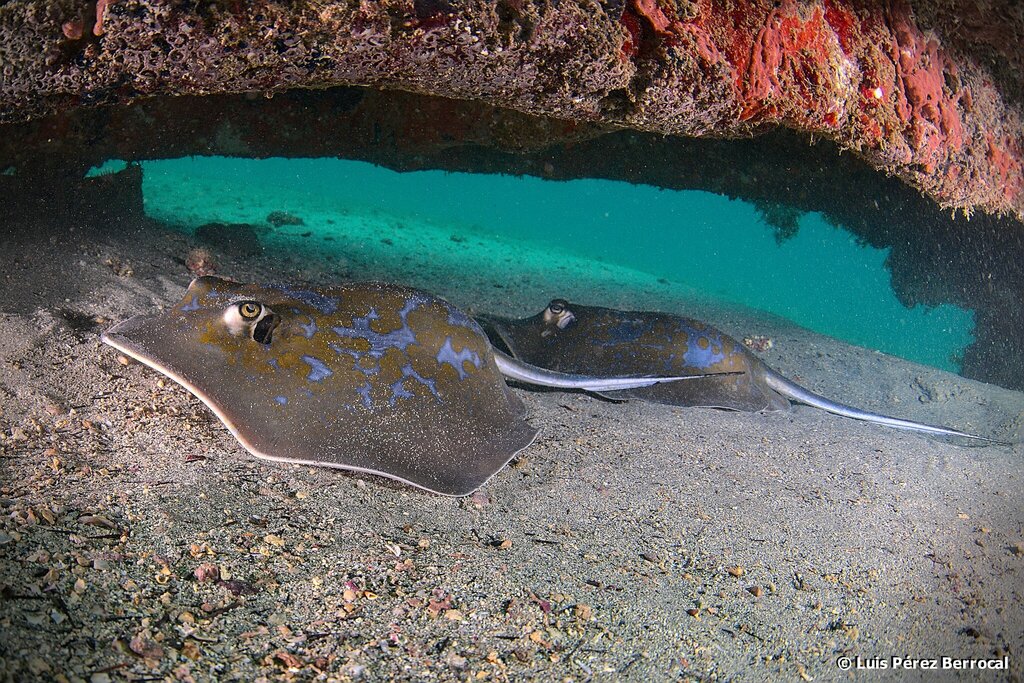
Marbled Stingray
Dasyatis marmorata
Dasyatis marmorata, the marbled stingray, is a species of stingray of the family Dasyatidae. Its geographic range covers the central and south-eastern Atlantic, from Morocco to South Africa. It is also present in the coastal waters of southern Mediterranean Sea and the Levantine Basin. This bottom-dweller generally inhabits sandy or muddy flats near rocky reefs and kelp forests, to a depth of 50 m (164 ft).
From the article Dasyatis marmorata on Wikipedia (CC BY-SA), quoted section by section
Description
A small to medium sized stingray with a snout and disc that doesn’t contain any spines. Their tails contain one dart at its base and the whole individual can measure up to 60 cm with a disk width of up to 44 cm. Their disc is more of an angular shape rather than a perfectly round sphere shape. One interesting fact that derives from their morphology, specifically their tail, is that Marbled Stingray has an undulatory locomotion swimming pattern. They contain prominent elongated snouts, a rhomboidal disc without spines, and very conspicuous bright blue blotches on a beautiful golden background. These bright blue blotches seem to be warning signs that reflect he stingray's toxicity and harmful poison to the human health. The marbled stingray has no caudal and anal fin, just a thick tail like a whip. In addition to this, they are considered bastoids with depressed bodies.
Wikipedia: “Description/Composition”
Range & habitat
They have been recorded in the south of Tunisia, along the coast of Israel, Lebanon, Turkey and Greece. The species is, however, absent from the Black Sea. Additionally, there have been studies where the marbled stingray has been found in the Eastern Atlantic and Mediterranean Sea, off West Africa and the eastern North Atlantic from Morocco to south Congo
Özbek did a close study in 2015 of the different Dasyatis species and the abundance and biomass of each one.
Wikipedia: “Geographic Distribution”
What it does
Their habitat is based on demersal species in temperate water, mainly inhabiting coastal and shallow water as they prefer warmer water temperatures. The Dasyatis marmorata is benthic on continental shelves that are found in sandy and muddy bottoms and/or sometimes even near rocky reefs They are found extremely deep from 12 to 100m under the ocean. The marbled stingray can be found in even deeper areas during winter.
Wikipedia: “Ecology”
In human culture
The Marbled Stingray had previously been misidentified as Dasyatis chrysonota in South Africa and as Dasyatis pastinaca in Europe, due to their similarities in disc length and width as well as the coloration on their pectoral fins. However, the main difference between D. marmota and D. pastinaca is that the marbled stingray has a yellowish surface with blue blotches, as opposed to the common stingray that exhibits brown to olive or grey coloration [4]. D.chrysonota and D. marmota also proved to differ in their snout angle as well as snout-to-vent length. Cowley and Compagno highlighted that the marbled stingray is a Northern hemisphere subspecies of Dasyatis chrysonota, that only has a slightly and more narrower angular snout. There have also been more newly found differences in the length and serrations of this structure proposed by Ergurden D. In addition, the marbled stingray's sexual maturity is known to be reached at 30 cm (274 mm) and 32 cm in Disc Width (DW) for both males and females in that order [4] is viviparous with a gestation period of 3–4 months [4]. They usually have 4 juveniles per litter, each year. Some research has attempted but not successfully advanced in finding the D. …
Wikipedia: “Life History/Biology”
Where it lives
Recorded sightings
—
geo-referenced records in GBIF, from museums, herbaria and field observers.
Drag the globe to turn it. Dots are where records exist, not a range map; darker means more records.
In the stacks
Searching the stacks…
Every page naming Dasyatis marmorata in the Biodiversity Heritage Library →
This page is assembled live from iNaturalist, GBIF, Wikipedia, the Source Library and the Internet Archive. It is not yet part of the hand-edited codex. iNaturalist taxon 99109.