- Animals
- ›Chordates
- ›Vertebrates
- ›Ray-finned Fishes
- ›Spiny-rayed fishes
- ›Jacks, Flounders, Barracudas, and Allies
- ›Jacks, Remoras, and Allies
- ›Jacks
- ›Caranginae
- ›Decapterus
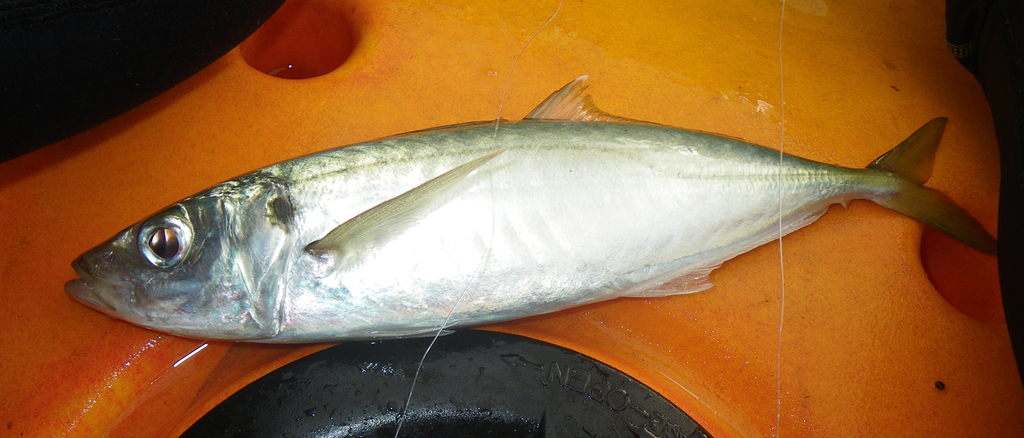
Indian Scad
Decapterus russelli
Decapterus russelli, also known as the Indian scad, northern mackerel scad, round scad, Russell's mackerel scad, slender scad, or three lined grunter, is a species of ray-finned fish in the family Carangidae. It naturally occurs in the Indian and the western Pacific Oceans and has colonised the eastern Mediterranean through the Suez Canal. It is an important species in coastal fisheries throughout its range.
From the article Decapterus russelli on Wikipedia (CC BY-SA), quoted section by section
Description
Decapterus russelli has an elongate, somewhat slender and slightly compressed body. The eyes are of moderate size and have a well developed adipose eyelid which completely covers eye apart from a vertical slit which has the pupil in its centre. The scales on top of head do not reach a line running through the centre of pupil. The lateral line has a low regular arch towards the head and the curved and straight parts meet below the second dorsal fin between 11th to 13th soft rays; there are 42–62 scales in the curved part of the lateral line and between 0 and 4 scutes, while the straight part has 0 to 4 scales which are followed by 30 to 40 scutes, meaning that the total count of scales and scutes is between 77 and 102 if caudal scutes are excluded). There is a dusky or transparent membrane at the join of the upper jaw, the posterior end of the upper jaw is straight above and a little concave and not horizontal antero-ventrally. Both jaws bear an anterior row of minute teeth which is quite irregular with a single series of posterior teeth. There are 10–14 upper gill rakers and 30 to 39 lower making a total of 41 to 53 on the first gill arch. The shoulder girdle has 3 small papillae on its margin, the lower one being the larger. There are two widely separate dorsal fins, the first is triangular with 8 spines and the second has one spine with 28–33 soft rays. …
Range & habitat
Decapterus russelli occurs throughout the Indian Ocean, from the coasts of eastern Africa from the Gulf of Suez as far south as South Africa to Indonesia, eastwards into the western Pacific Ocean, from Japan in the north and south to Australia. First recorded in the Mediterranean Sea off Israel in 2005, it is now common in Levantine waters up to Iskenderun (Turkey) and has become an important species in local fisheries.
Wikipedia: “Distribution”
In human culture
The specific name honours the Scottish surgeon and herpetologist Patrick Russell (1726–1805) who had described and illustrated in 1803 but did not give it a specific name.
== References ==
Wikipedia: “Etymology”
Where it lives
Recorded sightings
—
geo-referenced records in GBIF, from museums, herbaria and field observers.
Drag the globe to turn it. Dots are where records exist, not a range map; darker means more records.
In the stacks
Searching the stacks…
Every page naming Decapterus russelli in the Biodiversity Heritage Library →
This page is assembled live from iNaturalist, GBIF, Wikipedia, the Source Library and the Internet Archive. It is not yet part of the hand-edited codex. iNaturalist taxon 99146.