 NL·0321
Herbarium of the Nature Library
- Name
- Piranga olivacea
- Family
- Cardinalidae
- Native to
- Breeds in eastern North America; winters in north-western South America, mainly along the eastern Andean foothills from Colombia to Bolivia
- Habitat
- Deciduous forest, Mixed forest, Montane forest (winter)
On eBird ↗
Scarlet Tanager
Live sightings near you, the range map, bar charts of when it is seen, and Macaulay Library photos and recordings.
Scarlet tanager
Piranga olivacea
Also calledPiranga escarlata (Spanish) · Tangara écarlate (French)
A blazing red bird with jet-black wings that sings unseen high in the canopy of eastern forests. After breeding the male turns yellow-green, keeping only his black wings, before flying to the Andes for the winter.
The scarlet tanager is a medium-sized American songbird in the cardinal family (Cardinalidae). It was placed in the tanager family (Thraupidae) until 2009, but was moved to Cardinalidae following several genetic studies indicating the Piranga tanagers are more closely related to cardinals and their allies. Breeding males have bright red plumage with black wings and tails, while females are yellow-olive. Outside the breeding season, males develop plumage similar to that of females, although their wings and tails remain darker. The species breeds mainly in large deciduous forests in eastern North America. It migrates through Central America to spend the winter in forests along the Andean foothills of northwestern South America. Scarlet tanagers feed mainly on insects, but they also eat fruit when it is available. Habitat fragmentation can increase nest predation and brood parasitism, and populations are declining in some areas. However, the species is classified as Least Concern by the International Union for Conservation of Nature. Wikipedia
What it can do
- iUndergoes a complete colour change: scarlet in summer, olive-yellow in autumn and winter
- iiMigrates thousands of kilometres between the US and South America
- iiiGleans caterpillars from the high canopy, controlling forest insect pests
In the field
Field marks
- aBreeding male: brilliant scarlet body with solid black wings and tail
- bFemale and winter male: olive-green above, yellow below, with dark wings
- cNo wing bars
- dStout, pale, rather blunt bill
- Voice
- A hoarse, burry series of phrases, often described as 'a robin with a sore throat'; call a distinctive 'chick-burr'.
- Not to be confused with
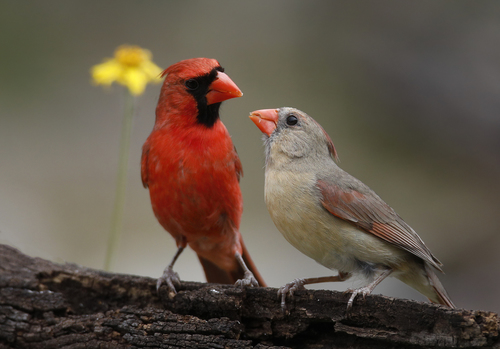
- Summer Tanager male is entirely rose-red including the wings. Northern Cardinal has a crest and a black face. Western Tanager has wing bars; female orioles have pointed bills and wing bars.
- Where to see it
- Mature oak forests of the eastern US, e.g. the Appalachians; on migration at sites such as Magee Marsh (Ohio) and Central Park (New York) in May.
- When
- Summer visitor, May–Sep
Listen
Looking for field recordings…
Life & habits
- Diet
- Caterpillars, beetles and other canopy insects; fruit in autumn
- Habitat
- Large tracts of mature deciduous and oak–hickory forest
- Size
- 16–17 cm; 23–38 g
- Lifespan
- Banding record about 11 years
It is sensitive to forest fragmentation and is scarce or absent in small woodlots.
Where it lives
Recorded sightings
—
geo-referenced records in GBIF, from museums, herbaria and field observers.
Native range
Breeds in eastern North America; winters in north-western South America, mainly along the eastern Andean foothills from Colombia to Bolivia
Drag the globe to turn it. Dots are where records exist, not a range map; darker means more records.
In the stacks
Searching the stacks…
Every page naming Piranga olivacea in the Biodiversity Heritage Library →
Marginalia
Curiosity
Its species name olivacea ('olive-green') describes the plumage of females and young birds, not the scarlet breeding male.
Kinship


Fact-checked: 1 correction made to this sheet. Photographs: iNaturalist contributors under the licences shown. Records: GBIF.org. Historical plates: Source Library (CC BY-SA 4.0; originals public domain). Summary text: Nature Library editors and Wikipedia (CC BY-SA). Medicinal and edibility notes are historical and educational, not advice. iNaturalist taxon 9921.