- Animals
- ›Chordates
- ›Vertebrates
- ›Ray-finned Fishes
- ›Spiny-rayed fishes
- ›Jacks, Flounders, Barracudas, and Allies
- ›Flatfishes
- ›True Soles
- ›Dicologlossa
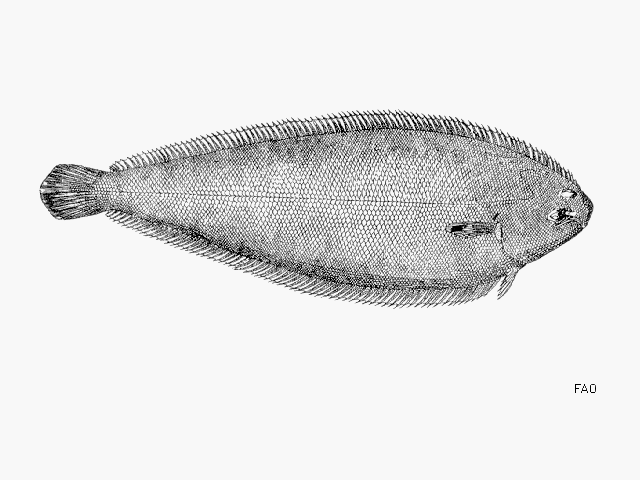
Wedge Sole
Dicologlossa cuneata
The wedge sole (Dicologlossa cuneata), is a flatfish of the Soleidae family. It is a bottom dwelling predatory fish inhabiting both sandy and muddy soils at depths between 10 and 450 m (33 and 1,476 ft) in the East Atlantic and Mediterranean Sea. It achieves a maximum size of 30 cm (12 in).
From the article Wedge sole on Wikipedia (CC BY-SA), quoted section by section
Description
Wedge soles are a flatfish having a maximum size of 30 cm (12 in). Several characteristics permit their distinction from other Soleidae, notably the juveniles of other species with which it is sometimes confused. Its body is more elongated than most other species of the Soleidae family, with scales that detach more easily than the common sole. The upper face is a chocolate brown and carries characteristic blueish marks. On this side, the pectoral fin has a black mark which doesn't extend to the end, contrary to other soles. This fin has a marked triangular shape. The angular snout covers a little of the lower jaw. Another feature is that the lateral line is formed of between 105 and 132 tubular scales, compared to between 116 and 163 for the common sole. Additionally, this line showed a marked curve towards the head in the supratemporal area, while it is more gently curved in Solea solea. Other anatomical differences between the species are the position of the migratory eye, the shape of the urohyal and the number of vertebrae; Dicologlossa cuneata has 43–45 vertebrae, compared to 49–52 for Solea solea.
Wikipedia: “Morphology”
Range & habitat
The wedge sole occurs in the eastern Atlantic from the Bay of Biscay south to Cape of Good Hope, including the Canary Islands and the Cape Verde Islands. It also extends into the western Mediterranean Sea along the coast of Spain to Málaga and on the coasts of Morocco and Algeria. There have also been records from Syria in 2014. The population in the northern part of its range is increasing, this may be due to the increasing temperatures of these waters caused by climate change.
Wikipedia: “Distribution and population”
What it does
The wedge sole is found on sandy or sand-mud bottoms at depths of 15 - 40m, although it has been found at depths of 115m along the inner shelf of the Gulf of Cadiz and at 400m off Mauritania. It is a predator of crustaceans, polychaetes and bivalves. The spawning season is extended starting in the autumn and continues through the winter until early summer. The eggs are pelagic and non-adhesive., although this varies geographically; running from May to September in the Bay of Bisccay and in late Autumn and Winter in the Mediterranean. Females reach sexual maturity at a total length of 18 cm (7.1 in), males at 15 cm (5.9 in).
Wikipedia: “Habitat and ecology”
Where it lives
Recorded sightings
—
geo-referenced records in GBIF, from museums, herbaria and field observers.
Drag the globe to turn it. Dots are where records exist, not a range map; darker means more records.
In the stacks
Searching the stacks…
Every page naming Dicologlossa cuneata in the Biodiversity Heritage Library →
This page is assembled live from iNaturalist, GBIF, Wikipedia, the Source Library and the Internet Archive. It is not yet part of the hand-edited codex. iNaturalist taxon 99274.