On eBird ↗
Antipodean Albatross
Live sightings near you, the range map, bar charts of when it is seen, and Macaulay Library photos and recordings.
Antipodean Albatross
Diomedea antipodensis
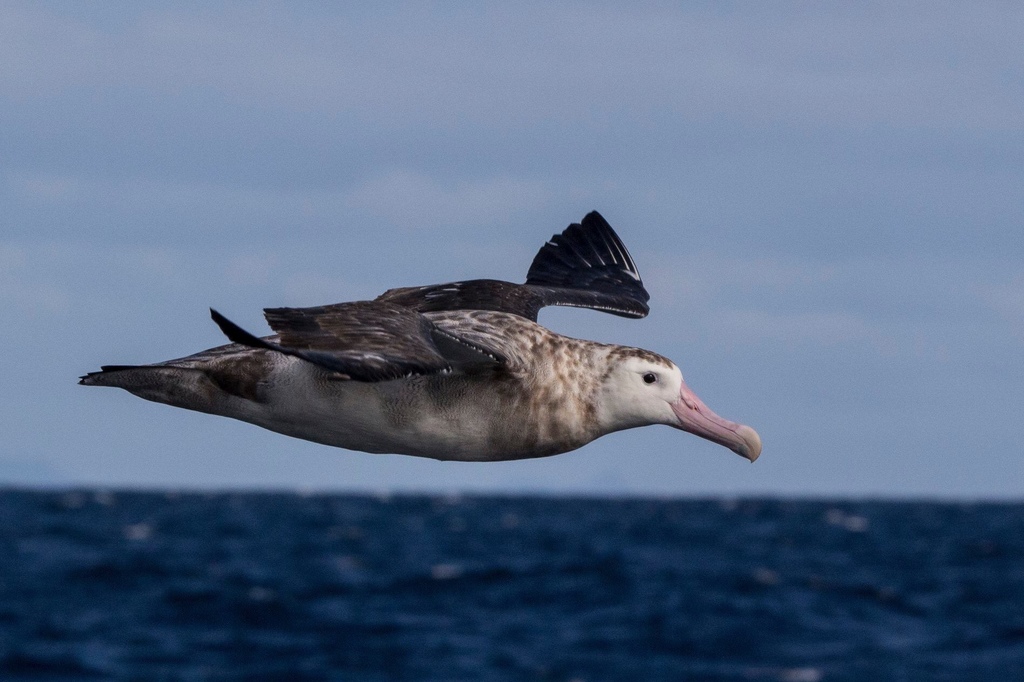
The Antipodean albatross (Diomedea antipodensis) (Māori: Toroa) is a large seabird in the albatross family. Its recognition as more than a subspecies of the wandering albatross is relatively recent, and still not accepted by all authorities. Antipodean albatrosses are smaller than other former wandering albatrosses, now called snowy albatrosses, and breed in predominantly brown plumage, but are otherwise difficult to distinguish from young snowy albatrosses (snowy albatrosses grow lighter in color with age, while the Antipodean stays darker).
From the article Antipodean albatross on Wikipedia (CC BY-SA), quoted section by section
Description
The Antipodean is large, at 110 cm (43 in) in length. Its breeding plumage is brown and white and its juveniles are similar in appearance to the snowy albatross. Breeding females have brown upper parts, and have white vermiculations on their back. Its face, throat, lower breast, and belly are white, and its undertail coverts are brown. Its underwings are also white, but with a dark tip. The bill of a small number of antipodensis, especially immatures and females, has a dusky tip to the lower mandible and can even appear to have a dark cutting edge to the upper mandible, like Amsterdam Island Albatross, especially when strongly backlit. Breeding males are whiter than females, but not as white as the snowy albatross, and both sexes have a pink bill. The females of the nominate race have a dark brown breast band and the males have a darker cap, tail, and humeral flexure than gibsoni.
Range & habitat
At sea Antipodean albatrosses range across the South Pacific from Australia to as far as Chile, from the Tropic of Capricorn south. The gibsonii seems to range to the east of Auckland Island, and the nominate race ranges to the east to Chile. They breed on the Auckland Islands, Antipodes Islands, and Campbell Island.
Wikipedia: “Range and habitat”
What it does
They feed predominantly on cephalopod and to a lesser extent fish (unlike other albatross species they are not recorded eating any crustaceans), and have been recorded visiting the spawning grounds of the giant cuttlefish off New South Wales. They nest on ridges, slopes, or plateaus, and will build their nest in the open or within patchy vegetation, such as tussock grassland.
Wikipedia: “Behaviour”
In human culture
The name Diomedea antipodensis includes the genus name Diomedea after the Greek warrior king Diomedes, whose companions turned to birds, and the species name antipodensis, the Latin form of the Antipodes Islands, where they are found.
Wikipedia: “Etymology”
Listen
Looking for field recordings…
Where it lives
Recorded sightings
—
geo-referenced records in GBIF, from museums, herbaria and field observers.
Drag the globe to turn it. Dots are where records exist, not a range map; darker means more records.
In the stacks
Searching the stacks…
Every page naming Diomedea antipodensis in the Biodiversity Heritage Library →
This page is assembled live from iNaturalist, GBIF, Wikipedia, the Source Library and the Internet Archive. It is not yet part of the hand-edited codex. iNaturalist taxon 99305.