- Animals
- ›Chordates
- ›Vertebrates
- ›Cartilaginous Fishes
- ›Sharks and Rays
- ›Rays
- ›Skates
- ›Hardnose Skates
- ›Dipturus
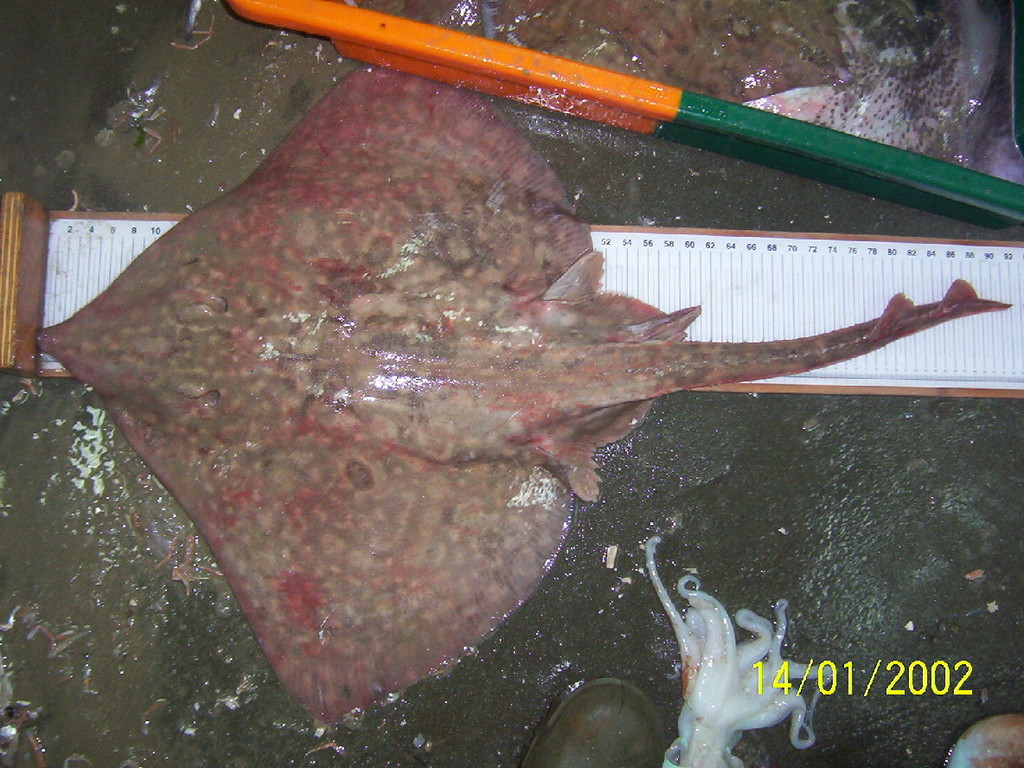
Common Skate
Dipturus batis
The blue skate (Dipturus batis), also known as the grey skate, blue-grey skate, and common skate, is a species of cartilaginous fish, a ray, belonging to the family Rajidae, the skates. It was formerly considered to be conspecific with the flapper skate (D. intermedius), the combined taxon being known as the common skate. Historically, it was one of the most abundant skates in the northeast Atlantic Ocean and the Mediterranean Sea. Despite its name, today it appears to be absent from much of this range. Where previously abundant, fisheries directly targeted this skate and elsewhere it is caught incidentally as bycatch. The former species was uplisted to critically endangered on the IUCN Red List in 2006 and it is protected within the EU.
Research published in 2009 and 2010 showed that the common skate should be split into two, the smaller southern D. cf. flossada (blue skate), and the larger northern D. cf. intermedius (flapper skate). Under this taxonomic arrangement, the name D. batis is recommended to be discarded. Currently, the scientific name D. batis (with flossada as a synonym) is retained for the blue skate and D. intermedius for the flapper skate.
From the article Blue skate on Wikipedia (CC BY-SA), quoted section by section
Description
The blue skate can reach up to 1.43 m (4 ft 8 in) in length. Overall shape features a pointed snout and rhombic shape, with a row of spines or thorns along the tail. The top surface is generally coloured olive-grey to brown, often with a pattern of spots, and the underside is lighter blue-grey. The blue skate has a pointed and long snout and can have from 0-3 interdorsal thorns, though it is usually 1-2. It can be confused with several other skates in its range, such as D. nidarosiensis, D. oxyrinchus, and Rostroraja alba.
Range & habitat
The blue skate is native to the northeast Atlantic. It is a bottom dwelling species mainly found at depths of 100–200 m, but it can occur as shallow as 30 m and as deep as 1,000 m. Blue skates prefer seabeds with a soft substrate, but have been found to occur over gravel, cobble, and rocky seabeds. Now, their population and range are severely depleted and fragmented, with disappearances being reported on several places. This species is found in northeastern Atlantic from Norway and Iceland to Senegal. Its presence in the Mediterranean Sea is questionable since earlier records could concern D. intermedius recently considered as a distinct species.
Wikipedia: “Range, habitat, and ecology”
What it does
The blue skate can reach an estimated age of 50–100 years and maturity is reached when about 11 years old. The size where they reach maturity depend on sex and population. In D. cf. flossada (blue skate) males reach maturity when about 1.15 m (3 ft 9 in) long and females when about 1.23 m (4 ft 0 in) long. In D. cf. intermedia (flapper skate), males reach maturity when about 1.86 m (6 ft 1 in) long and females when about 1.98 m (6 ft 6 in) long. The sex ratio is 1:1, but this can vary depending on geography and season. When hatching, juveniles measure up to 22.3 cm (8+3⁄4 in) long. Once they have reached sexual maturity, they reproduce only every other year. They mate in the spring, and during the summer, females lay about 40 egg cases in sandy or muddy flats. The eggs develop for 2–5 months before hatching.
Egg case. Egg cases measure up to 25 cm (10 in) long, excluding the horns, and 15 cm (6 in) wide. They are covered in close-felted fibers and often wash up on the shore. Egg case hunts have been done throughout the general distribution of the common skate. In the British Isles, egg cases were found only in northern Scotland and the north of Ireland. In the 19th and 20th centuries, egg cases were seen along the entire British coastline in high numbers, but now they are found only in a few areas.
Wikipedia: “Growth and reproduction”
Where it lives
Recorded sightings
—
geo-referenced records in GBIF, from museums, herbaria and field observers.
Drag the globe to turn it. Dots are where records exist, not a range map; darker means more records.
In the stacks
Searching the stacks…
Every page naming Dipturus batis in the Biodiversity Heritage Library →
This page is assembled live from iNaturalist, GBIF, Wikipedia, the Source Library and the Internet Archive. It is not yet part of the hand-edited codex. iNaturalist taxon 99394.