On eBird ↗
Savannah Sparrow
Live sightings near you, the range map, bar charts of when it is seen, and Macaulay Library photos and recordings.
Savannah Sparrow
Passerculus sandwichensis
The Savannah sparrow (Passerculus sandwichensis) is a small New World sparrow that is the only member of the genus Passerculus. It is a widespread and abundant species that occupies open grassland habitats in North America.
Over most of its range it is migratory, breeding in Canada and the northern United States while wintering in Mexico and the southern United States. It is a sexually monomorphic species that is quite variable in appearance. Around 17 subspecies are currently recognised. These are divided into several groups, some of which have sometimes been considered as separate species.
From the article Savannah sparrow on Wikipedia (CC BY-SA), quoted section by section
Description
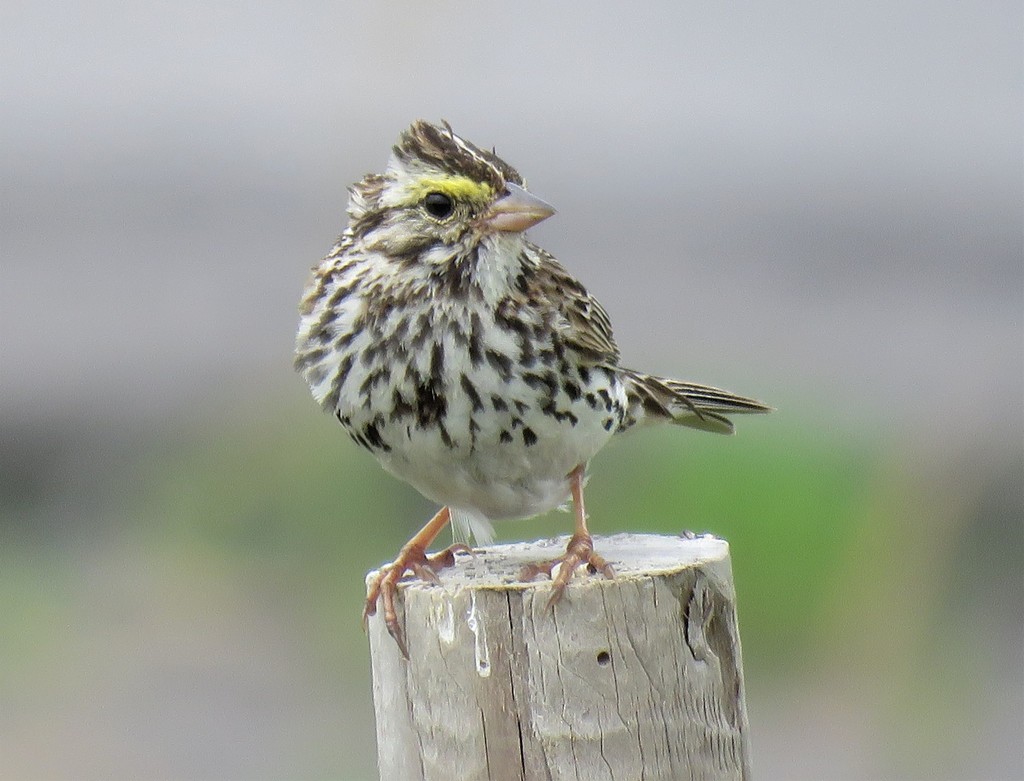
The Savannah sparrow has a typically sparrow-like dark-streaked brown back, and whitish underparts with brown or blackish breast and flank streaking. It has whitish crown and supercilium stripes, sometimes with some yellow (more often near the beak). The cheeks are brown and the throat white. The flight feathers are blackish-brown with light brown or white border. The eyes are dark. The feet and legs are horn-colored, as is the lower part of the bill, with the upper part being dark grey. It is a very variable species, with numerous subspecies, several of which have been split as separate species at various times. The different forms vary principally in the darkness of the plumage. The variation generally follows Gloger's rule, with Alaskan and interior races the palest, and southwestern coastal forms the darkest. There are some exceptions, though, most conspicuously in some island populations that presumably were strongly affected by founder effects. The general pattern of variation has a fairly clear divide, southwest of which the birds become notably darker; this agrees quite well with the limit between P. sandwichensis and P. (s.) rostratus. Savannah sparrows show some variation in size across subspecies. The total length can range from 11 to 17 cm (4.3 to 6.7 in), wingspan ranges from 18 to 25 cm (7.1 to 9.8 in) and body mass from 15 to 29 g (0.53 to 1.02 oz). …
Range & habitat
This passerine bird breeds in Alaska, Canada, northern, central and Pacific coastal United States, Mexico and Guatemala. The Pacific and Mexican breeders are resident, but other populations are migratory, wintering from the southern United States across Central America and the Caribbean to northern South America. It is a very rare vagrant to western Europe.
Wikipedia: “Distribution and habitat”
What it does
These birds forage on the ground or in low bushes; particularly in winter they are also found in grazed low-growth grassland. They mainly eat seeds, but also eat insects in the breeding season. They are typically encountered as pairs or family groups in the breeding season, and assemble in flocks for the winter migration. The flight call is a thin seep. Sensu lato, the Savannah sparrow is considered a threatened species by the IUCN. The song is mixture of chirps and trills.
Wikipedia: “Behavior”
Listen
Looking for field recordings…
Where it lives
Recorded sightings
—
geo-referenced records in GBIF, from museums, herbaria and field observers.
Drag the globe to turn it. Dots are where records exist, not a range map; darker means more records.
In the stacks
Searching the stacks…
Every page naming Passerculus sandwichensis in the Biodiversity Heritage Library →
This page is assembled live from iNaturalist, GBIF, Wikipedia, the Source Library and the Internet Archive. It is not yet part of the hand-edited codex. iNaturalist taxon 9981.