- Animals
- ›Chordates
- ›Vertebrates
- ›Ray-finned Fishes
- ›Spiny-rayed fishes
- ›Freshwater Sunfishes, Grunters, and Allies
- ›Freshwater Sunfishes and relatives
- ›Freshwater Sunfishes
- ›Centrarchinae
- ›Enneacanthus
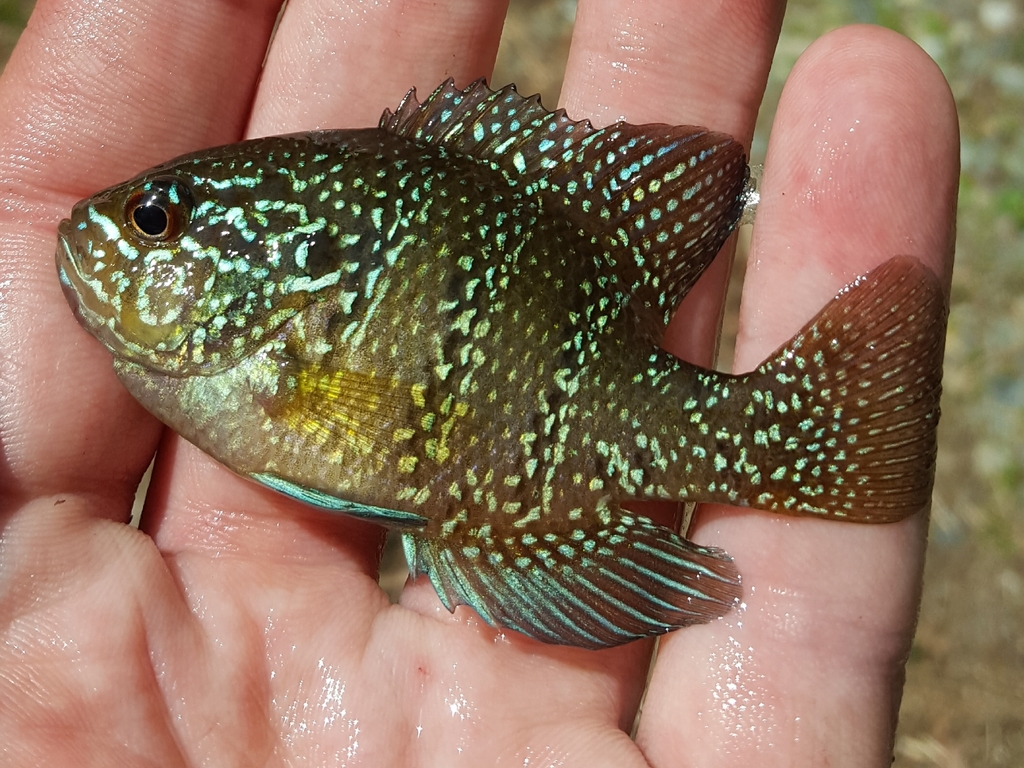
Banded Sunfish
Enneacanthus obesus
The banded sunfish (Enneacanthus obesus) is a freshwater fish of the family, Centrarchidae. They can grow to 2–3 inches long. They are native to North America.
From the article Banded sunfish on Wikipedia (CC BY-SA), quoted section by section
Description
The banded sunfish is similar to the blackbanded sunfish and has a very compressed and deep body. Its sides are iridescent and dark colored. There are dark bands on its side and nuptial males and females will develop blue specks on their bodies. Its mouth is upturned and its pectoral and tail fins are rounded. It grows to an approximate length of 9.5 cm.
Range & habitat
The banded sunfish is found in the Atlantic coastal drainages of North America from southern Maine south to central Florida and along the Gulf slope as far west as the Perdido River drainage in Alabama.
Wikipedia: “Distribution”
What it does
Spawning occurs from April through July. They can spawn when they become one year old. The male will construct a sand or gravel nest where the eggs are laid but does guard the eggs as the eggs are buoyant and float way from the nest.
Wikipedia: “Reproduction”
In human culture
The banded sunfish was first formally described as Pomotis obesus in 1854 by the French ichthyologist Charles Frédéric Girard (1822-1895) with the type locality given as Framingham and in a branch of the Charles River, at Holliston, Massachusetts. The generic name Enneacanthus means "nine-spined" while the specific name obesus means "fat".
Wikipedia: “Taxonomy and etymology”
Where it lives
Recorded sightings
—
geo-referenced records in GBIF, from museums, herbaria and field observers.
Drag the globe to turn it. Dots are where records exist, not a range map; darker means more records.
In the stacks
Searching the stacks…
Every page naming Enneacanthus obesus in the Biodiversity Heritage Library →
This page is assembled live from iNaturalist, GBIF, Wikipedia, the Source Library and the Internet Archive. It is not yet part of the hand-edited codex. iNaturalist taxon 99993.