- Animals
- ›Arthropods
- ›Hexapods
- ›Insects
- ›Winged and Once-winged Insects
- ›Flies
- ›Brachyceran Flies
- ›Cyclorrhaphan Flies
- ›Schizophoran Flies
- ›Acalyptrate Flies
- ›Kelp, Marsh, Thick-headed Flies and Allies
- ›Black Scavenger Flies
- ›Sepsis
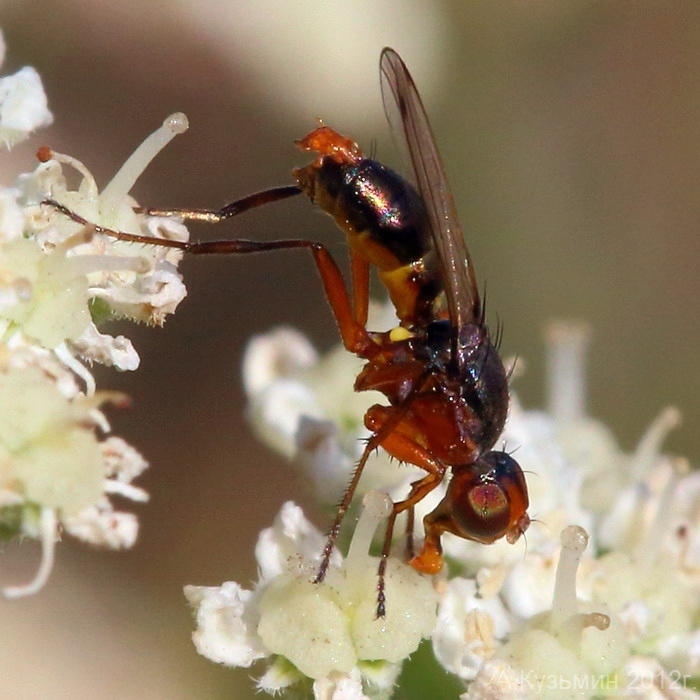
Sepsis thoracica
Sepsis thoracica, more commonly known as the black scavenger fly, a species of fly from the genus Sepsis and the family Sepsidae. It was discovered by Robineau-Desvoidy in 1830. It resembles a small flying ant. The fly is most commonly found inhabiting cow dung.
Sepsis thoracica shows positive directional selection in body size that corresponds with negative selection of melanism. In addition, body size and coloration are coupled via gene regulation. A hypothesized mechanism is through the enzyme phenoloxidase.
From the article Sepsis thoracica on Wikipedia (CC BY-SA), quoted section by section
Description
Sepsis thoracica is a relatively small fly (often described as ant-like), averaging 5 mm in length and 0.75 mm in width. They have a rounded head with compound eyes. The last segment of the body contains short, silver hair. Their wings are mostly transparent with dark spots towards the ends. The developmental temperature influences their body size, in accordance with the temperature-size rule. Females are completely black and smaller than males.
Male polymorphism. Males can be either black or amber, a coloration that is usually only observed in more tropical species. S. thoracica is the only fly of the genus Sepsis to exhibit this male polymorphism in relation to size. While males can be a spectrum of colors between black and amber, most are usually one of the extremes. Thermal radiation, which is the long-waves emitted by the atmosphere, is important in the development of S. thoracica because the
Range & habitat
Sepsis thoracica has a wide distribution. It is mainly found in Europe, particularly in the United Kingdom, extending as far north as Denmark and southern Sweden. It is also in Afrotropical and Australasian regions. It has most recently been found in Vietnam and South Korea. It is mostly dispersed near the coasts and at high elevations in mountain ranges.
Wikipedia: “Distribution”
At the table
They spend a considerable amount of their life foraging for nectar and their insect prey, Sc. stercoraria. They feed on dung for protein and nectar for carbohydrates. While they are found to mostly feed on cow dung, they have been shown to feed on horse dung if it is available in their area. The competitor density they face largely depends on the amount of eggs laid in the dung pat from which they emerged. They don't face much outside species competition.
Wikipedia: “Food resources”
In human culture
Females deposit their eggs into the dung. The larvae are not able to escape this during development and thus the flies only leave when they are adults. The larvae are amphipneustic, meaning that both their first and last spiracles are functional. The two spiracle pairs of the respiratory system are on the prothorax and the posterior of the abdomen. The developmental time of the larvae is four days and five hours, optimally at a temperature of 26-28 °C. In cow dung, 15–22 days marks the total developmental time. These flies enter dormancy in response to dropping temperatures.
Wikipedia: “Life history”
Listen
Looking for field recordings…
Where it lives
Recorded sightings
—
geo-referenced records in GBIF, from museums, herbaria and field observers.
Drag the globe to turn it. Dots are where records exist, not a range map; darker means more records.
In the stacks
Searching the stacks…
Every page naming Sepsis thoracica in the Biodiversity Heritage Library →
This page is assembled live from iNaturalist, GBIF, Wikipedia, the Source Library and the Internet Archive. It is not yet part of the hand-edited codex. iNaturalist taxon 689510.