- Animals
- ›Arthropods
- ›Hexapods
- ›Insects
- ›Winged and Once-winged Insects
- ›Grasshoppers, Crickets, and Katydids
- ›Grasshoppers, Locusts, and Allies
- ›Grasshoppers
- ›Short-horned Grasshoppers and Locusts
- ›Short-horned Grasshoppers
- ›Slant-faced Grasshoppers
- ›Gomphocerini
- ›Gomphocerippus
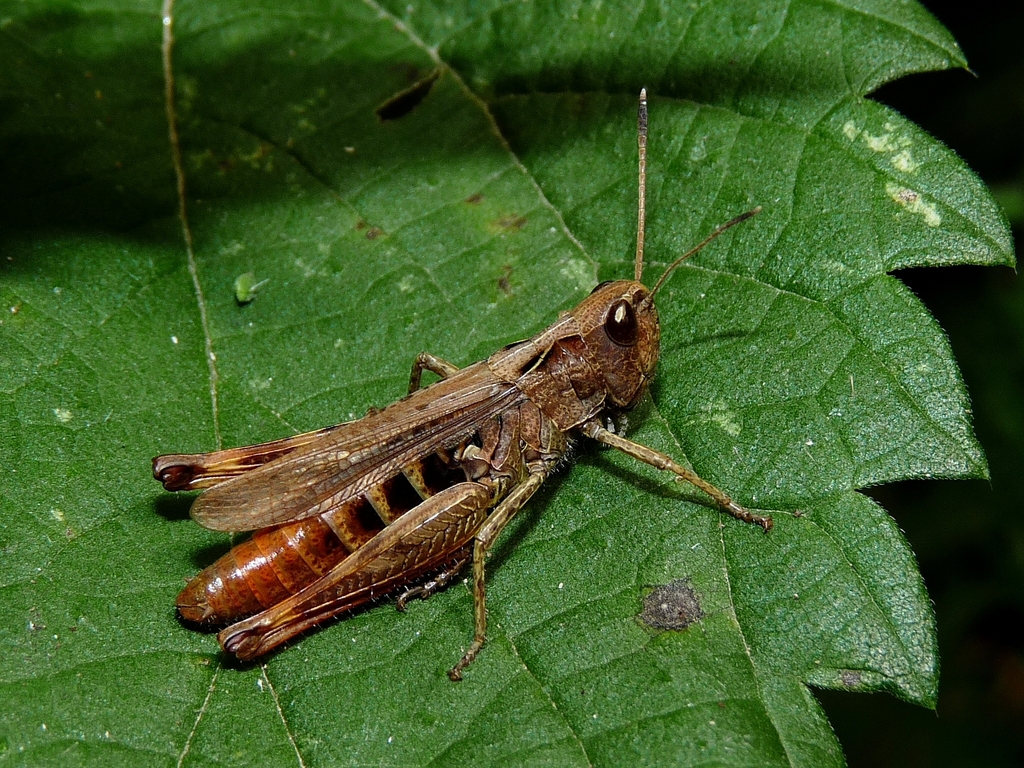
Rufous Grasshopper
Gomphocerippus rufus
The rufous grasshopper (Gomphocerippus rufus) is a species of grasshopper. It is a medium-sized, broad, brown, short-horned grasshopper with clubbed antennae that are tipped with a conspicuous white or pale colour. It is fairly large, averaging 14 to 22 mm in length. It is of the subfamily Gomphocerinae in the family Acrididae, the predominant family of grasshoppers. This species is present in most of Europe, in the eastern Palearctic realm, and in the Near East. It can be encountered from late July through mid-December, usually in dry or slightly moist habitats. The environments in which it typically resides include dry grassland on calcareous soils, sheltered valleys with scrub, and the open borders of forests. It feeds on grasses and various herbaceous plants. It is known for its distinctive courtship song and accompanying display.
From the article Rufous grasshopper on Wikipedia (CC BY-SA), quoted section by section
Range & habitat
The rufous grasshopper is usually found in open land, particularly terrain such as meadows, pastures, and forest edges that feature tall grass. More specifically, it can often be found in chalk grassland. It has been found on southern slopes of the Alps up to approximately 8100 feet. It prefers warm environments of moisture levels ranging from dry to moist. Very common locations include regions of Europe, including Germany, Sweden, France, and the United Kingdom. In fact, it can be found across almost all of Europe and Asia, ranging from France to parts of Siberia and from Scandinavia to northern Germany. These adept climbers prefer to avoid remaining on the ground, and instead perch on plants in sunny, elevated areas. As such they tend to live near herbaceous, taller plants and only by short plants infrequently. One situation that illustrates this preference well was the outbreak of the myxomatosis virus in rabbits in Britain in the 1950s. The rabbit population became severely depleted. As rabbits have the effect of cropping grass short to eat it, this decrease in the population led to less cropped grass. …
Wikipedia: “Habitat”
What it does
Grasshoppers in general, including this species, are herbivorous and subsist mainly on grasses. Scientists have gained knowledge of the diet of G. rufus through the use of feces as a source of DNA. It has been documented to eat plants of the genus Bromus, the species Holcus lanatus, and the subfamily Pooideae, all within the family Poaceae. Poaceae is a family of flowering monocots whose members are referred to as true grasses. Pooideae includes lawn grasses and cereals such as wheat and barley. Bromus is composed of grasses called brome grasses or cheat grasses. Holcus lanatus, more commonly known as Yorkshire fog or velvet grass, is a species of perennial pasture grass noted for its hairy texture. The rufous grasshopper has also been known to sparingly eat other plants such as rushes.
Wikipedia: “Diet”
Listen
Looking for field recordings…
Where it lives
Recorded sightings
—
geo-referenced records in GBIF, from museums, herbaria and field observers.
Drag the globe to turn it. Dots are where records exist, not a range map; darker means more records.
In the stacks
Searching the stacks…
Every page naming Gomphocerippus rufus in the Biodiversity Heritage Library →
This page is assembled live from iNaturalist, GBIF, Wikipedia, the Source Library and the Internet Archive. It is not yet part of the hand-edited codex. iNaturalist taxon 117313.