- Animals
- ›Arthropods
- ›Hexapods
- ›Insects
- ›Winged and Once-winged Insects
- ›True Bugs, Hoppers, Aphids, and allies
- ›Plant-parasitic Hemipterans
- ›Aphids and Allies
- ›Aphidoidea
- ›Aphids
- ›Aphidinae
- ›Macrosiphini
- ›Myzus
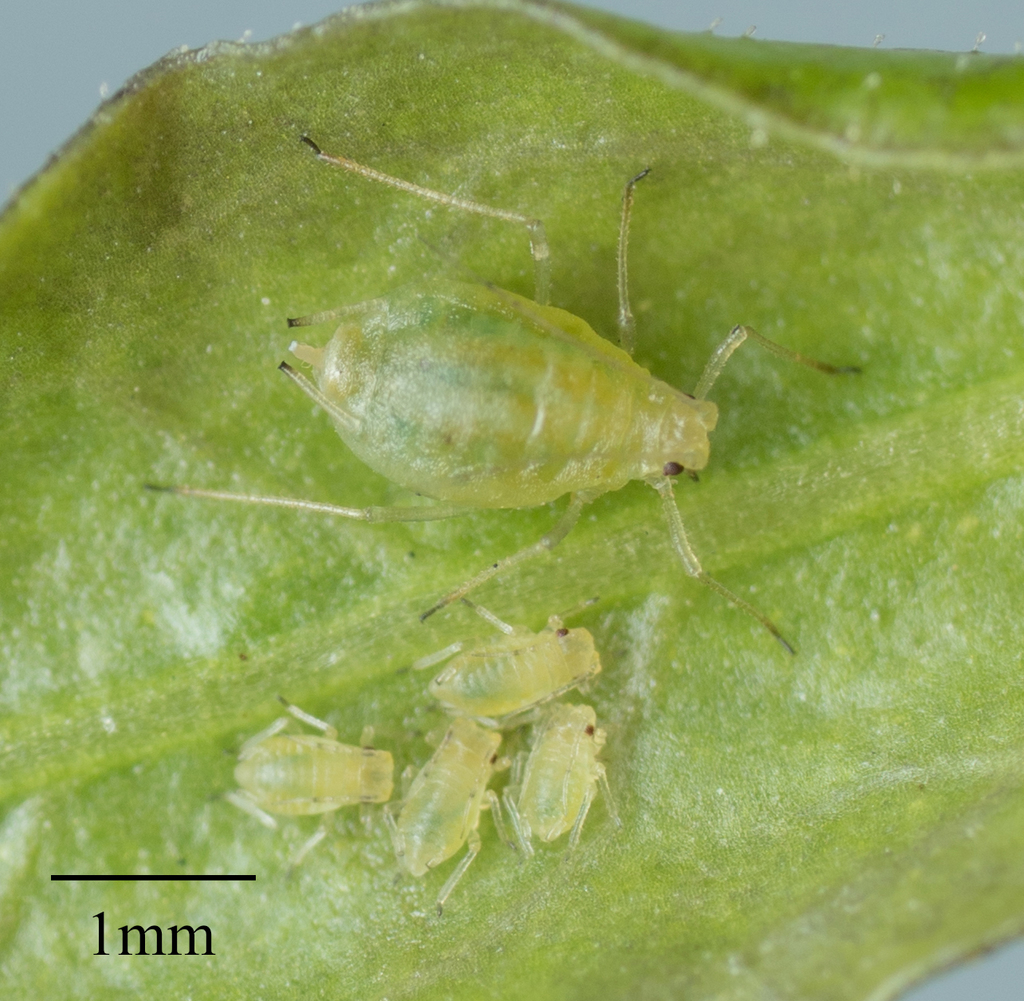
Green Peach Aphid
Myzus persicae
Myzus persicae, known as the green peach aphid, greenfly, or the peach-potato aphid, is a small green aphid belonging to the order Hemiptera. It is the most significant aphid pest of peach trees, causing decreased growth, shrivelling of the leaves and the death of various tissues. It also acts as a vector for the transport of plant viruses such as cucumber mosaic virus (CMV), potato virus Y (PVY) and tobacco etch virus (TEV). Potato virus Y and potato leafroll virus can be passed to members of the nightshade/potato family (Solanaceae), and various mosaic viruses to many other food crops.
Originally described by Swiss entomologist Johann Heinrich Sulzer in 1776, its specific name is derived from the Latin genitive persicae, "of the peach". The syntype specimen of this species is located in the Illinois Natural History Survey Insect Collection.
From the article Myzus persicae on Wikipedia (CC BY-SA), quoted section by section
Description
Eggs of this species measure about 0.6 millimetres (0.024 in) long and 0.3 millimetres (0.012 in) wide, and are elliptical in shape. The eggs are initially yellow or green but turn black. The nymphs are initially green, but soon turn yellowish and resemble the viviparous adults. Nymphs that give rise to winged females may be pinkish. Adult winged aphids have a black head and thorax, and a yellowish green abdomen with a large dark dorsal patch. They measure approximately 1.8 to 2.1 millimetres (0.071 to 0.083 in) in length. The wingless adult aphids are yellowish or greenish in colour, with the possibility of medial and lateral green strips being present. Their cornicles match their body colour, are moderately long and unevenly swollen along their length. The appendages are pale. The adult green peach aphid can be yellowish-green, red, or brown in colour because of morphological differences influenced primarily by the host plants, nutrition, and temperature. Distinguishing morphological traits from this group include their convergent inner faces of the antennal tubercles in dorsal view, and the slightly clavate siphunculi which are dark-tipped and approximately as long as the terminal process of the antenna.
Wikipedia: “Morphology”
Range & habitat
The green peach aphid is found worldwide but is likely of Asian origin, much like its primary host plant, Prunus persica. This species does not prefer areas of extreme temperature or humidity. These particular aphids can be transported great distances by wind and storms. However, previous studies suggest that long-distance migration is uncommon in M. persicae, thus the spread of diverse genotypes over distance geographic regions is likely a result of anthropogenic influence. These insects are not only a pest towards field crops, but tend to invade greenhouses as well. Thus, when young plants are infested by these aphids in greenhouses and are then transported to other locations, they are widely distributed. This explains their great distribution lengths, as well as their ability of high survival in areas with inclement weather and their ability to be readily transported on plant material. This species has been introduced into 16 countries or islands (see global distribution figure). It is found in terrestrial habitats, and as mentioned previously, its native range is likely of Asia-Temperate origin. Its European Nature Information System (EUNIS) habitat is classified as lines of trees, small anthropogenic woodlands, recently felled woodland, early-stage woodland and coppice.
Wikipedia: “Distribution”
What it does
Life cycle of the green peach aphid varies depending on temperature. A fully completed generation takes approximately 10 to 12 days with over 20 annual generations reported in mild climates. Aphids overwinter on Prunus plants and once plants break their dormancy, the eggs hatch and nymphs feed on the flowers, young foliage and stems of the plant. After several generations, winged individuals deposit nymphs on summer hosts. In cold climates, adults will return to Prunus plants in the autumn, where mating occurs and eggs are then deposited. All generations except the autumn generation culminating in egg production are parthenogenetic (non-sexual). Females give birth to offspring 6–17 days after birth, with an average age of 10.8 days at first birth. Length of reproduction varies but averages 14.8 days. Average length of life is approximately 23 days, without the presence of predators. The worst damage on plants is in the early summertime for the aphid breeding peak, because winged dispersants from Prunus spp. where the egg of overwintering aphid stage deposit nymphs on summer hosts migrating to tobacco, potatoes and cruciferous vegetables to be harmful continuously after a few generations.
Wikipedia: “Life cycle”
At the table
Some groups of aphids feed predominantly in the parenchymal tissue of plants while most aphid species feed on the phloem sap. The green peach aphid ingests sugary fluids via a membrane. While feeding on a plant long term, Myzus persicae can uptake chloroplast DNA, even though the chloroplasts themselves are uninjured. Process of exudation from M. persicae stylets is exhibited to ingest phloem sap on plants with assisted pressure within the plants. On artificial diets, this species is also able to ingest food from a source with negligible pressure and can even produce honeydew on certain artificial diets.
Wikipedia: “Food habits”
Listen
Looking for field recordings…
Where it lives
Recorded sightings
—
geo-referenced records in GBIF, from museums, herbaria and field observers.
Drag the globe to turn it. Dots are where records exist, not a range map; darker means more records.
In the stacks
Searching the stacks…
Every page naming Myzus persicae in the Biodiversity Heritage Library →
This page is assembled live from iNaturalist, GBIF, Wikipedia, the Source Library and the Internet Archive. It is not yet part of the hand-edited codex. iNaturalist taxon 243745.