- Animals
- ›Arthropods
- ›Crustaceans
- ›Typical Crustaceans
- ›Barnacles and Copepods
- ›Copepods
- ›Neocopepoda
- ›Gymnoplea
- ›Calanoid Copepods
- ›Clausocalanidae
- ›Pseudocalanus
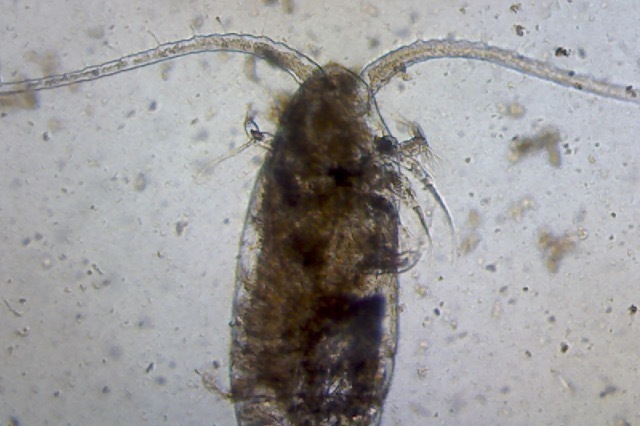
Pseudocalanus elongatus
Pseudocalanus elongatus is a copepod found primarily in the Atlantic Ocean.
From the article Pseudocalanus elongatus on Wikipedia (CC BY-SA), quoted section by section
Description
The female P. elongatus ranges from about .7 to 1.8 millimetres (0.028 to 0.071 in) in length, and the male is usually between about .5 and 1.4 millimetres (0.020 and 0.055 in).
Range & habitat
Pseudocalanus elongatus is generally found in temperate or sub-Arctic waters in the Atlantic and in the western Mediterranean Sea, although it is also found in the Arctic, and off of the southwestern coast of the United States.
Wikipedia: “Distribution”
What it does
Pseudocalanus elongatus is abundant (at least off the coast of Plymouth, UK) from March to October, and breeds from January to December, usually having from four to six generations. It is most abundant from April to August, and peaks during June and August. In the southern North Sea, P. elongatus breeds year round. The peaks in abundance here in June, August, and October is likely caused by advection of other individuals into the area. In this region, maximum reproduction occurs during April and May (during which the concentration of chlorophyll a is at its highest), clutch size and egg production rate being highest during this period. Clutch size, hatching success, and egg production rate are negatively correlated with temperature. The proportion of breeding females is significantly related to the concentration of chlorophyll a.
== References ==
Wikipedia: “Life cycle and reproduction”
Where it lives
Recorded sightings
—
geo-referenced records in GBIF, from museums, herbaria and field observers.
Drag the globe to turn it. Dots are where records exist, not a range map; darker means more records.
In the stacks
Searching the stacks…
Every page naming Pseudocalanus elongatus in the Biodiversity Heritage Library →
This page is assembled live from iNaturalist, GBIF, Wikipedia, the Source Library and the Internet Archive. It is not yet part of the hand-edited codex. iNaturalist taxon 329013.