- Animals
- ›Molluscs
- ›Cephalopods
- ›Octopuses, Squids, and Cuttlefishes
- ›Squids and Cuttlefishes
- ›Inshore Squids
- ›Pencil Squids
- ›Sepioteuthis
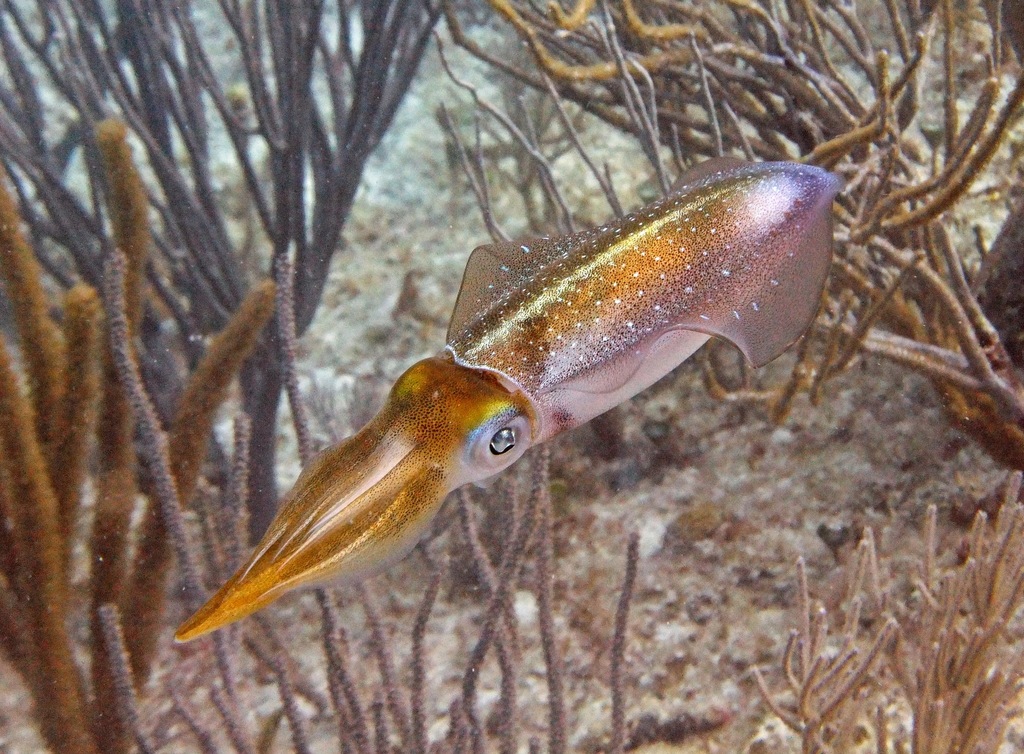
Caribbean Reef Squid
Sepioteuthis sepioidea
The Caribbean reef squid (Sepioteuthis sepioidea), commonly called the reef squid, is a species of small, torpedo-shaped squid with undulating fins that extend nearly the entire length of the body, approximately 20 cm (8 in) in length. They are most commonly found in the Caribbean Sea in small schools. As part of the Cephalopod class of Molluscs, these organisms exhibit specific characteristics to help them in their environment, such as tentacles for movement and feeding and color pigments that reflect their behavioral conditions.
From the article Caribbean reef squid on Wikipedia (CC BY-SA), quoted section by section
Description
Like most squid species, reef squid exhibit an asymmetric, horizontal pupil, commonly referred to as W-shaped. Its purpose is currently unknown, though research supports utilization in balancing light within their vision field. This creates evenly visualized images. Another phenomenon, deemed the "half-and-half" body pattern, is a body morph that occurs during interactions with other cephalopods. One half of the cephalopod's body gets darker than the typical coloration a few minutes after the interaction occurs. This color-change is also observed during the sleeping state. The extended 'quiet state' results in a pale, uniform color compared to the shorter 'active state' including varying colors, textures, and patterns.
Wikipedia: “Characteristics”
Range & habitat
The Caribbean reef squid is found throughout the Caribbean Sea as well as off the coast of Florida, commonly in small schools of four to thirty in the shallows associated with reefs. The habitat of the Reef Squid changes according to the squid's stage of life and size. New hatchlings tend to reside close to the shore in areas from 0.2 to 1 metre (1 to 3 ft) below the surface on or under vegetation. Young small squid typically congregate in shallow turtle grass near islands and remain several centimeters to two meters from the surface to avoid bird predators. Adults venture out into open water and can be found in depths up to 150 m. When mating, adults are found near coral reefs in depths of 1.5 to 8 metres (5 to 26 ft). The Caribbean reef squid is the only squid species commonly sighted by divers over inshore reefs in the Florida, Bahamas and Caribbean regions. They are also found around Brazilian reef habitats, due to a symbiotic relationship in which the squid protect juvenile fish from open-ocean predators.
Wikipedia: “Distribution and habitat”
What it does
This species, like most squids, is a voracious eater and typically consumes 30–60% of its body weight daily. Prey is caught using the club-like end of the long tentacles which are then pulled towards the mouth supported by the shorter arms. Like other cephalopods, it has a strong beak which it uses to cut the prey into parts so that the raspy tongue, or radula, can be used to further process the food. It consumes small fish, other molluscs, and crustaceans.
Wikipedia: “Feeding behavior”
In human culture
The reef squid is included in the monophyletic family Loliginidae, which houses a discovered twenty-six species. The origin of the family is the geographical Cretaceous period within the Indo-Pacific sea region. In 2001, marine biologist Silvia Maciá discovered that squid were able to propel themselves up out of the water about 2 m (6.6 ft) and fly approximately 10 m (33 ft) before re-entry; a discovery which led to the identification of six species of flying squid.
Wikipedia: “History and phylogeny”
Where it lives
Recorded sightings
—
geo-referenced records in GBIF, from museums, herbaria and field observers.
Drag the globe to turn it. Dots are where records exist, not a range map; darker means more records.
In the stacks
Searching the stacks…
Every page naming Sepioteuthis sepioidea in the Biodiversity Heritage Library →
This page is assembled live from iNaturalist, GBIF, Wikipedia, the Source Library and the Internet Archive. It is not yet part of the hand-edited codex. iNaturalist taxon 49440.