- Animals
- ›Molluscs
- ›Gastropods
- ›Heterobranchs
- ›Euthyneura
- ›Tectipleura
- ›Eupulmonata
- ›Systellommatophoran Slugs
- ›Leatherleaf and Prism Slugs
- ›Leatherleaf Slugs
- ›Laevicaulis
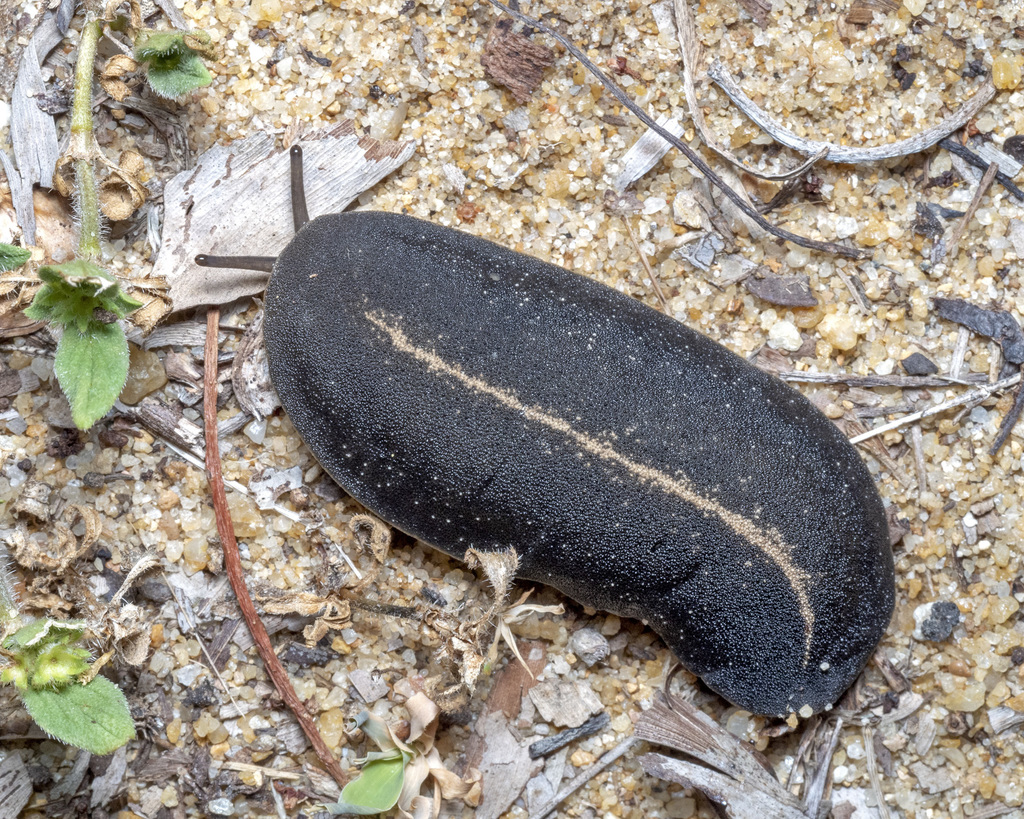
Tropical Leatherleaf Slug
Laevicaulis alte
The tropical leatherleaf, scientific name Laevicaulis alte, is a species of tropical land slug, a terrestrial pulmonate gastropod mollusk in the family Veronicellidae, the leatherleaf slugs.
From the article Laevicaulis alte on Wikipedia (CC BY-SA), quoted section by section
Description
Laevicaulis alte is a round, dark-coloured slug with no shell, 7 or 8 cm (2.8 or 3.1 in) long. Its skin is slightly tuberculated. The central keel is beige in colour. This slug has a unique, very narrow foot; juvenile specimens have a foot 1 mm (0.039 in) wide and adult specimens have a foot that is only 4 or 5 mm (0.16 or 0.20 in) wide. The tentacles are small, 2 or 3 mm (0.079 or 0.118 in) long, and they are only rarely extended beyond the edge of the mantle.
Range & habitat
The species is probably indigenous to sub-Saharan Africa, including Tanzania, Botswana and South Africa It has been introduced and has become an invasive species in the following areas:
Southern Asia Taiwan China Ryukyu Islands, Japan United States (Hawaii) Islands in the Indian Ocean Australia (since 1889) Samoa The species is already established in the USA, and is considered to represent a potentially serious threat as a pest, an invasive species which could negatively affect agriculture, natural ecosystems, human health or commerce. Therefore, it has been suggested that this species be given top national quarantine significance in the USA.
Wikipedia: “Distribution”
What it does
The slug hatches from eggs. Laevicaulis alte has several adaptations for living in dry conditions: a rounded shape with as small as possible surface area, and a narrow foot to reduce evaporation. Juvenile specimens search for food nearly always at night, and stay buried in the soil during the day. Larger specimens are active during the day sometimes. The slug can grow up from 0.5 cm (0.20 in) to approximately 4 cm (1.6 in) in length in 7 months.
Wikipedia: “Life cycle”
Where it lives
Recorded sightings
—
geo-referenced records in GBIF, from museums, herbaria and field observers.
Drag the globe to turn it. Dots are where records exist, not a range map; darker means more records.
In the stacks
Searching the stacks…
Every page naming Laevicaulis alte in the Biodiversity Heritage Library →
This page is assembled live from iNaturalist, GBIF, Wikipedia, the Source Library and the Internet Archive. It is not yet part of the hand-edited codex. iNaturalist taxon 85102.