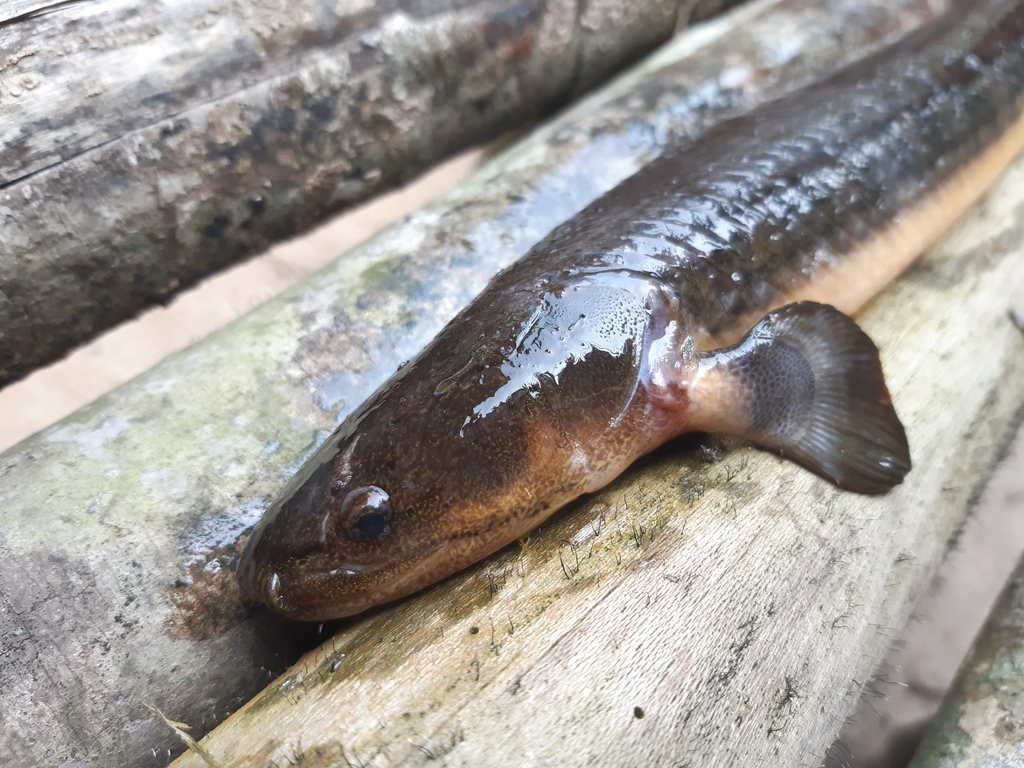
West African Bichir
Polypterus retropinnis
The West African bichir or retropinnis bichir (Polypterus retropinnis), is a freshwater fish in the family Polypteridae, is found in the central Congo River basin and Ogooué River in Africa. It is a long, slender fish that grows to a maximum length of about 34 cm (13 in).
From the article West African bichir on Wikipedia (CC BY-SA), quoted section by section
Description
Bichirs are primitive fish which have a jaw structure that resembles that of tetrapods rather than bony fishes; they also have rudimentary lungs and two slit-like spiracles used for exhalation, and can breathe air when there is insufficient oxygen in the water. The West African bichir has an elongated cylindrical body with a maximum length of 34 cm (13 in). It can be distinguished from other members of the genus by having jaws that are about the same length, and in living specimens, having creamy-white irises speckled with black. The dorsal fin consists of 7 to 9 separate finlets each topped with a sharp spine. The pectoral fin is fleshy and has 30 to 32 soft rays and the anal fin has 12 to 15 spines. The dorsal surface and flanks are olive brown with irregular markings of darker brown and the ventral surface is whitish or pale beige. The dorsal and caudal fins are pale beige with dark marks in rows, and black blotches at the base of the spines. The pectoral fins have distinctive black blotches at the base and rows of tiny black spots on the webbing. The pelvic and anal fins are whitish.
Range & habitat
The West African bichir is a freshwater fish native to tropical West Africa. Its range includes the basins of the Ogooué River and the Congo River, and possibly the Cross River basin in Cameroon. Its typical habitat is swamps and floodplains.
Wikipedia: “Distribution”
What it does
This species is territorial, with territory holders threatening intruders. The attacker starts the encounter by raising its dorsal fin spines and emitting staccato thumping sounds; both fish may continue by biting at each other, or one may submit and flee, emitting drawn-out moans.
Wikipedia: “Behaviour”
Where it lives
Recorded sightings
—
geo-referenced records in GBIF, from museums, herbaria and field observers.
Drag the globe to turn it. Dots are where records exist, not a range map; darker means more records.
In the stacks
Searching the stacks…
Every page naming Polypterus retropinnis in the Biodiversity Heritage Library →
This page is assembled live from iNaturalist, GBIF, Wikipedia, the Source Library and the Internet Archive. It is not yet part of the hand-edited codex. iNaturalist taxon 110007.