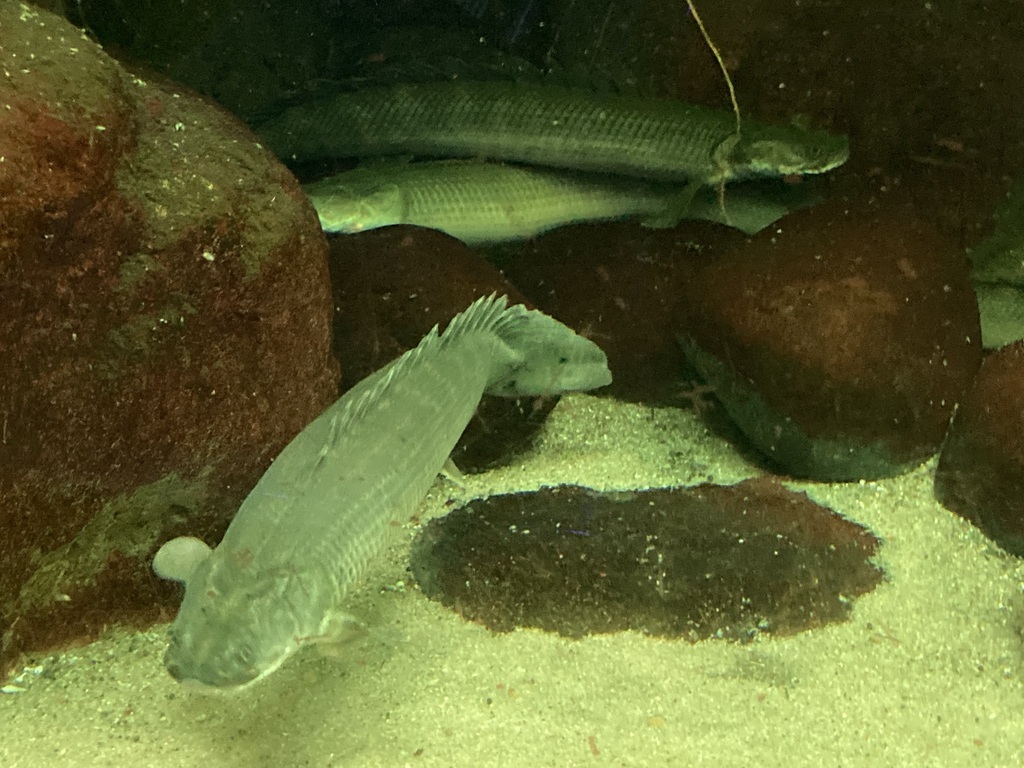
Nile Bichir
Polypterus bichir
Polypterus bichir, the Nile bichir, is a fish which lives in the Nile and some of its tributaries in Africa. It is a dark grayish color on the top, with a dark vertical marking and bands on the flank. This marking is more prominent on juveniles, and fades as the fish grows.
From the article Polypterus bichir on Wikipedia (CC BY-SA), quoted section by section
Description
Polypterus bichir lives in the Nile and some of its tributaries in Africa. It is a dark grayish color on the top, with a dark vertical marking and bands on its elongated flank. This marking is more prominent on juveniles, and fades as the fish grows. The Nile bichir is characterized by 5-18 dorsal finlets made up of a dorsal spine and connected dorsal ray. This is noted in the etymology of this species name where Polypterus can be traced back to the Greek words meaning 'many' and 'wing', noting the dorsal finlets. The fish itself is elongated in an anguilliform body plan, with flexible movement. Their swimming style itself mimics eels, with powerful sweeps of its long tail and free movement of the head from side-to-side, otherwise known as an undulatory motion. The bichir's pectoral fins, meanwhile, operate to keep the fish balanced through this process.
Nile bichirs are often regarded as ancestral 'primitive' fish due to their unique morphology that is usually found only in ancestral actinopterygian fish. Along with the dorsal finlets and coloring, the bichir is known for possessing 'armor-like' ganoid scales, true lungs, holoblastic egg development, sexually dimorphic anal fins, and spiracles. In captivity, bichir larvae and juveniles initially show fast growth up to a certain, species-specific, size but subsequently growth rates slow down once they reach maturity. P. …
Range & habitat
The Nile bichir is one of the more highly distributed species across Africa, ranging from the Nile River to the Congo Basin to West African countries like Senegal. P. Bichir live in the deeper depressions of muddy riverbeds, sometimes considered a bottom-living fish, bichir are still active swimmers and travel mostly at night in search of food.
Wikipedia: “Distribution”
What it does
Nile bichirs are often found hunting prey in the vegetated shallow beds of the water bodies it inhabits, using suction-feeding. Suction feeding - the process of rapid oral cavity expansion to draw prey into its mouth, is often found in ancestral Osteichthyes fishes like bichirs. Most fish often use protrusible jaws to achieve this mechanism, but the bichir is unique in that they lack these protrusible jaws and instead have a relatively simplified mechanism of achieving this feeding method. Instead, they generate their feeding strike power from their body flexibility coordinated with various muscular and skeletal structure movements to create a vacuum, suction force, that draws the prey in. Nile bichir can project cartilaginous-supported labial folds to form a funnel to further aid in this suction feeding mechanism. Bichirs stomachs are adapted to swallow prey whole, the gastric muscles working in tandem to compress the dangerous spines found on their prey, preventing their stomach pouch from being torn. Among these vegetated shallow beds, P. bichir often hunt for aquatic and terrestrial invertebrates, fish and amphibians, with the size of prey depending on the size of their mouths but can eat fish up to half their size. Nile bichirs rely heavily on their sense of smell to achieve this as they navigate the swamps, rivers and lakes they live in.
Wikipedia: “Diet”
Where it lives
Recorded sightings
—
geo-referenced records in GBIF, from museums, herbaria and field observers.
Drag the globe to turn it. Dots are where records exist, not a range map; darker means more records.
In the stacks
Searching the stacks…
Every page naming Polypterus bichir in the Biodiversity Heritage Library →
This page is assembled live from iNaturalist, GBIF, Wikipedia, the Source Library and the Internet Archive. It is not yet part of the hand-edited codex. iNaturalist taxon 121328.