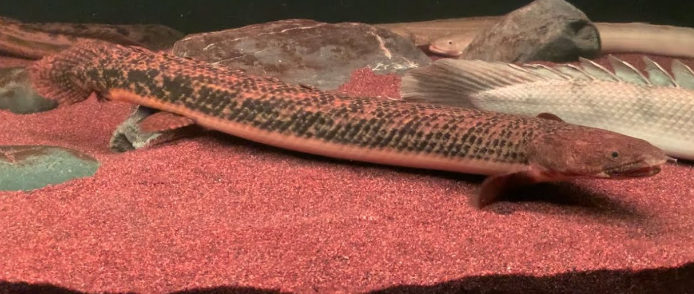
Cross River Bichir
Polypterus teugelsi
Polypterus teugelsi (also known as the Teugelsi bichir) is a species of carnivorous, nocturnal bichir (a group of ray-finned fishes) that lives in the Cross River drainage basin in the country of Cameroon. P. teugelsi was only very recently classified; it was classified in 2004 by Ralf Britz. It can grow to up to 16 inches long. It has a network of black markings on the dorsal surface and the medial and pelvic fins, completely black...
From the article Polypterus teugelsi on Wikipedia (CC BY-SA), quoted section by section
Description
Wild-caught P. teugelsi can reach lengths of 24-26 inches (60-66 cm), but captive-bred specimens rarely exceed 16 inches (40 cm). It has a network of black markings on the dorsal surface and the medial and pelvic fins, completely black pectoral fins, and an orange ventral surface. It can be distinguished from the similar-looking Polypterus palmas by its ruddier color, fuller and usually erect dorsal finlets and caudal fin, and elongated body. The species is most commonly found in shady, slow-moving streams with lush foliage on the edge of the streams. It is a seasonal spawner and egg scatterer that does not exhibit parental care. The IUCN does not have enough data to evaluate the condition of this species. Because bichirs diverged from other ray-finned fishes so early in their evolutionary history, P. teugelsi's morphology is unusually "primitive" when compared to other extant fishes. As a result, it is considered a living fossil. Because it retained true lungs, it is amphibious and can gulp air from the surface of the water in conditions with low dissolved oxygen. Similarly to stem-tetrapods, it uses a blowhole-like organ called a spiracle to take breaths of atmospheric oxygen. If their gills remain sufficiently wet, they can survive on land indefinitely. Juvenile P. teugelsi have external gills that resemble those of young amphibians. …
In human culture
Named in honor of Guy Teugels (1954–2003), curator of fishes at the Musée Royale de l'Afrique Centrale.
Wikipedia: “Etymology”
Where it lives
Recorded sightings
—
geo-referenced records in GBIF, from museums, herbaria and field observers.
Drag the globe to turn it. Dots are where records exist, not a range map; darker means more records.
In the stacks
Searching the stacks…
Every page naming Polypterus teugelsi in the Biodiversity Heritage Library →
This page is assembled live from iNaturalist, GBIF, Wikipedia, the Source Library and the Internet Archive. It is not yet part of the hand-edited codex. iNaturalist taxon 110008.