- Animals
- ›Chordates
- ›Vertebrates
- ›Ray-finned Fishes
- ›Spiny-rayed fishes
- ›Jacks, Flounders, Barracudas, and Allies
- ›Jacks, Remoras, and Allies
- ›Jacks
- ›Caranginae
- ›Selaroides
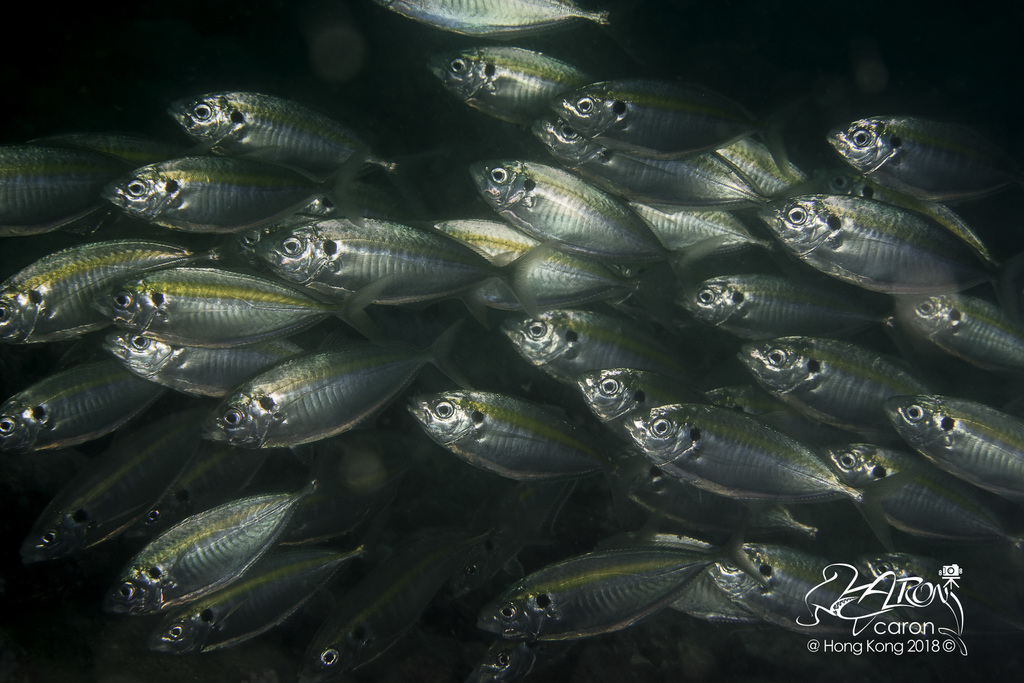
Yellowstripe Scad
Selaroides leptolepis
The yellowstripe scad (Selaroides leptolepis), also known as the yellowstripe trevally, yellow-banded trevally, smooth-tailed trevally, slender-scaled trevally and slender trevally, is a species of small inshore fish in the jack and horse mackerel family Carangidae, and the only member of the genus Selaroides. The yellowstripe trevally is distributed throughout the tropical waters of the Indo-West Pacific region, ranging from the Persian Gulf in the west to Vanuatu and New Caledonia in the east. The species is distinguished by its prominent lateral yellow band, and differs from the scads of the genus Selar in having a smaller eye and different dentition. Although the yellowstripe scad reaches a maximum recorded length of 22 cm, it is normally encountered at sizes less than 15 cm. Phylogenetic studies indicate the yellowstripe scad is closely related to the scads of the genus Selar, although its exact placement in the family Carangidae is less well agreed upon.
A schooling species that predominantly inhabits inshore waters, the yellowstripe scad is a predatory fish, taking crustaceans, small fish and a variety of other planktonic prey. Feeding occurs at different times of the day and night throughout its range. The species reaches sexual maturity at around 8–13 cm, with spawning in India shown to occur in two peak periods from January to April and July to October. The yellowstripe scad is an important commercial species, with between 113,000 t and 195,000 t reported worldwide between 1990 and 2010.
From the article Yellowstripe scad on Wikipedia (CC BY-SA), quoted section by section
Description
The yellowstripe scad is a small species, attaining a maximum length of 22 cm, but is more common at lengths less than 15 cm. The species has a body shape typical of many scads, with a compressed elongate, oblong body with the dorsal and ventral profiles equally curved. There is a fairly well developed adipose eyelid on the latter half of the eye. The dentition of the yellowstripe scad is one of the diagnostic features of the species, with the upper jaw and mouth being devoid of any teeth while the lower has a single series of fine villiform teeth. The dorsal fin is in two parts; the first having 8 spines and the second 1 spine and 24 to 26 soft rays. The anal fin has 2 detached spines followed by 20 to 23 soft rays. In one recorded case these two spines were not present. The soft dorsal and anal fins both have scaly basal sheaths. The pectoral fin is falcate and doesn't reach the junction of the curved and straight sections of the lateral line. The pectoral girdle has no groove, and is another defining characteristic. The anterior curve in the lateral line is moderate, with the straight section containing 13 to 25 scales and 24 to 29 small scutes. The breast is completely scaled. …
Range & habitat
The yellowstripe scad is distributed throughout the tropical and subtropical waters of the Indian and western Pacific Oceans. In the Indian Ocean its ranges from the Persian Gulf and the northern Arabian Peninsula, eastward to India and South East Asia, and down to northern Australia where it is known from Shark Bay in the west to Brisbane in the east. The species is also known from offshore islands such as the Maldives in the Indian Ocean. The yellowstripe scad inhabits the western Pacific Ocean from Japan in the north south to the Indonesian Archipelago and several east Pacific Islands including New Caledonia and Vanuatu. The yellowstripe scad is predominantly an inshore species, and occurs in large demersal schools over soft substrates. In Australia it inhabits inshore and shallow shelf waters to depths of 50m, while in Malaysia has been recorded to 70 m depth, although is most common between 40 and 60 m depth.
Wikipedia: “Distribution and habitat”
What it does
The yellowstripe scad is a common schooling species throughout its range, and due to its importance to fisheries has been well studied. In northern Australia, the Philippines and parts of India it has been found to be one of the most common species in these waters. Schools of yellowstripe scad is known to seasonally migrate to coastal waters in summer and back to deeper shelf waters in Taiwan, with no other clear movements recorded throughout its range. The yellowstripe scad is a predatory fish, taking a variety of crustaceans and other small prey items, with its exact diet varying both spatially and temporally. In northern Australia the most common prey items are ostracods, gastropods and euphausiids. The diet of individuals in India is more varied, with crustaceans, notably decapods and copepods making up the main part of the diet. Small fishes of the genus Anchoviella, pteropods, algal material, diatoms, molluscan larvae and foraminifera make up a lesser part of the diet here also. The species shows some diet partitioning between size classes, and during the year, the diet shifts as prey items vary in abundance. The species is diurnally active in India, while elsewhere in its range, nocturnal feeding has been reported. …
Wikipedia: “Biology and ecology”
Where it lives
Recorded sightings
—
geo-referenced records in GBIF, from museums, herbaria and field observers.
Drag the globe to turn it. Dots are where records exist, not a range map; darker means more records.
In the stacks
Searching the stacks…
Every page naming Selaroides leptolepis in the Biodiversity Heritage Library →
This page is assembled live from iNaturalist, GBIF, Wikipedia, the Source Library and the Internet Archive. It is not yet part of the hand-edited codex. iNaturalist taxon 182585.