 NL·0788
Herbarium of the Nature Library
- Name
- Xiphias gladius
- Family
- Xiphiidae
- Native to
- Tropical and temperate oceans worldwide, including the Mediterranean
- Habitat
- Open ocean (pelagic), Mesopelagic (twilight zone)
Swordfish
Xiphias gladius
Also calledPez espada (Spanish) · Mekajiki (Japanese) · Abu sayf (Arabic) · Kılıç balığı (Turkish) · Espadon (French)
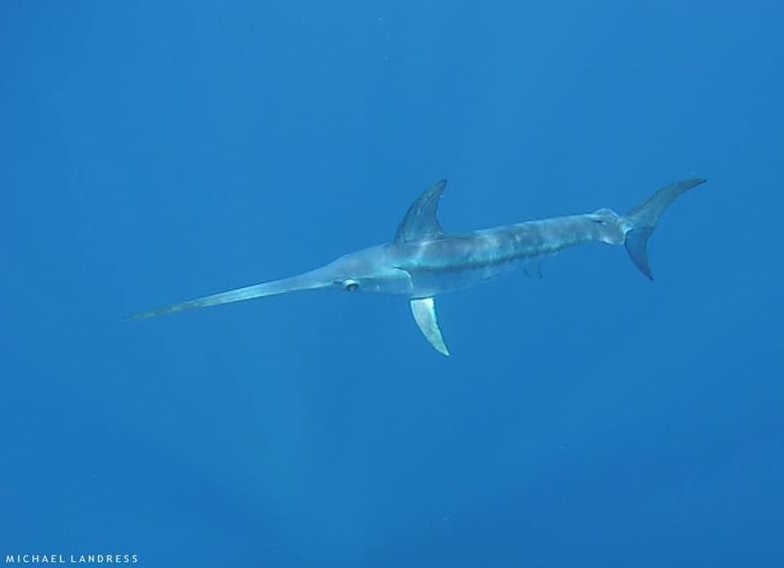
A flattened 'sword' bill and a special heater organ that warms its eyes and brain make the swordfish a night hunter of the deep. Adults lose their teeth and scales entirely.
The swordfish, also known as the broadbill in some countries, are large, highly migratory predatory fish characterized by a long, flat, sword-like, pointed bill. They are the sole member of the family Xiphiidae. They are a popular sport fish of the billfish category. Swordfish are elongated, round-bodied, and lose all teeth and scales by adulthood. These fish are found widely in tropical and temperate parts of the Atlantic, Pacific, and Indian Oceans, and can typically be found from near the surface to a depth of 550 m (1,800 ft), and exceptionally up to depths of 2,878 m (9,442 ft). They commonly reach 3 m (10 ft) in length, and the maximum reported is 4.55 m in length and 650 kg (1,430 lb) in weight. Wikipedia
What it can do
- iA brown heater tissue derived from eye muscle warms the eyes and brain up to 10–15 °C above ambient water
- iiWarmed eyes improve temporal resolution for spotting fast prey in cold, dark water
- iiiDives daily to 500 m or more, hunting at depth by day and nearer the surface at night
- ivSlashes prey with its flat bill rather than spearing it
In the field
Field marks
- aLong, flat, sword-like bill about one-third of body length
- bNo pelvic fins and, in adults, no scales or teeth
- cTall, rigid, crescent-shaped first dorsal fin that does not fold down
- dSingle large keel on each side of the tail base
- eDark bronze-purple back, paler below
- Not to be confused with
- Marlins and sailfish have a round, spear-like bill, scales, pelvic fins and a long-based dorsal fin; swordfish's bill is flat and broad.
- Where to see it
- Strait of Messina (traditional harpoon fishery), Florida Straits night fishing, offshore Chile and California
- When
- Year-round; seasonal feeding migrations into temperate waters in summer
Life & habits
- Diet
- Squid, mackerel, hake and other pelagic and deep-water fish
- Habitat
- Open ocean from the surface to about 550 m and deeper
- Size
- Commonly 3 m; record ~4.5 m and 650 kg
Solitary hunters that may bask at the surface with the dorsal fin and upper tail lobe out of the water.
Where it lives
Recorded sightings
—
geo-referenced records in GBIF, from museums, herbaria and field observers.
Native range
Tropical and temperate oceans worldwide, including the Mediterranean
Drag the globe to turn it. Dots are where records exist, not a range map; darker means more records.
In the old herbals & bestiaries
Woodcuts and engravings matched from the Source Library’s scanned books by name. Plates marked “relative” show a close kin rather than this exact species. Click a plate to read the page it came from, with translation.


In the stacks
Searching the stacks…
Every page naming Xiphias gladius in the Biodiversity Heritage Library →
Marginalia
Pliny the Elder described swordfish piercing ships, and the Strait of Messina harpoon hunt from tall-masted 'passerelle' boats continues a tradition dating to antiquity.
Curiosity
Swordfish bills have been found embedded in the wooden hulls of ships, and one became wedged in the research submersible Alvin in 1967.
Kinship




Photographs: iNaturalist contributors under the licences shown. Records: GBIF.org. Historical plates: Source Library (CC BY-SA 4.0; originals public domain). Summary text: Nature Library editors and Wikipedia (CC BY-SA). Medicinal and edibility notes are historical and educational, not advice. iNaturalist taxon 115167.