- Animals
- ›Chordates
- ›Vertebrates
- ›Ray-finned Fishes
- ›Tarpons, Eels, and Allies
- ›True Eels
- ›Congroidei
- ›Congers and Garden Eels
- ›Garden Eels
- ›Gorgasia
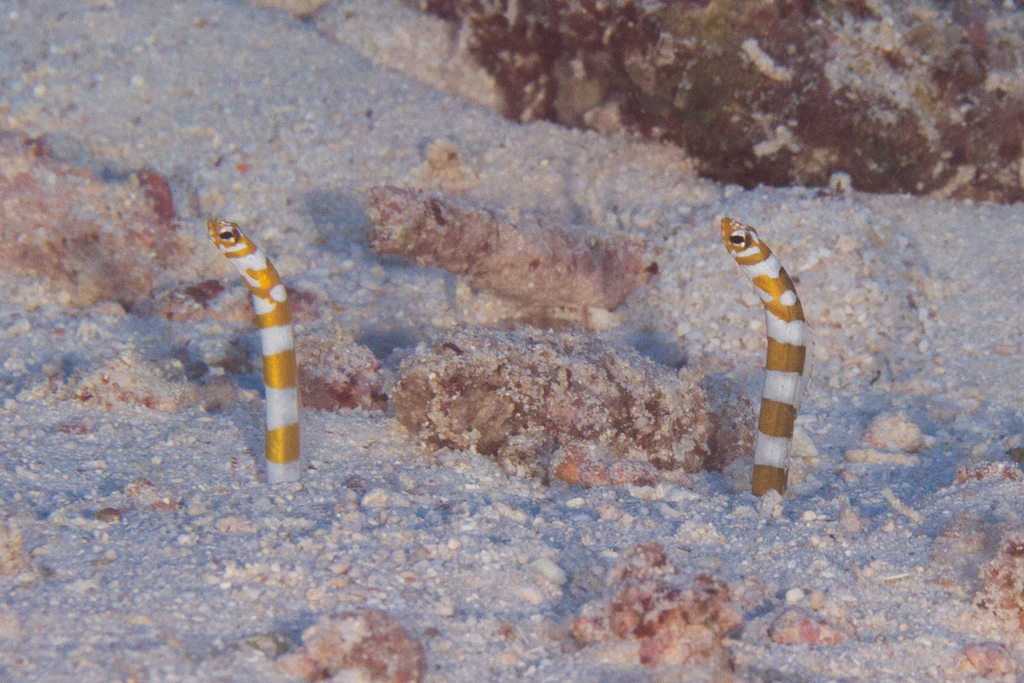
Splendid garden eel
Gorgasia preclara
Gorgasia preclara, the splendid garden eel, orange-banded garden eel, or orange-barred garden eel, is a species of Indo-Pacific garden eel.
From the article Gorgasia preclara on Wikipedia (CC BY-SA), quoted section by section
Description
The splendid garden eel is a medium-sized fish, reaching a maximum length up to 40 cm. Its body has a circular shape with a diameter of about 10 mm. Its body color is yellow to orange with characteristic white bands.
Range & habitat
Gorgasia preclara is widespread throughout the tropical waters of the Indo-West Pacific area from the Maldives to Indonesian archipelago and the Papua New Guinea and north to Ryukyu, Japanese archipelagos, and south to the Philippines. It occurs in sandy areas exposed to currents at depths between 18 and 75 m, but is usually observed at an average depth of 30 m.
Wikipedia: “Distribution and habitat”
What it does
During mating season male and female eels will move burrows to increase proximity to one another. Males will often engage in a courtship display of protective behaviors and may bite rival eels. After a male has won a display, the male and female eel will stretch from their burrows to intertwine bodies. Splendid garden eels are pelagic spawners, meaning that female eels will release fertilized eggs into the current. When the eggs hatch in the current, larvae continue to float until they reach a certain size. Once they've hit this size threshold juvenile eels will dig their sand burrow.
Wikipedia: “Reproduction”
Where it lives
Recorded sightings
—
geo-referenced records in GBIF, from museums, herbaria and field observers.
Drag the globe to turn it. Dots are where records exist, not a range map; darker means more records.
In the stacks
Searching the stacks…
Every page naming Gorgasia preclara in the Biodiversity Heritage Library →
This page is assembled live from iNaturalist, GBIF, Wikipedia, the Source Library and the Internet Archive. It is not yet part of the hand-edited codex. iNaturalist taxon 372194.