- Animals
- ›Chordates
- ›Vertebrates
- ›Ray-finned Fishes
- ›Spiny-rayed fishes
- ›Cods and Hakes
- ›Merlucciid Hakes
- ›Merlucciid Hakes
- ›Merluccius
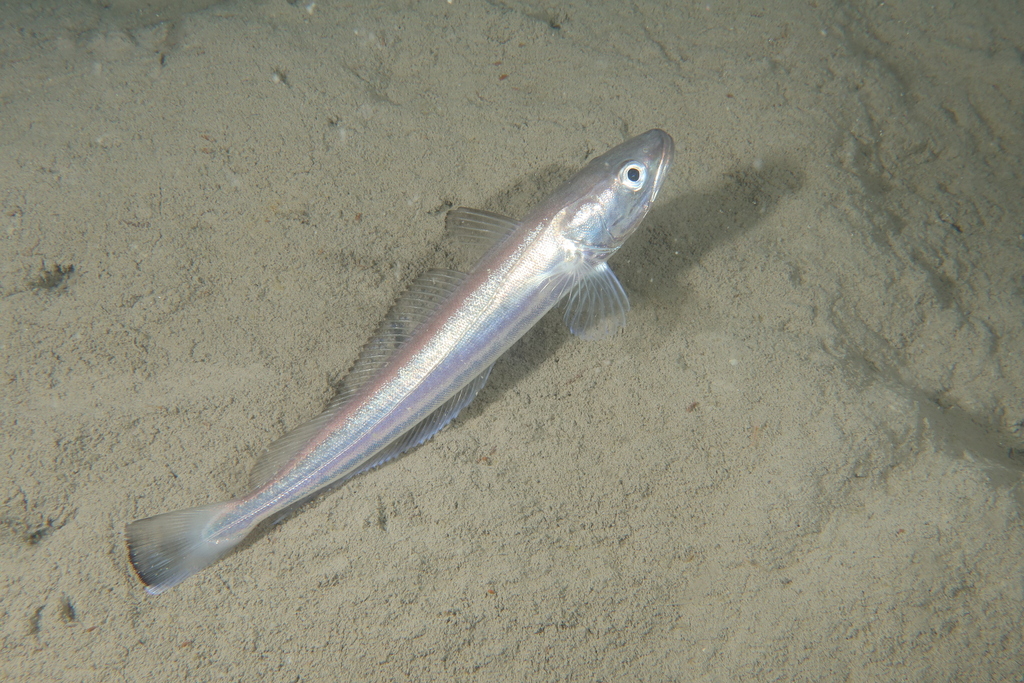
European Hake
Merluccius merluccius
Merluccius merluccius or the European hake is a merluccid hake of the genus Merluccius. Other vernacular names include Cornish salmon and herring hake. It is a predatory species, which was often netted alongside one of its favoured prey, the Atlantic herring, hence the latter common name. It is found in the eastern Atlantic from Norway and Iceland south to Mauritania and into the Mediterranean Sea. It is an important species in European fisheries and is heavily exploited, with some populations being fished unsustainably.
From the article Merluccius merluccius on Wikipedia (CC BY-SA), quoted section by section
Description
Merluccius merluccius is a slim-bodied fish with a large head and large jaws in which are set a number of large curved teeth, the lower jaw having two rows of teeth and the upper jaw one row. The inside of the mouth and the branchial cavity are black. The body is at its widest just behind its head. It has two dorsal fins, the first triangular, high with a short base, while the second is long, nearly the same length as the anal fin, and both the second dorsal fin and the anal fin have a slightly convex profile. The first dorsal fin has a single spine and 7 to 10 fin rays; the second dorsal fin has 36 to 40 fin rays and the anal fin has 36 to 40 fin rays. The tips of the pectoral fins extend to the level of the origin of the anal fin in young fish that are less than 20 cm (7.9 in) in standard length but does not do so in adults. The caudal fin is well developed and has a truncate margin. The lateral line is straight and darker than the background colour. It is blue-grey on the back, silvery on the flanks and whitish on the underside. They grow to 180 cm (71 in) but this is rare and a more common larger size is 100 cm (39 in).
Range & habitat
Merluccius merluccius is found in the eastern Atlantic from Norway and Iceland, south along the European coast to the Straits of Gibraltar and south along the west coast of Africa to Mauritania. It also occurs in the Mediterranean Sea. It extends into the Black Sea but it is restricted to the southern and western (Bulgarian Black Sea Waters, Cape Emine) shorelines of this sea. In the Baltic Sea it does not normally extend further east than the Kattegat but it has been recorded as far east as Lithuania.
Wikipedia: “Distribution”
At the table
European hake is mainly sold in its fresh form, but it may also be frozen, dried, salted and canned. The flesh has a mild flavour, more subtle than that of cod with a white flaky texture. The raw flesh is quite soft but when it has been cooked the texture changes to firm and meaty. In France this popular species is marketed as "colin" and occasionally as "saumon blanc", i.e. "white salmon". It is also a popular food fish in Iberia where it is grilled, pan-fried and baked. The meat can be matched with strong flavours and hake is often cooked with tomatoes, garlic, chorizo and paprika.
A medium-sized hake, known in Spanish as pescadilla, is often presented with its mouth biting its tail receiving the name of pescadilla de rosca ("torus hake"). La pescadilla que se muerde la cola, "the hake that bites its tail", is a proverbial Spanish expression for circular reasoning and vicious circles.
== References ==
Wikipedia: “Use as food”
Where it lives
Recorded sightings
—
geo-referenced records in GBIF, from museums, herbaria and field observers.
Drag the globe to turn it. Dots are where records exist, not a range map; darker means more records.
In the stacks
Searching the stacks…
Every page naming Merluccius merluccius in the Biodiversity Heritage Library →
This page is assembled live from iNaturalist, GBIF, Wikipedia, the Source Library and the Internet Archive. It is not yet part of the hand-edited codex. iNaturalist taxon 118603.