- Animals
- ›Chordates
- ›Vertebrates
- ›Mammals
- ›Therians
- ›Placental Mammals
- ›Ungulates, Carnivorans, and Allies
- ›Carnivorans
- ›Pinnipeds
- ›Earless Seals
- ›Monachinae
- ›Antarctic Seals
- ›Leptonychotes
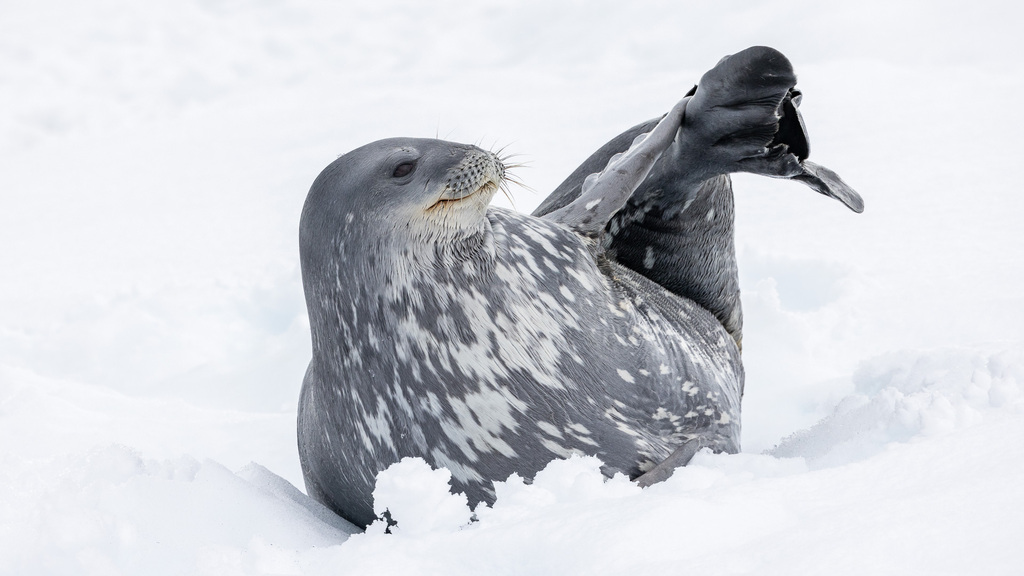
Weddell Seal
Leptonychotes weddellii
The Weddell seal (Leptonychotes weddellii) is a relatively large and abundant true seal with a circumpolar distribution surrounding Antarctica. The Weddell seal was discovered and named in the 1820s during expeditions led by British sealing captain James Weddell to the area of the Southern Ocean now known as the Weddell Sea. The life history of this species is well documented since it occupies fast ice environments close to the Antarctic continent and often adjacent to Antarctic bases. It is the only species in the genus Leptonychotes.
From the article Weddell seal on Wikipedia (CC BY-SA), quoted section by section
Description
Weddell seals measure about 2.5–3.5 m (8 ft 2 in – 11 ft 6 in) long and weigh 400–600 kg (880–1,320 lb). They are amongst the largest seals, with a rather bulky body and short fore flippers relative to their body length. Males weigh less than females, usually about 500 kg (1,100 lb) or less. Male and female Weddell seals are generally about the same length, though females can be slightly larger. However, the male seal tends to have a thicker neck and a broader head and muzzle than the female. A molecular genetic-based technique has been established to confirm the sex of individuals in the laboratory. The Weddell seal face has been compared to that of a cat due to a short mouth line and similarities in the structure of the nose and whiskers. The Weddell seal grows a thin fur coat around its whole body except for small areas around the flippers. The colour and pattern of the coat vary, often fading to a duller colour as the seal ages. This coat moults around the beginning of summer. Adults show a counter-shaded colouration that varies from bluish-black to dark grey dorsally and to light grey/silver ventrally. Coats may change to shades of brown before the annual moult. Adult males usually bear scars, most of them around the genital region. …
Listen
Looking for field recordings…
Where it lives
Recorded sightings
—
geo-referenced records in GBIF, from museums, herbaria and field observers.
Drag the globe to turn it. Dots are where records exist, not a range map; darker means more records.
In the stacks
Searching the stacks…
Every page naming Leptonychotes weddellii in the Biodiversity Heritage Library →
This page is assembled live from iNaturalist, GBIF, Wikipedia, the Source Library and the Internet Archive. It is not yet part of the hand-edited codex. iNaturalist taxon 41731.