- Animals
- ›Chordates
- ›Vertebrates
- ›Mammals
- ›Therians
- ›Placental Mammals
- ›Primates, Rodents, and Allies
- ›Rodents
- ›Mice, Rats, and Hamsters
- ›Muroids
- ›Old World Mice and Rats
- ›Gerbils
- ›Gerbillini
- ›Rhombomys
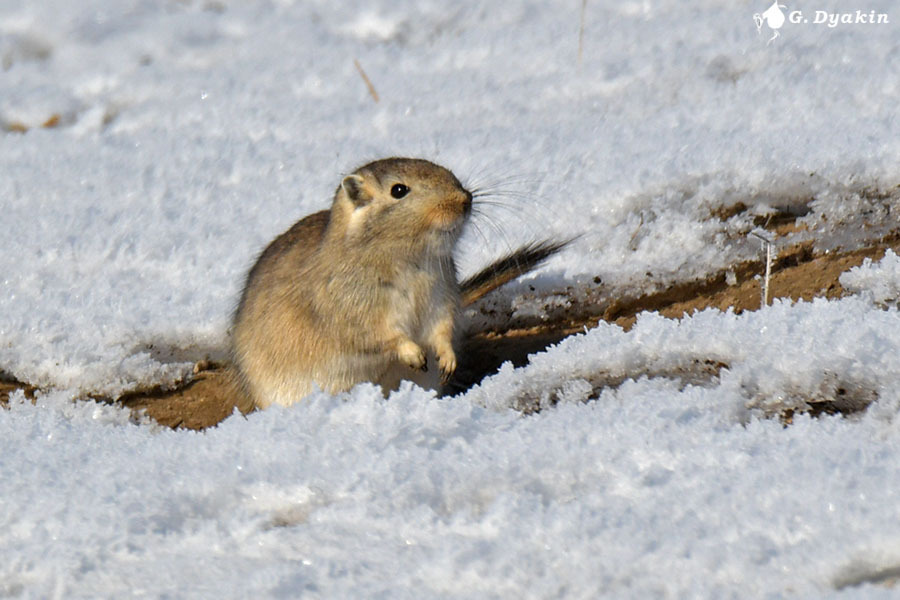
Great Gerbil
Rhombomys opimus
The great gerbil (Rhombomys opimus) is a large gerbil found throughout much of Central Asia.
From the article Great gerbil on Wikipedia (CC BY-SA), quoted section by section
Description
The largest of the gerbils, great gerbils have a head and body length of 15–20 cm (6–8 in). Their skulls are distinctive by having two grooves in each incisor. They have large front claws used for burrowing.
Range & habitat
Great gerbils are found in arid habitats, predominantly in sandy or clay deserts. They are found in Turkmenistan, Kazakhstan, Mongolia, China, Pakistan, Afghanistan, and Iran.
Wikipedia: “Distribution and habitat”
What it does
Great gerbils live in family groups and occupy one burrow per family. Their burrows can be fairly extensive with separate chambers for nests and food storage. Great gerbils spend considerably more time in the burrows during winter, but do not hibernate. They are predominantly diurnal. Food consists mostly of vegetable matter. The animals are often colonial. Longevity is 2–4 years. Burrow system complexes have a distinctive region of cleared soil and can be seen and mapped from aerial photos and satellite images. Inhabited great gerbil burrows can be distinguished from abandoned burrows using satellite images. Great gerbils are known reservoirs of Yersinia pestis, the bacterium that causes plague, and of Leishmania major, the causative agent of zoonotic cutaneous leishmaniasis. They are also known as crop pests and have been implicated in exacerbating erosion.
Wikipedia: “Ecology and behavior”
Listen
Looking for field recordings…
Where it lives
Recorded sightings
—
geo-referenced records in GBIF, from museums, herbaria and field observers.
Drag the globe to turn it. Dots are where records exist, not a range map; darker means more records.
In the stacks
Searching the stacks…
Every page naming Rhombomys opimus in the Biodiversity Heritage Library →
This page is assembled live from iNaturalist, GBIF, Wikipedia, the Source Library and the Internet Archive. It is not yet part of the hand-edited codex. iNaturalist taxon 45832.