 NL·0540
Herbarium of the Nature Library
- Name
- Eumomota superciliosa
- Family
- Momotidae
- Native to
- South-eastern Mexico (including the Yucatán Peninsula) through Guatemala, Belize, El Salvador, Honduras and Nicaragua to north-western Costa Rica
- Habitat
- Tropical dry forest, Forest edge, Scrub, Farmland
On eBird ↗
Turquoise-browed Motmot
Live sightings near you, the range map, bar charts of when it is seen, and Macaulay Library photos and recordings.
Turquoise-browed motmot
Eumomota superciliosa
Also calledTorogoz (Spanish, El Salvador) · Guardabarranco (Spanish, Nicaragua) · Pájaro reloj (Spanish, Yucatán) · Motmot à sourcils bleus (French)
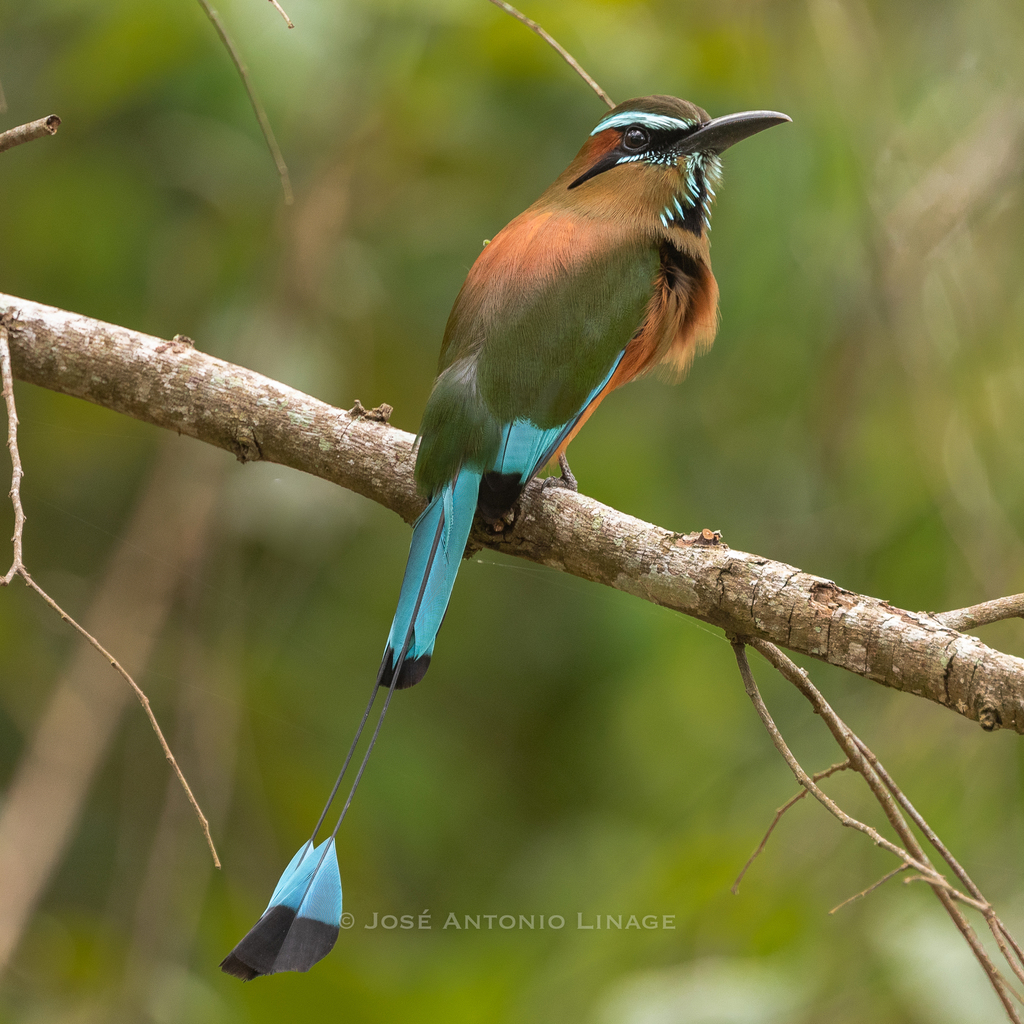
A colourful motmot with a long tail ending in two bare-shafted 'rackets' that it swings like a pendulum. It is the national bird of both El Salvador and Nicaragua.
The turquoise-browed motmot is a colourful, medium-sized bird of the motmot family, Momotidae. It is the only species in its genus Eumomota. It inhabits Central America from south-east Mexico, to Costa Rica, where it is common and not considered threatened. It lives in fairly open habitats such as forest edge, gallery forest and scrubland. It has a preference for higher tree diversity and richness, alongside a low open canopy and dense understory. It also appears to prefer dry forest. This is in contrast to the other motmot known to inhabit the Yucatán, Lesson’s motmot, which prefers moist forest. As a result, their respective distributions allow ecologists to map the process of aridification induced by anthropogenic climate change. Some literature thus considers the turquoise-browed motmot to be a bioindicator. Wikipedia
What it can do
- iIts tail rackets form when weakly attached barbs near the tips fall off during preening and wear
- iiWags its tail in a pendulum display aimed at predators — a signal that it has seen them
- iiiDigs long nesting tunnels in earth banks, quarries, wells and Maya ruins
In the field
Field marks
- aLong tail with bare shafts ending in blue-and-black rackets
- bBright turquoise eyebrow stripe above a black mask
- cBlack throat stripe edged with turquoise
- dRufous back and belly; blue-green wings
- Voice
- A low, hollow, croaking 'kwaa' or 'cowak', often at dawn.
- Not to be confused with
- Lesson's Motmot has a blue crown ring around a black cap and a green body. Russet-crowned Motmot has a rufous crown.
- Where to see it
- Cenotes and Maya sites of the Yucatán such as Ek Balam and Cobá, Guanacaste (Costa Rica), and dry forests of El Salvador and Nicaragua.
- When
- Resident year-round
Listen
Looking for field recordings…
Life & habits
- Diet
- Large insects, spiders, small lizards and frogs; some fruit
- Habitat
- Open dry forest, edges, gardens, riverbanks and cenotes
- Size
- About 34 cm including tail; 65 g
It often nests colonially in the walls of Yucatán cenotes and limestone sinkholes.
Where it lives
Recorded sightings
—
geo-referenced records in GBIF, from museums, herbaria and field observers.
Native range
South-eastern Mexico (including the Yucatán Peninsula) through Guatemala, Belize, El Salvador, Honduras and Nicaragua to north-western Costa Rica
Drag the globe to turn it. Dots are where records exist, not a range map; darker means more records.
In the stacks
Searching the stacks…
Every page naming Eumomota superciliosa in the Biodiversity Heritage Library →
Marginalia
El Salvador's torogoz and Nicaragua's guardabarranco ('ravine guardian') are both this species; its pendulum-like tail earned it the Yucatán name pájaro reloj, 'clock bird'.
Curiosity
It is a 'pursuit-deterrent' signaller: tail-wagging tells predators they have been spotted and a chase is pointless.
Kinship


Photographs: iNaturalist contributors under the licences shown. Records: GBIF.org. Historical plates: Source Library (CC BY-SA 4.0; originals public domain). Summary text: Nature Library editors and Wikipedia (CC BY-SA). Medicinal and edibility notes are historical and educational, not advice. iNaturalist taxon 2168.