- Animals
- ›Chordates
- ›Vertebrates
- ›Birds
- ›Woodpeckers and Allies
- ›Woodpeckers
- ›Typical woodpeckers
- ›Pied woodpeckers and allies
- ›Melanerpes
On eBird ↗
Guadeloupe Woodpecker
Live sightings near you, the range map, bar charts of when it is seen, and Macaulay Library photos and recordings.
Guadeloupe Woodpecker
Melanerpes herminieri
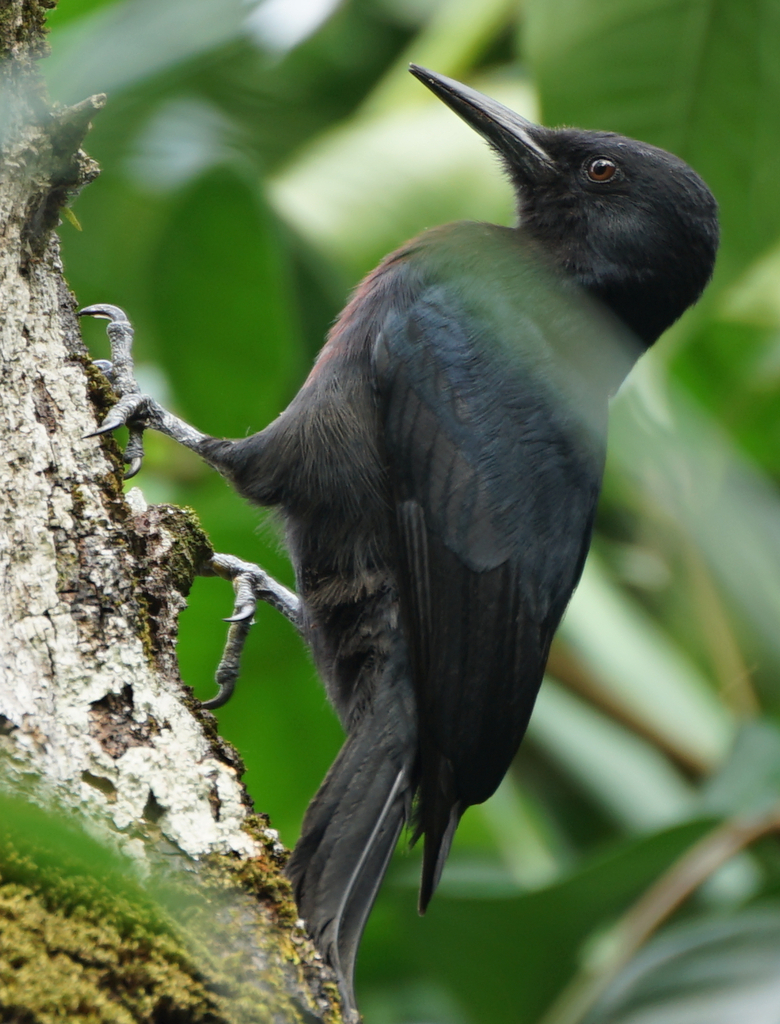
The Guadeloupe woodpecker (Melanerpes herminieri) or Tapeur is a species of bird in the woodpecker family Picidae belonging to the genus Melanerpes. Endemic to the Guadeloupe archipelago in the Lesser Antilles, it is a medium-sized forest woodpecker with entirely black plumage and red-to-purple reflections on its stomach. It lives mainly in the islands' tropical rainforest areas. The woodpecker has no sexual dimorphism. The species has adapted under the pressure of urbanization to more open forest environments.
During the breeding season, the Guadeloupe woodpecker is solitary bird that nests in holes it digs with its beak in the trunk of dead trees—mainly coconut—where the female lays three to five eggs. The eggs are incubated for fifteen days before hatching, after which the adult female feeds the chicks in the nest for about a month. Juvenile birds stay with the parents for several months before becoming independent. Guadeloupe woodpeckers are mainly insectivorous, but they also feed on small vertebrates like tree frogs and Anolis marmoratus, as well as a variety of seasonal fruits.
From the article Guadeloupe woodpecker on Wikipedia (CC BY-SA), quoted section by section
Description
The Guadeloupe woodpecker is a medium-sized, robust woodpecker species measuring 26–28 cm (10–11 in) in length, and with a mass of 86–97 g (3.0–3.4 oz) in males and 69–78 g (2.4–2.8 oz) in females. It is distinct in its appearance within its genus, and unlike other species of Melanerpes, males and females do not present a marked sexual dimorphism in their plumage; they are entirely black with gradual reflections ranging from dark red to burgundy on the ventral plumage, dark blue on the back, and metallic blue on the wing tips. Males have a wingspan of 42.5 cm (16.7 in) compared with 40.5 cm (15.9 in) in females). The black coloration of the Guadeloupe woodpecker may be an advantage in drying feathers by exposure to the sun and fighting against humidity, and the black feathers may be resistant to abrasion, but no definitive explanation has been advanced by the scientific community. This woodpecker is solitary animal, a social behavioral trait that is often associated with plumage monomorphism. The legs, which terminate in four toes in a zygodactyl arrangement, are gray-green to gray-blue and powerful, with highly developed talons. The talons are curved for gripping bark with the tip of the claw; this represents an adaptation to living on trunks and branches of trees. The eyes are 6 mm (0.24 in) in diameter (pupil 2 mm (0.079 in)) with dark brown irises. …
Range & habitat
Since the extinction of the Guadeloupe parakeet (Psittacara labati) and the Guadeloupe amazon (Amazona violacea) in the 18th century (if they existed), the Guadeloupe woodpecker is the only bird species that is endemic to Guadeloupe, and is the only woodpecker species found in the Lesser Antilles. It, along with two species of forest bats and two species of frogs, is one of the archipelago's five endemic animal species. The Guadeloupe woodpecker is present on the main island from sea level to the upper tree line, at around 1,000 m (39,000 in) altitude, but is historically more common on island of Basse-Terre, where it has a preference for the island's east coast, than on Grande-Terre. It is absent from the dependencies of Guadeloupe (Îles des Saintes, Marie-Galante, and La Désirade). The Guadeloupe woodpecker, an exclusively stationary species, is found in a wide variety of forest types across the islands: it is most common in the tropical rainforest areas of Basse-Terre; in 1998, these rainforests had more than 70 percent of the population of the species in Guadeloupe, 5 percent were in deciduous areas, while the deciduous forests of Grande-Terre hosted about 20 percent, and the mangrove and swamp in the center of the archipelago held the remaining 5 percent. In 2008, a study of Guadeloupean avifauna showed the presence of the Guadeloupe woodpecker in all zones of Guadeloupe N …
Wikipedia: “Distribution and habitat”
At the table
The adult Guadeloupe woodpecker feeds mainly on termites, ants, larvae, myriapods, and arthropods—90 percent of which are collected when piercing dead wood— and fruits. Due to the difference in the size of their beaks, males preferentially seek their prey on large branches and dead trunks while females more frequently attach themselves to branches, especially those with small cross-sections. Scientific studies of a captive woodpecker have shown the tip of the bird's long tongue has horny, backward-facing, saliva-coated hooks that allow it to grasp and extract insects from deep holes in wood rather than "harpooning" them. It has been reported the Guadeloupe woodpecker may occasionally and opportunistically feed on a small lizards (Anolis marmoratus), which are also endemic to the archipelago. Female woodpeckers may occasionally consume crab carcasses during the breeding season to obtain the calcium necessary for the production of their eggshells. No precise studies of woodpecker feeding, such as identification and quantity of insects consumed, in adults could be made because of the speed of their prey consumption. During the nesting period, however, studies have shown the typical diet of nestlings—brought by the parents at a rate of five times per hour—mainly consists of large prey ranging from 20–40 mm (0.79–1.57 in) with an average of 20 mm (0.79 in). …
Wikipedia: “Food”
Listen
Looking for field recordings…
Where it lives
Recorded sightings
—
geo-referenced records in GBIF, from museums, herbaria and field observers.
Drag the globe to turn it. Dots are where records exist, not a range map; darker means more records.
In the stacks
Searching the stacks…
Every page naming Melanerpes herminieri in the Biodiversity Heritage Library →
This page is assembled live from iNaturalist, GBIF, Wikipedia, the Source Library and the Internet Archive. It is not yet part of the hand-edited codex. iNaturalist taxon 18184.