- Animals
- ›Chordates
- ›Vertebrates
- ›Birds
- ›Woodpeckers and Allies
- ›Woodpeckers
- ›Typical woodpeckers
- ›Pied woodpeckers and allies
- ›Xiphidiopicus
On eBird ↗
Cuban Green Woodpecker
Live sightings near you, the range map, bar charts of when it is seen, and Macaulay Library photos and recordings.
Cuban Green Woodpecker
Xiphidiopicus percussus
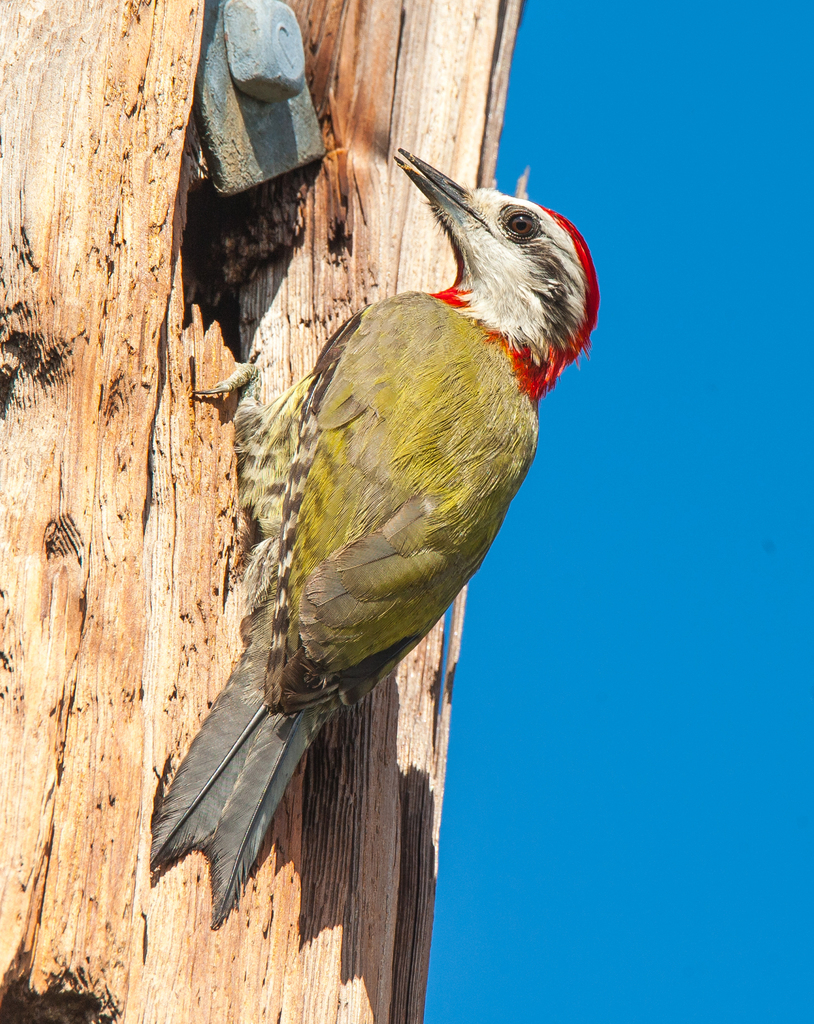
The Cuban green woodpecker (Xiphidiopicus percussus) is a species of woodpecker in the family Picidae and tribe Melanerpini, known locally in Cuban Spanish as carpintero verde (literally "green woodpecker"). It is the only species within the genus Xiphidiopicus and is one of two woodpeckers endemic to Cuba, along with the likely-extinct Cuban ivory-billed woodpecker. It is the most widespread and common woodpecker in Cuba, inhabiting primarily woodlands, as well as dry and wet forests, pine forests and mangroves. The population of the Cuban green woodpecker is stable and its status is listed as "Least Concern".
From the article Cuban green woodpecker on Wikipedia (CC BY-SA), quoted section by section
Description
A medium-sized and colorful bird, the Cuban green woodpecker is similar to a sapsucker in general shape and size. Featuring olive green overparts and yellow, streaked underparts, the Cuban green woodpecker usually appears crested, and features a bright red upper breast, as well as a black chin contrasting a white face and supercilium. In males, a red crown is present, while females possess black crowns with white stripes. The area around the cloaca, or the crissum, is yellow with black barring. Its beak is short and straight with a progressively darkening coloration, from dark blue to black from base to tip dark blue to black coloration. They have been shown to have brown irises and grayish green tarsi and toes Cuban green woodpeckers show slight sexually dimorphic qualities; females have shorter bills and are generally significantly smaller than their male counterparts. Juveniles will show more barring and streaking on their breasts and lack the depth of color adults have in their plumage. They typically measure between 21 and 25 cm (8.3 and 9.8 in) in length and weigh approximately 48 to 97 g (1.7 to 3.4 oz).
Wikipedia: “Appearance”
Range & habitat
The Cuban green woodpecker is only found in Cuba, but is extremely common on the island. Its natural habitats are wet and dry forests, mangroves, open woodland with palms, and pine forests, lowland moist forests, and heavily degraded former forest.
Wikipedia: “Habitat and distribution”
What it does
The Cuban green woodpecker is found most frequently in pairs, and less frequently in small groups. It is able to remain completely still for long periods and will forage for dead insects on dead limbs at any height within its habitat. They are very territorial, especially during breeding season, and use active vocalization, utilizing both drumming and vocal signals, and active pursuit, pursuing threats while flicking their wings, in order deter intruders in their nests, which is usually the West Indian woodpecker (Melanerpes superciliaris). Similarly to all other woodpeckers, its flight is undulating.
Calls and songs. The Cuban green woodpecker's call is a short, harsh "jhhhorr, jhhhorr, jhhhorr," as well as a higher pitched "yeh-yeh-yeh." The call is usually single noted with double notes occasionally being uttered. It may sometimes produce a slurred, two-note call "ta-ha", which is similar to the Yellow-bellied Sapsucker (Sphyrapicus varius)'s call. It will use its call mostly while protecting nest and chicks from intruder.
Diet. The Cuban green woodpecker's is primarily an insectivore, focusing on large insects, but will also consume fruits and small frogs occasionally. It has also been documented taking eggs of other birds such as herons nesting in mangroves. It will also feed on flower nectar, especially Cordia sebestena. …
Wikipedia: “Behavior”
Listen
Looking for field recordings…
Where it lives
Recorded sightings
—
geo-referenced records in GBIF, from museums, herbaria and field observers.
Drag the globe to turn it. Dots are where records exist, not a range map; darker means more records.
In the stacks
Searching the stacks…
Every page naming Xiphidiopicus percussus in the Biodiversity Heritage Library →
This page is assembled live from iNaturalist, GBIF, Wikipedia, the Source Library and the Internet Archive. It is not yet part of the hand-edited codex. iNaturalist taxon 18475.