- Animals
- ›Chordates
- ›Vertebrates
- ›Birds
- ›Woodpeckers and Allies
- ›Woodpeckers
- ›Typical woodpeckers
- ›Pied woodpeckers and allies
- ›Dendropicos
On eBird ↗
Cardinal Woodpecker
Live sightings near you, the range map, bar charts of when it is seen, and Macaulay Library photos and recordings.
Cardinal Woodpecker
Dendropicos fuscescens
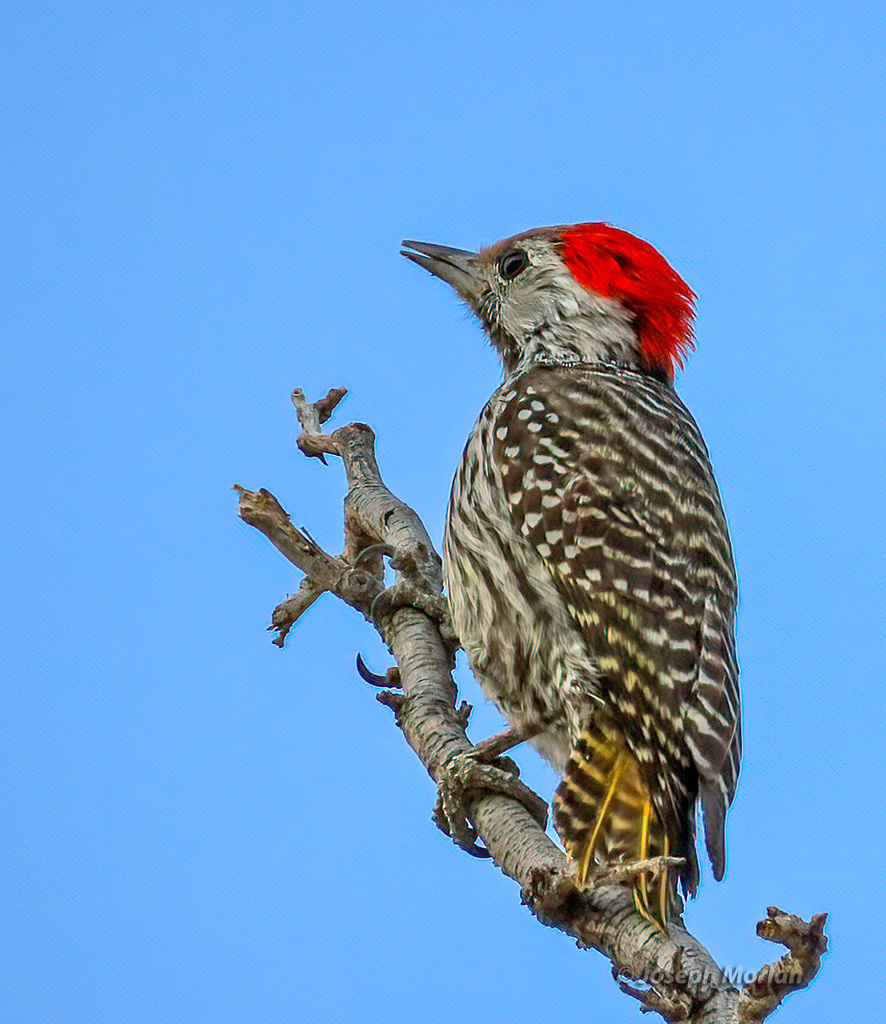
The cardinal woodpecker (Dendropicos fuscescens) is a widespread and common resident breeder in much of sub-Saharan Africa. It occurs in a wide range of habitats, ranging from dense forest to thorn bush. It is fairly vocal and is easily identified by its call notes. The sexes are distinguishable by their head patterns. They feed primarily on tree-boring insects; using their adhering tongues they extract the insects from holes in wood or bark.
From the article Cardinal woodpecker on Wikipedia (CC BY-SA), quoted section by section
Description
Like other woodpeckers, this species has a straight pointed bill, a stiff tail to provide support against tree trunks, and zygodactyl or "yoked" feet, with two toes pointing forward, and two backward. The long tongue can be darted forward to capture insects. This is a very small woodpecker. It measures 14 to 15 cm (5.5 to 5.9 in) from bill tip to tail tip, and its body shape is typical of a woodpecker. Its back plumage is dull olive in colour, and is marked with paler dots and bands. The underparts are white, heavily streaked with black, and the rump plumage is tawny. The white throat and face are separated by a conspicuous black malar stripe, and the fore crown is olive brown. As with other woodpeckers, the head pattern varies with age and sex. The male has a red hind crown and nape, the female has a dark hind crown and black nape. Juvenile males have a red hind crown and black nape. The small crest is raised when the bird is excited.
Range & habitat
The cardinal woodpecker is native to tropical parts of western and central Africa. Its range includes Angola, Benin, Botswana, Burkina Faso, Burundi, Cameroon, Central African Republic, Chad, Congo, Democratic Republic of Congo, Djibouti, Eritrea, Eswatini, Ethiopia, Gabon, Gambia, Ghana, Guinea, Guinea-Bissau, Ivory Coast, Kenya, Lesotho, Malawi, Mali, Mauritania, Mozambique, Namibia, Nigeria, Rwanda, Senegal, Sierra Leone, Somalia, South Africa, South Sudan, Sudan, Tanzania, Togo, Uganda, Zambia and Zimbabwe. It is found in a wide range of habitats from dense forest to thorn bush.
Wikipedia: “Distribution and habitat”
What it does
The cardinal woodpecker often occurs in small family groups or may join small mixed flocks. Forages mainly in the lower storeys of trees and among shrubs and vines, on maize stalks and reeds. Pecks rapidly and probes dense vegetation, clambering along and hanging from small twigs. Like other woodpeckers, this species is an insectivore. It is frequently seen, and regularly drums softly. The call is a high-pitched krrrek-krrrek-krrrek. It nests in a tree hole, unlined apart from wood chippings.
Breeding. Breeding usually occurs in spring or early summer. Like other woodpecker species they usually excavate a new breeding cavity every season, which takes a few weeks. With this species a nest is not located in the vicinity of the previous season's nest. The entrance hole is oval in shape, and situated about 2 meters from the ground. The glossy white eggs, 1 to 3 in number, are laid on a layer of wood chips. They are laid at one day intervals and incubation starts with the first egg. Both parents partake in incubation, brooding and feeding. The clutch is incubated for about 12 days, and the chicks leave the nest in some 27 days. The young are cared for by the parents for another 8–10 weeks. The scaly-throated honeyguide is recorded as a nest parasite.
Wikipedia: “Behaviour and ecology”
Listen
Looking for field recordings…
Where it lives
Recorded sightings
—
geo-referenced records in GBIF, from museums, herbaria and field observers.
Drag the globe to turn it. Dots are where records exist, not a range map; darker means more records.
In the stacks
Searching the stacks…
Every page naming Dendropicos fuscescens in the Biodiversity Heritage Library →
This page is assembled live from iNaturalist, GBIF, Wikipedia, the Source Library and the Internet Archive. It is not yet part of the hand-edited codex. iNaturalist taxon 1506260.