- Animals
- ›Chordates
- ›Vertebrates
- ›Birds
- ›Woodpeckers and Allies
- ›Woodpeckers
- ›Typical woodpeckers
- ›Green Woodpeckers, Flickers, and Allies
- ›Picus
On eBird ↗
Eurasian Green Woodpecker
Live sightings near you, the range map, bar charts of when it is seen, and Macaulay Library photos and recordings.
Eurasian Green Woodpecker
Picus viridis
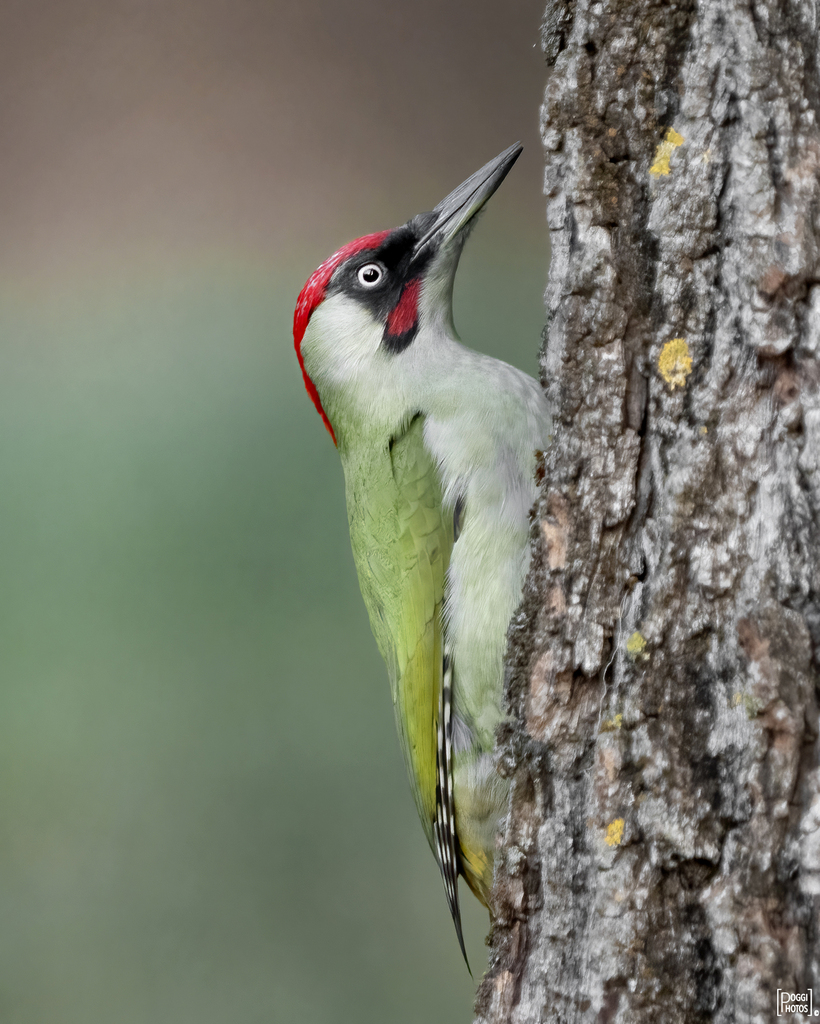
The European green woodpecker (Picus viridis), also known as the yaffle and sometimes called a nickle, is a large green woodpecker with a bright red crown and a black moustache. Males have a red centre to the moustache stripe which is absent in females. It is resident across much of Europe and the western Palearctic but in Spain and Portugal it is replaced by the similar Iberian green woodpecker (Picus sharpei).
The European green woodpecker spends much of its time feeding on ants on the ground and does not often 'drum' on trees like other woodpecker species. Though its vivid green and red plumage is particularly striking, it is a shy bird, and is more often heard than seen, drawing attention with its loud calls. A nest hole is excavated in a tree; four to six eggs are laid which hatch after 19–20 days.
From the article European green woodpecker on Wikipedia (CC BY-SA), quoted section by section
Description
The European green woodpecker measures 30–36 cm (12–14 in) in length with a 45–51 cm (18–20 in) wingspan. Both sexes are green above and pale yellowish green below, with yellow rump and red crown and nape; the moustachial stripe has a red centre in the male but is solid black in the female. The lores and around the white eye are black in both male and female, except in the Iberian race P. v. subsp. sharpei, in which it is dark grey and males have only a lower black border to the moustache. Juveniles are spotty and streaked all over; the moustache is dark initially, though juvenile males can show some red feathers by early June or usually by July or August. Moult takes place between June and November with the first flight feathers being lost around the time the young fledge. Juveniles moult quickly after fledging and gain their adult plumage between August and November. Although the European green woodpecker is shy and wary, it usually draws attention with its loud calls known as yaffling. It 'drums' rarely (a soft, fast roll), but often gives a noisy kyü-kyü-kyück while flying. The song is a loud series of 10–18 'klü' sounds which gets slightly faster towards the end and falls slightly in pitch. The female makes a thinner pü-pü-pü-pü-pü-pü-pü. …
Range & habitat
More than 75% of the range of the European green woodpecker is in Europe, where it is absent from some northern and eastern parts and from Ireland, Greenland and the Macaronesian Islands, but otherwise distributed widely. Over half of the European population is thought to be in France and Germany, with substantial numbers also in United Kingdom, Sweden, Russia, Croatia, Romania and Bulgaria. It also occurs in western Asia. The European green woodpecker has a large range and an Estimated Global Extent of Occurrence of between 1 million to 10 million square kilometres, and a population in the region of 920,000 to 2.9 million birds. Populations appear to be stable, so the species is considered of Least Concern. The species is highly sedentary and individuals rarely move more than around 500 m between breeding seasons. A combination of old deciduous trees for nesting, and nearby feeding grounds with plenty of ants, is essential. This is usually found in semi-open landscapes with small woodlands, hedges, scattered old trees, edges of forests and floodplain forests. Suitable habitats for foraging include grassland, heaths, plantations, orchards and lawns.
Wikipedia: “Distribution and habitat”
What it does
The main food of the European green woodpecker is ants of the genera Lasius and Formica for which it spends much of its time foraging on the ground, though other insects and small reptiles are also taken occasionally. The bird's distinctive, elongated, cylindrical droppings often consist entirely of ant remains. At ant nests, it probes into the ground and licks up adult ants and their larvae. They have tongues that wrap to the back of their head.
A study of a nest in Romania found that 10 species of ant were fed to the chicks. During the first 10 days, the young received an average of 15 g (0.53 oz) each, from days 10–20, 39.5 g (1.39 oz), and from day 20, 49.3 g (1.74 oz). The seven chicks consumed an estimated 1.5 million ants and pupae before leaving the nest. The beak is relatively weak and used for pecking in soft wood only. In common with other woodpecker species, the green woodpecker's tongue is long (10 cm) and has to be curled around its skull. It lacks the barbs of the Dendrocopos woodpeckers and black woodpecker (Dryocopus martius), but is made sticky by secretions from the enlarged salivary glands. Heavy, prolonged snow cover makes feeding difficult for the green woodpecker and can result in high mortality, from which it may take ten years for the population to recover. Ant nests can be located under the snow; one bird was observed to dig 85 cm to reach a nest.
Wikipedia: “Food and feeding”
In human culture
'Professor Yaffle', the wooden bookend character in the 1974 children's animation series Bagpuss, was based loosely upon the green woodpecker. 'Yaffle' was among many English folk names for the European green woodpecker relating to its laughing call; others include laughing Betsey, yaffingale, yappingale and Jack Eikle. Other names, including rain-bird, weather cock and wet bird, suggest its supposed ability to bring on rain. The species has been the subject of postage stamps from several countries. The European green woodpecker is associated with Woodpecker Cider, an image of the bird is used on the merchandise. The woodpecker was the totem of the Italic tribe of the Picentes, and features of the coat of arms and flag of the Italian region of the Marches.
Wikipedia: “In culture”
Listen
Looking for field recordings…
Where it lives
Recorded sightings
—
geo-referenced records in GBIF, from museums, herbaria and field observers.
Drag the globe to turn it. Dots are where records exist, not a range map; darker means more records.
In the old herbals & bestiaries


In the stacks
Searching the stacks…
Every page naming Picus viridis in the Biodiversity Heritage Library →
This page is assembled live from iNaturalist, GBIF, Wikipedia, the Source Library and the Internet Archive. It is not yet part of the hand-edited codex. iNaturalist taxon 144243.