On eBird ↗
Channel-billed Toucan
Live sightings near you, the range map, bar charts of when it is seen, and Macaulay Library photos and recordings.
Channel-billed Toucan
Ramphastos vitellinus
The channel-billed toucan (Ramphastos vitellinus) is a near-passerine bird in the family Ramphastidae found on the Caribbean island of Trinidad and in tropical South America as far south as southern Brazil and central Bolivia.
From the article Channel-billed toucan on Wikipedia (CC BY-SA), quoted section by section
Description
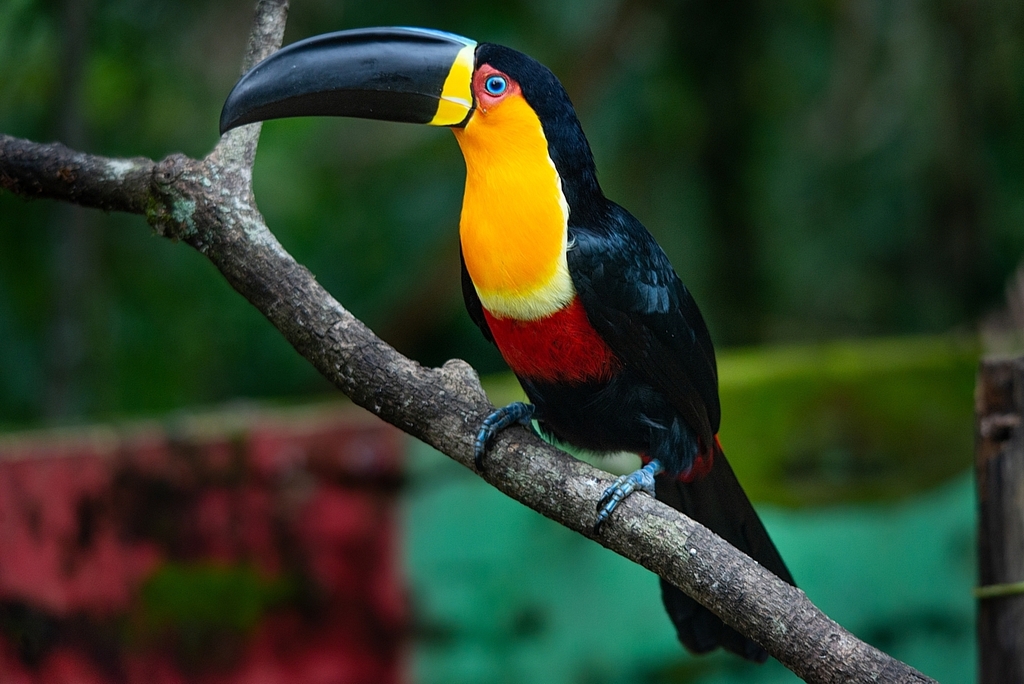
Like other toucans, the channel-billed is brightly marked and has a huge bill. It is typically 48 cm (19 in) long with a 9–14 cm (3½-5½ in) bill. It weighs 300–430 g (11–15 oz)
Nominate race (R. v. vitellinus): Its upperparts, belly, tail and most of the bill are black, and the uppertail and undertail coverts are red. The bare eye-patch and bill base are blue, the throat is white, most of the central breast is yellow-orange fading to white laterally and the lower breast sharply contrasts with a broad transverse red band. The iris is dark brownish. It is found in the north-eastern part of this species' range. Race culminatus: It resembles the nominate, but has a yellow base of the upper mandible and ridge to its bill, orange-yellow uppertail coverts and the throat and breast are white (occasionally tinged yellow), with just a narrow red band separating the latter from the black belly. It occurs in the eastern and south-central part of this species' range. It is very similar to, and easily confused with, Cuvier's toucan (Ramphastos tucanus cuvieri). Race ariel: It resembles the nominate, but the base of its bill is yellow, the skin around the pale blue eye is red and the entire throat and chest are orange. It occurs in the south-east Amazon. The unnamed population from the coastal regions of eastern Brazil is virtually identical. Race citreolaemus. …
Range & habitat
Found in forest and woodland. Prefers humid regions, but locally extends into drier regions (esp. along rivers). Mainly in lowlands, but locally to an altitude of 1,700 m (5,600 ft).
Wikipedia: “Habitat”
What it does
This species is an arboreal fruit-eater but will take insects, small reptiles, eggs and frogs. Typically consumed are lipid-rich fruits such as Virola and Euterpe palm fruits. Other fruits which the channel-billed toucan feeds upon are those borne by Cecropia, Ficus, Hevea, Nectandra, Oenocarpus, Pourouma and Pouteria. They will also consume papaya, mangoes, avocados and peppers if human intrusions into their habitat occur. The call is a croaking "cree-op cree-op cree-op". The parents are both active in raising the young. The white eggs are laid in a high unlined tree cavity. There is a gestation period of 18 days, and the parents both incubate for 15 to 16 days. However, they can be impatient sitters, often leaving their eggs uncovered for hours at a time. Newborn toucans remain in the nest after hatching. They are blind and naked at birth, and their eyes open after about 3 weeks. They have short bills and specialized pads on their heels to protect them from the rough floor of the nest. The feathers do not begin to expand until they are nearly 4 weeks old. They are helpless and unable to leave the nest for about 8 weeks, dependent upon both parents to feed them. After this, the young can care for themselves. They begin to leave the nest after 40 to 50 days, depending on size.
Wikipedia: “Behavior”
Listen
Looking for field recordings…
Where it lives
Recorded sightings
—
geo-referenced records in GBIF, from museums, herbaria and field observers.
Drag the globe to turn it. Dots are where records exist, not a range map; darker means more records.
In the stacks
Searching the stacks…
Every page naming Ramphastos vitellinus in the Biodiversity Heritage Library →
This page is assembled live from iNaturalist, GBIF, Wikipedia, the Source Library and the Internet Archive. It is not yet part of the hand-edited codex. iNaturalist taxon 18803.