 NL·0213
Herbarium of the Nature Library
- Name
- Accipiter nisus
- Family
- Accipitridae
- Native to
- Europe, North Africa, the Middle East and Central Asia across Siberia to Japan; northern birds winter south to Africa and South Asia
- Habitat
- Woodland, Temperate forest, Farmland, Gardens and parks
On eBird ↗
Eurasian Sparrowhawk
Live sightings near you, the range map, bar charts of when it is seen, and Macaulay Library photos and recordings.
Eurasian sparrowhawk
Accipiter nisus
Also calledBashiq (Arabic) · Qerqi (Persian) · Atmaca (Turkish) · Basha (Urdu) · Sperber (German) · Épervier d'Europe (French) · Gavilán (Spanish)
A short-winged, long-tailed hawk built for ambush, flashing along hedgerows to snatch small birds by surprise. Females are much larger than males, nearly twice their weight.
The Eurasian sparrowhawk, also known as the northern sparrowhawk or simply the sparrowhawk, is a small bird of prey in the family Accipitridae. Adult male Eurasian sparrowhawks have bluish grey upperparts and orange-barred underparts; females and juveniles are brown above with brown barring below. The female is up to 25% larger than the male – one of the greatest size differences between the sexes in any bird species. Though it is a predator which specialises in catching woodland birds, the Eurasian sparrowhawk can be found in any habitat and often hunts garden birds in towns and cities. Males tend to take smaller birds, including tits, finches and sparrows; females catch primarily thrushes and starlings but are capable of killing birds weighing 500 g (18 oz) or more. Wikipedia
What it can do
- iHunts by surprise, using hedges and buildings as cover to ambush songbirds
- iiFemales take prey up to woodpigeon size; males mostly hunt tits and finches
- iiiLong legs and toes snatch birds from the air or from inside bushes
- ivRecovered across Europe after organochlorine pesticides such as DDT were banned
In the field
Field marks
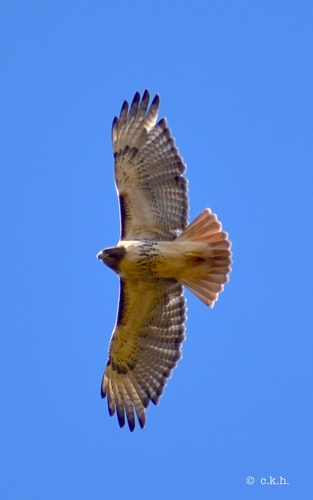
- aShort, rounded wings and long, square-ended barred tail
- bMale slate-blue above with orange-barred underparts and cheeks
- cFemale grey-brown above, finely barred grey below, with a white eyebrow
- dYellow eyes and thin, long yellow legs
- Voice
- Mostly silent; a rapid, chattering 'kew-kew-kew' near the nest.
- Not to be confused with
- Northern goshawk is much larger with a bulging rear body and bold white eyebrow. Common kestrel has pointed wings and hovers. Levant sparrowhawk (southeast Europe, Middle East) has dark wingtips and is pale below.
- Where to see it
- Widespread over European farmland and gardens; huge autumn passages over Falsterbo, the Bosphorus and Batumi (Georgia).
- When
- Resident in much of Europe; passage migrant and winter visitor in the south
Listen
Looking for field recordings…
Life & habits
- Diet
- Almost entirely small and medium birds
- Habitat
- Woodland, farmland with hedges, towns and gardens
- Size
- 28–41 cm; wingspan 59–80 cm; males ~150 g, females ~260 g
- Lifespan
- Typically about 4 years
Often seen in a brief, dashing attack on a garden bird feeder before vanishing over a hedge.
Where it lives
Recorded sightings
—
geo-referenced records in GBIF, from museums, herbaria and field observers.
Native range
Europe, North Africa, the Middle East and Central Asia across Siberia to Japan; northern birds winter south to Africa and South Asia
Drag the globe to turn it. Dots are where records exist, not a range map; darker means more records.
In the old herbals & bestiaries
Woodcuts and engravings matched from the Source Library’s scanned books by name. Plates marked “relative” show a close kin rather than this exact species. Click a plate to read the page it came from, with translation.


In the stacks
Searching the stacks…
Every page naming Accipiter nisus in the Biodiversity Heritage Library →
Marginalia
In medieval falconry the sparrowhawk was the hawk assigned to priests in the 'Book of St Albans' (1486), and its small male was called a 'musket', a word later given to a firearm.
Curiosity
Ian Newton's decades-long study in southern Scotland made the sparrowhawk one of the best-studied raptors in the world.
Kinship





Fact-checked: 1 correction made to this sheet. Photographs: iNaturalist contributors under the licences shown. Records: GBIF.org. Historical plates: Source Library (CC BY-SA 4.0; originals public domain). Summary text: Nature Library editors and Wikipedia (CC BY-SA). Medicinal and edibility notes are historical and educational, not advice. iNaturalist taxon 5106.