- Animals
- ›Chordates
- ›Vertebrates
- ›Birds
- ›Pelicans, Herons, Ibises, and Allies
- ›Ibises and Spoonbills
- ›Platalea
On eBird ↗
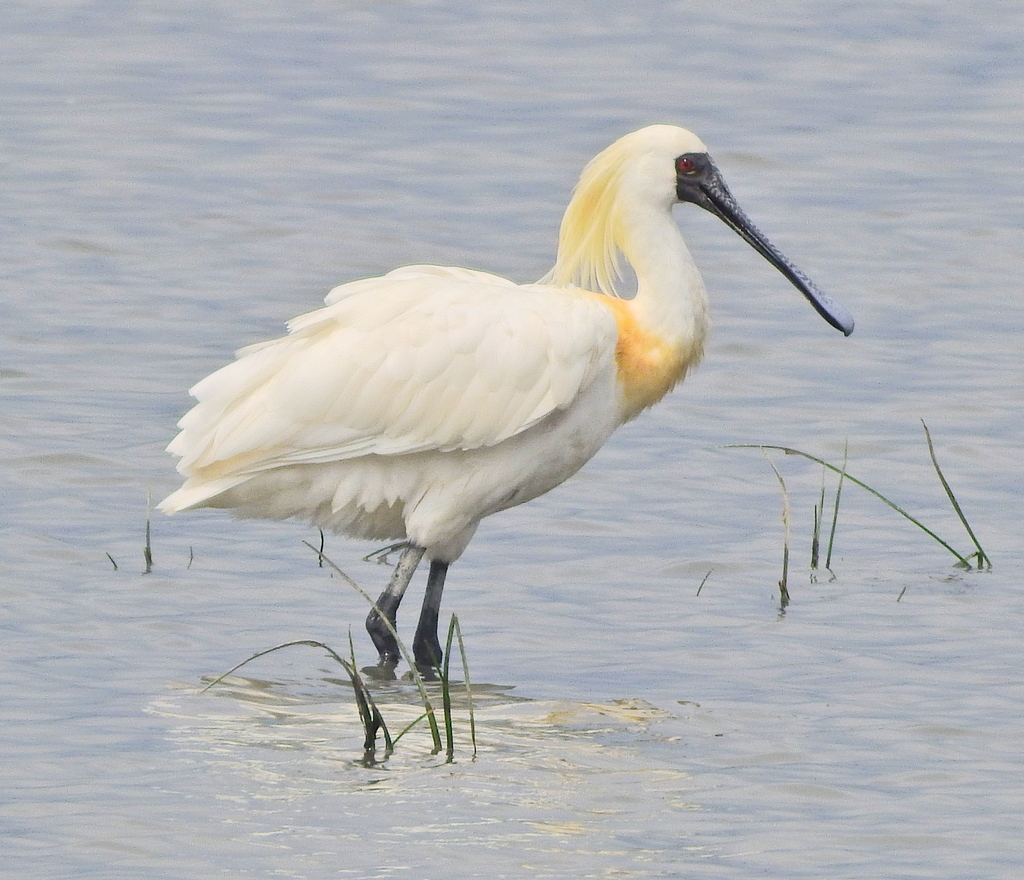
Black-faced Spoonbill
Live sightings near you, the range map, bar charts of when it is seen, and Macaulay Library photos and recordings.
Black-faced Spoonbill
Platalea minor
The black-faced spoonbill (Platalea minor) is a species of wading bird in the ibis and spoonbill family Threskiornithidae, found in eastern Asia. This species has the most restricted distribution of the six spoonbill species, and is the only one regarded as vulnerable. Spoonbills are large water birds with dorso-ventrally flattened, spatulate bills; they use a tactile method of feeding, wading in the water and sweeping their beaks from side-to-side to detect prey.
Confined to the coastal areas of eastern Asia, it seems that it was once common throughout its area of distribution. It currently breeds mostly on a few small rocky islands off the west coast of North Korea and South Korea, with four wintering sites at Macau, Hong Kong, Taiwan and Vietnam, as well as other places where they have been observed in migration. Wintering also occurs in Jeju, South Korea, Kyushu and Okinawa, Japan, and the Red River delta in Vietnam. More recently, sightings were noted in Thailand, the Philippines, and at additional sites in China.
From the article Black-faced spoonbill on Wikipedia (CC BY-SA), quoted section by section
Range & habitat
The global population of this species is likely based on the winter population count which was carried out in 1988–1990 in all known sites. This count estimated about only 288 individuals. As of 2006, following sustained conservation efforts, the estimated global population had increased to 1,679; the 2008 census resulted in an estimated total count of 2,065 individuals; and a 2010 census reported 2,346. The known localised population of North Korea is not known to exceed 30 birds. However, there is believed to be another, so far undiscovered colony which provides regional population stability and it is assumed to be probably located in north-east China; for example, on the islands of Liaoning (near the Korean nesting zone). As black-faced spoonbills are migratory, their conservation is based on the protection of their breeding, "stop-over" and wintering grounds, making conservation efforts complex. However, spoonbills are able to adapt to disturbance on a large scale. The exact distribution of the species remains unclear, although some attempts at modelling population developments under climate change impacts have been made.
Wikipedia: “Distribution”
Listen
Looking for field recordings…
Where it lives
Recorded sightings
—
geo-referenced records in GBIF, from museums, herbaria and field observers.
Drag the globe to turn it. Dots are where records exist, not a range map; darker means more records.
In the stacks
Searching the stacks…
Every page naming Platalea minor in the Biodiversity Heritage Library →
This page is assembled live from iNaturalist, GBIF, Wikipedia, the Source Library and the Internet Archive. It is not yet part of the hand-edited codex. iNaturalist taxon 3729.