On eBird ↗
Short-billed Dowitcher
Live sightings near you, the range map, bar charts of when it is seen, and Macaulay Library photos and recordings.
Short-billed Dowitcher
Limnodromus griseus
The short-billed dowitcher (Limnodromus griseus), like its congener, the long-billed dowitcher, is a medium-sized, stocky, long-billed shorebird in the family Scolopacidae.
It is an inhabitant of North America, Central America, the Caribbean, and northern South America. It is strongly migratory; it completely vacates its breeding areas during the snow-bound months. This species favors a variety of habitats, including tundra in the north to ponds and mudflats in the south. It feeds on invertebrates often by rapidly probing its bill into mud in a sewing machine fashion. It and the very similar long-billed dowitcher were considered one species until 1950. Field identification of the two American Limnodromus remains difficult today. Distinguishing wintering or juvenile short-billed dowitchers from the long-billed species is very difficult and, even given examination of their subtlety different body shapes, cannot always be isolated to a particular species. They differ most substantially in vocalizations. The names of American dowitchers are misleading, as there is much overlap in their bill lengths. Only a small percentage can be identified by this character alone.
From the article Short-billed dowitcher on Wikipedia (CC BY-SA), quoted section by section
Description
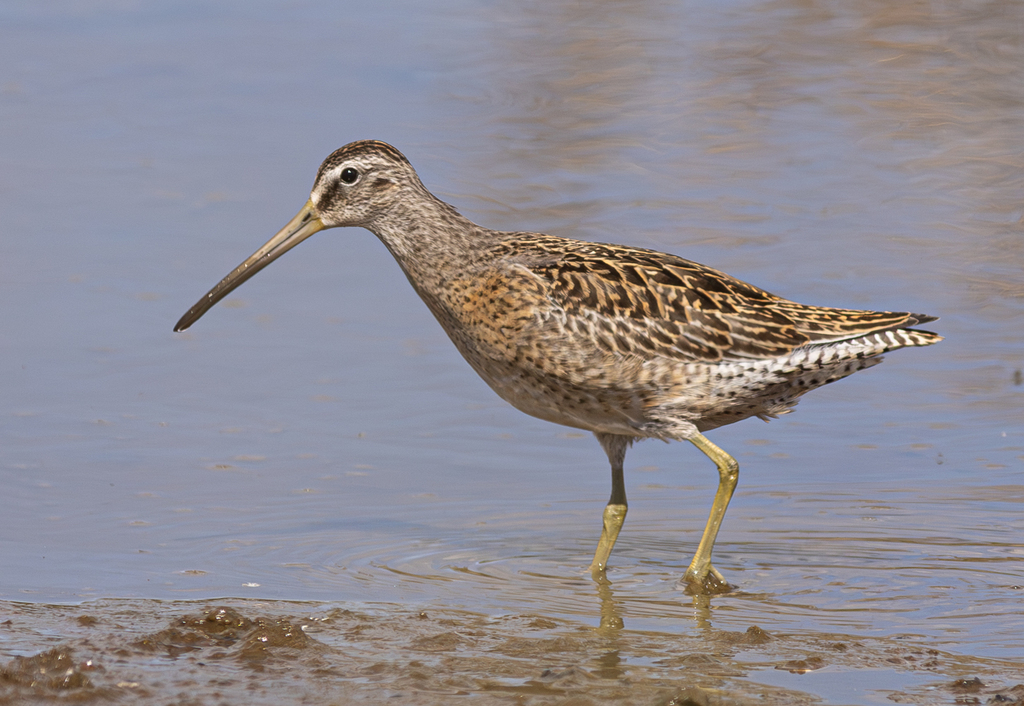
Adults' bodies are dark brown on top and reddish underneath. The tail has a black-and-white barred pattern, and the legs are yellowish. The three subspecies have slight variations in appearance:
Limnodromus griseus griseus has a white belly and barred flanks. Limnodromus griseus hendersoni has a reddish belly and spotted flanks. Limnodromus griseus caurinus has a white belly, heavily barred flanks, and a densely spotted breast. None of these combines the reddish belly and barred flanks of the breeding plumage of the long-billed dowitcher. The winter plumage is largely grey. This bird can range from 23 to 32 cm (9.1 to 12.6 in) in length, 46 to 56 cm (18 to 22 in) in wingspan and 73–155 g (2.6–5.5 oz) in body mass. The call of this bird is more mellow than that of the long-billed dowitcher, and is useful in identification, particularly of the difficult adult plumages.
Range & habitat
The breeding habitat of the short-billed dowitcher includes bogs, tidal marshes, mudflats or forest clearings south of the tree line in northern North America. L. g. griseus breeds in northern Quebec; L. g. hendersoni breeds in north central Canada; L. g. caurinus breeds in southern Alaska and southern Yukon. The birds migrate to the southern United States and as far south as Brazil. This bird is more likely to be seen near ocean coasts during migration than the long-billed dowitcher. This species occurs in western Europe only as a scarce vagrant.
Wikipedia: “Distribution and habitat”
What it does
These birds forage by probing in shallow water or on wet mud. They mainly eat insects, mollusks, crustaceans, and marine worms, but they also eat some plant material.
Wikipedia: “Food and feeding”
Listen
Looking for field recordings…
Where it lives
Recorded sightings
—
geo-referenced records in GBIF, from museums, herbaria and field observers.
Drag the globe to turn it. Dots are where records exist, not a range map; darker means more records.
In the stacks
Searching the stacks…
Every page naming Limnodromus griseus in the Biodiversity Heritage Library →
This page is assembled live from iNaturalist, GBIF, Wikipedia, the Source Library and the Internet Archive. It is not yet part of the hand-edited codex. iNaturalist taxon 3869.