On eBird ↗
Black-tailed Godwit
Live sightings near you, the range map, bar charts of when it is seen, and Macaulay Library photos and recordings.
Black-tailed Godwit
Limosa limosa
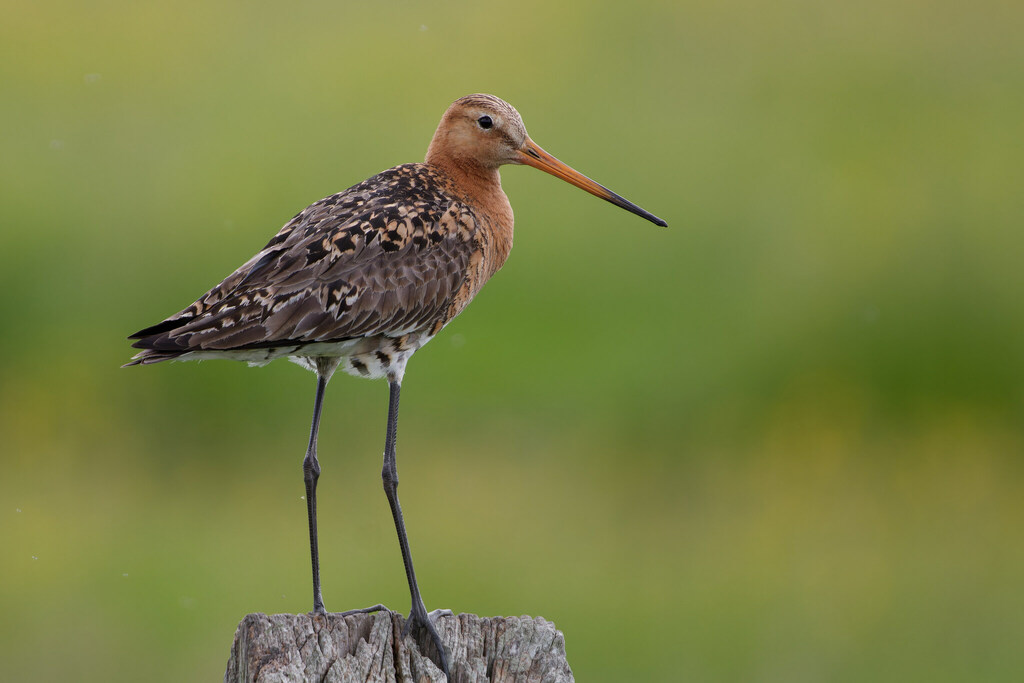
The black-tailed godwit (Limosa limosa) is a large, long-legged, long-billed shorebird first described by Carl Linnaeus in 1758. It is a member of the godwit genus, Limosa. There are four subspecies, all with orange head, neck and chest in breeding plumage and dull grey-brown winter coloration, and distinctive black and white wingbar at all times.
Its breeding range stretches from Iceland through Europe and areas of central Asia. Black-tailed godwits spend (the northern hemisphere) winter in areas as diverse as the Indian subcontinent, Australia, New Zealand, western Europe and west Africa. The species breeds in fens, lake edges, damp meadows, moorlands and bogs and uses estuaries, swamps and floods in (the northern hemisphere) winter; it is more likely to be found inland and on freshwater than the similar bar-tailed godwit. The world population is estimated to be 634,000 to 805,000 birds and is classified as Near Threatened.
From the article Black-tailed godwit on Wikipedia (CC BY-SA), quoted section by section
Description
The black-tailed godwit is a large wader with long bill (7.5 to 12 cm (3.0 to 4.7 in) long), neck and legs. During the breeding season, the bill has a yellowish or orange-pink base and dark tip; the base is pink in winter. The legs are dark grey, brown or black. The sexes are similar, but in breeding plumage, they can be separated by the male's brighter, more extensive orange breast, neck and head. In winter, adult black-tailed godwits have a uniform brown-grey breast and upperparts (in contrast to the bar-tailed godwit's streaked back). Juveniles have a pale orange wash to the neck and breast. In flight, its bold black and white wings and white rump can be seen readily. When on the ground it can be difficult to separate from the similar bar-tailed godwit, but the black-tailed godwit's longer, straighter bill and longer legs are diagnostic. Black-tailed godwits are similar in body size and shape to bar-taileds, but stand taller. It measures 42 cm (17 in) from bill to tail with a wingspan of 70–82 cm (28–32 in). Males weight around 280 g (9.9 oz) and females 340 g (12 oz). The female is around 5% larger than the male, with a bill 12–15% longer. The most common call is a strident weeka weeka weeka. A study of black-tailed godwits in the Netherlands found a mortality rate of 37.6% in the first year of life, 32% in the second year, and 36.9% thereafter. …
Range & habitat
Black-tailed godwits have a discontinuous breeding range stretching from Iceland to the far east of Russia. Their breeding habitat is river valley fens, floods at the edges of large lakes, damp steppes, raised bogs and moorlands. An important proportion of the European population now uses secondary habitats: lowland wet grasslands (with vegetation up to about 50 cm tall), coastal grazing marshes, pastures, wet areas near fishponds or sewage works, and saline lagoons. Breeding can also take place in sugar beet, potato and rye fields in the Netherlands and Germany. In spring, black-tailed godwits feed largely in grasslands, moving to muddy estuaries after breeding and for winter. On African wintering grounds, swamps, floods and irrigated paddy fields can attract flocks of birds. In India, inland pools, lakes and marshes are used, and occasionally brackish lakes, tidal creeks and estuaries. Godwits from the Icelandic population winter mainly in the United Kingdom, Ireland, France, and the Netherlands, though some fly on to Spain, Portugal, and perhaps Morocco. Birds of the limosa subspecies from western Europe fly south to Morocco and then on to Senegal and Guinea-Bissau. Birds from the eastern European populations migrate to Tunisia and Algeria, then on to Mali or Chad. …
Wikipedia: “Distribution and habitat”
What it does
They mainly eat invertebrates, but also aquatic plants in winter and on migration. In the breeding season, prey includes beetles, flies, grasshoppers, dragonflies, mayflies, caterpillars, annelid worms and molluscs. Occasionally, fish eggs, frogspawn and tadpoles are eaten. In water, the most common feeding method is to probe vigorously, up to 36 times per minute, and often with the head completely submerged. On land, black-tailed godwits probe into soft ground and also pick prey items from the surface.
Wikipedia: “Food and feeding”
Listen
Looking for field recordings…
Where it lives
Recorded sightings
—
geo-referenced records in GBIF, from museums, herbaria and field observers.
Drag the globe to turn it. Dots are where records exist, not a range map; darker means more records.
In the stacks
Searching the stacks…
Every page naming Limosa limosa in the Biodiversity Heritage Library →
This page is assembled live from iNaturalist, GBIF, Wikipedia, the Source Library and the Internet Archive. It is not yet part of the hand-edited codex. iNaturalist taxon 3947.