On eBird ↗
Green Sandpiper
Live sightings near you, the range map, bar charts of when it is seen, and Macaulay Library photos and recordings.
Green Sandpiper
Tringa ochropus
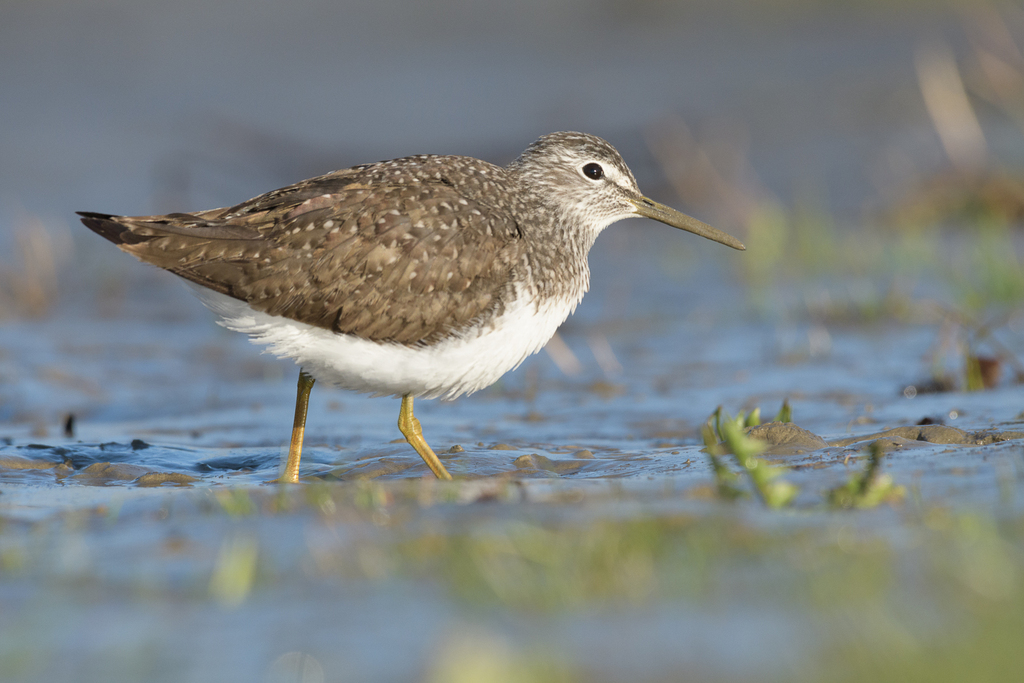
The green sandpiper (Tringa ochropus) is a small wader (shorebird) of the Old World.
The green sandpiper represents an ancient lineage of the genus Tringa; its only close living relative is the solitary sandpiper (T. solitaria). They both have brown wings with little light dots and a delicate but contrasting neck and chest pattern. In addition, both species nest in trees, unlike most other scolopacids.
From the article Green sandpiper on Wikipedia (CC BY-SA), quoted section by section
Description
This species is a somewhat plump wader with a dark greenish-brown back and wings, greyish head and breast and otherwise white underparts. The back is spotted white to varying extents, being maximal in the breeding adult, and less in winter and young birds. The legs and short bill are both dark green. It is conspicuous and characteristically patterned in flight, with the wings dark above and below and a brilliant white rump. The latter feature reliably distinguishes it from the slightly smaller but otherwise very similar solitary sandpiper (T. solitaria) of North America. In flight it has a characteristic three-note whistle.
Range & habitat
The green sandpiper breeds across subarctic Europe and east across the Palearctic and is a migratory bird, wintering in southern Europe, the Indian subcontinent, Southeast Asia, and tropical Africa. Food is small invertebrate items picked off the mud as this species works steadily around the edges of its chosen pond. This is not a gregarious species, although sometimes small numbers congregate in suitable feeding areas. Green sandpiper is very much a bird of freshwater, and is often found in sites too restricted for other waders, which tend to like a clear all-round view.
Wikipedia: “Distribution and migration”
Listen
Looking for field recordings…
Where it lives
Recorded sightings
—
geo-referenced records in GBIF, from museums, herbaria and field observers.
Drag the globe to turn it. Dots are where records exist, not a range map; darker means more records.
In the stacks
Searching the stacks…
Every page naming Tringa ochropus in the Biodiversity Heritage Library →
This page is assembled live from iNaturalist, GBIF, Wikipedia, the Source Library and the Internet Archive. It is not yet part of the hand-edited codex. iNaturalist taxon 3885.