On eBird ↗
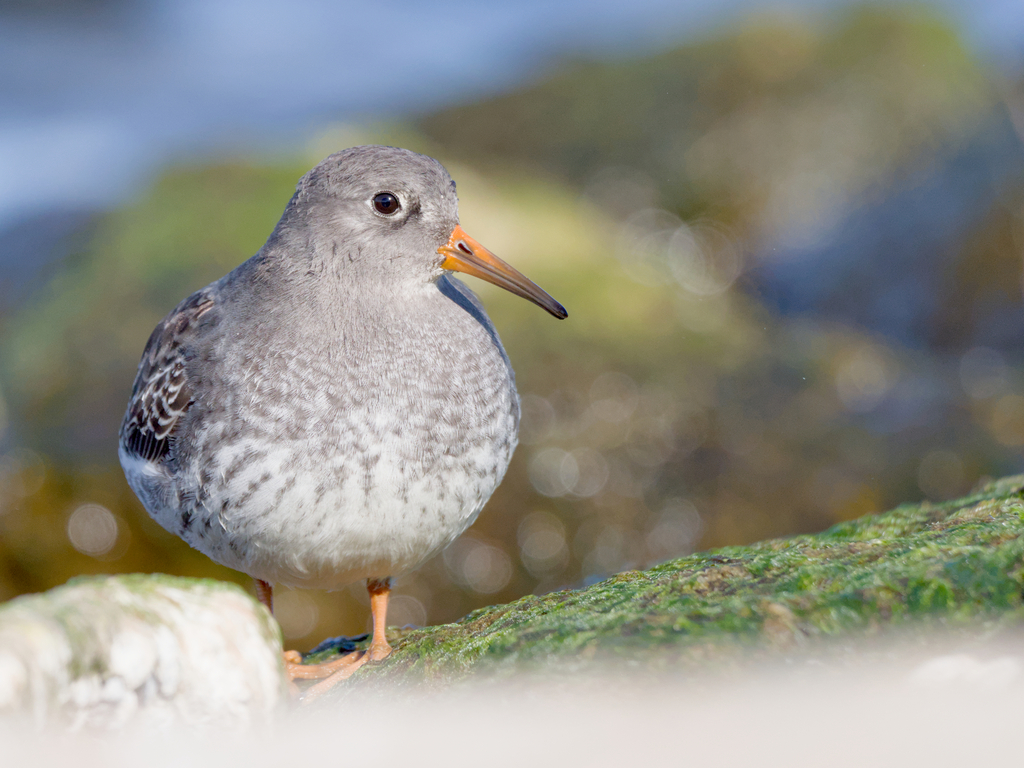
Purple Sandpiper
Live sightings near you, the range map, bar charts of when it is seen, and Macaulay Library photos and recordings.
Purple Sandpiper
Calidris maritima
The purple sandpiper (Calidris maritima) is a small shorebird. The genus name is from Ancient Greek kalidris or skalidris, a term used by Aristotle for some grey-coloured waterside birds. The specific maritima is from Latin and means "of the sea", from mare, "sea".
From the article Purple sandpiper on Wikipedia (CC BY-SA), quoted section by section
Description
Adults have short yellow legs and a medium thin dark bill with a yellow base. The body is dark on top with a slight purplish gloss and mainly white underneath. The breast is smeared with grey and the rump is black. They measure 20–22 cm (7.9–8.7 in) in length and 42–46 cm (17–18 in) across the wings, and weight is from 50–105 g (1.8–3.7 oz).
Range & habitat
The purple sandpiper's breeding range extends from the arctic islands of northern Canada, eastwards to Greenland, Iceland, Svalbard and northern Scandinavia across to Western Siberia and the Taymyr Peninsula. In the high arctic the sandpiper breeds at low altitude on the tundra, sometimes far from the coastline, but in the subarctic regions of Sweden and Norway it breeds on barren mountain sides near the limit of the frozen ground. Birds breeding at high latitudes migrate south and spend the winter on rocky shores on both sides of the north Atlantic. They winter along the North America coast as far south as South Carolina and on the eastern Atlantic coast as far south as France and northern Iberia. Birds wintering in northern Scotland and southwest Ireland migrate to Canada (Baffin Island and Devon Island) to breed. In Britain, these birds occur in winter in good numbers principally along the east and south coasts, where they favour rocky shorelines adjacent to the sea. It is much rarer as a breeding bird, found only in a localised area of the Cairngorms National Park, where 1–3 pairs have bred since 1978. Records of breeding by this species in the UK are monitored and archived by the Rare Breeding Birds Panel. They are late migrants and move to rocky, ice-free Atlantic coasts in winter. Most go no further south than North Carolina and northern Portugal. …
Wikipedia: “Distribution and habitat”
What it does
These birds forage on rocky coasts, picking up food by sight. They mainly eat arthropods and molluscs, mainly littorinids and mussels, also some plant material. One of the main staples are seaweed flies of the Coelopa genera (C. frigida).
Wikipedia: “Feeding”
Listen
Looking for field recordings…
Where it lives
Recorded sightings
—
geo-referenced records in GBIF, from museums, herbaria and field observers.
Drag the globe to turn it. Dots are where records exist, not a range map; darker means more records.
In the stacks
Searching the stacks…
Every page naming Calidris maritima in the Biodiversity Heritage Library →
This page is assembled live from iNaturalist, GBIF, Wikipedia, the Source Library and the Internet Archive. It is not yet part of the hand-edited codex. iNaturalist taxon 3856.