On eBird ↗
White-rumped Sandpiper
Live sightings near you, the range map, bar charts of when it is seen, and Macaulay Library photos and recordings.
White-rumped Sandpiper
Calidris fuscicollis
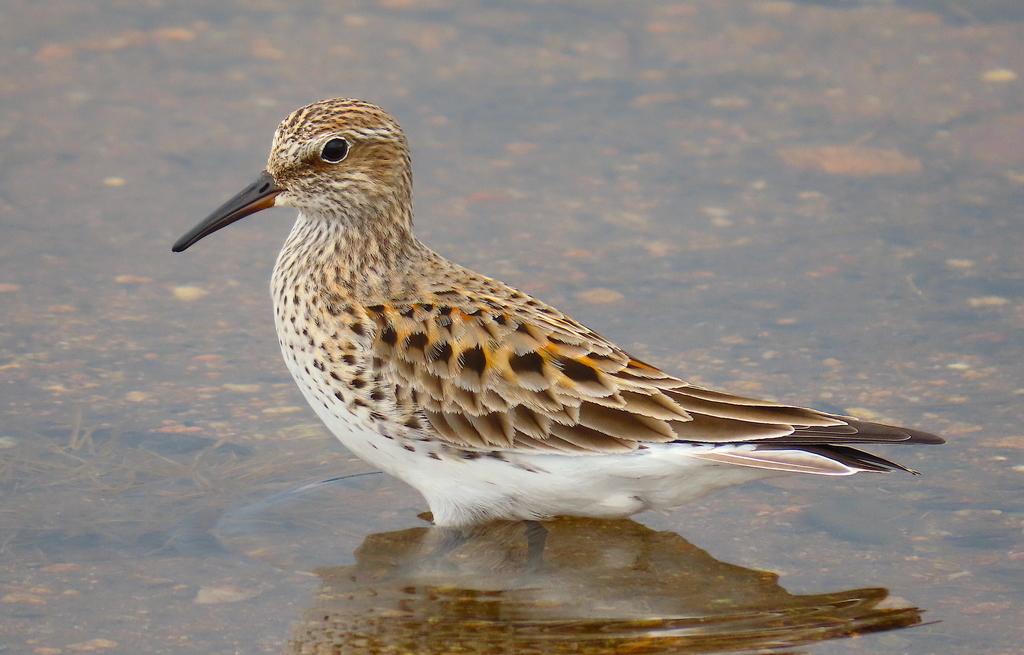
The white-rumped sandpiper (Calidris fuscicollis) is a small migratory shorebird that breeds in the northern tundra of Canada and Alaska. This bird can be difficult to distinguish from other similar tiny shorebirds; these are known collectively as "peeps" or "stints". In flight, it is more easily picked out by its namesake white rump.
From the article White-rumped sandpiper on Wikipedia (CC BY-SA), quoted section by section
Description
The white-rumped sandpiper is a relatively small bird measuring only 15–18 cm (5.9–7.1 in), with a wingspan of 36–38 cm (14–15 in). The top of its body is a dull grey-brown colour and it has a white eye stripe. Its beak is of medium length, thin and dark, and its legs are very dark. This bird is often mistaken with many similar-looking sandpipers that live in its range or along its migration path. The plumage is much less distinct during the winter; however, during all seasons males and females remain similar in their appearance. In adult breeding plumage, the crown and face have a brownish tinge. The supercilium is pale, there are black feathers on the back and there are grey edges on the wing coverts. The breast and flanks are streaked and the underparts are white. In adult winter plumage, the upperparts are a dark grey and at the centers there are black feathers. The underparts are white but the breast is dark grey. The supercilium is white, while the crown and eyeline are darker. The juvenile plumage features black-based feathers on the back and wing coverts. These have brown edges towards the scapulars and whiter edges towards the wing coverts. The breast is finely streaked and there is a white "V" on its back. The underparts and supercilium are white, the crown is brownish in colour, and the face is pale
Identification. …
Range & habitat
The white-rumped sandpiper inhabits relatively vegetated patches of the tundra. More specifically, they live in the marshy, heavily vegetated, hummocky arctic tundra of Alaska and Canada during the breeding season. They can be found in various types of wetlands while migrating. During the winter months they inhabit a variety of freshwater and saltwater habitats such as lagoons, estuaries and marshes. In general, they tend to avoid sandy beaches and fast moving water.
Migration. They are a long-distance migrant, wintering in southern South America and the Caribbean. They are considered one of the most extreme long-distance migrants in the world, traversing the entire continent of North America in the span of one month. The white-rumped sandpiper is a nearctic migrant. After breeding in northern Canada and Alaska, it flies over the Atlantic Ocean to spend the majority of its non-breeding period in South America, particularly along the Patagonian coast in both Chile and Argentina. It also frequently visits Fracasso Beach, Argentina. Many shorebirds concentrate in this area due to the abundance of intertidal invertebrates, especially clams. The white-rumped sandpiper has also been reported in Venezuela, Suriname, Brazil and Paraguay during its migration. …
Wikipedia: “Distribution and habitat”
What it does
Their diet consists primarily of small invertebrates including: molluscs, crustaceans, polychaetes, annelids and both adult and larval insects. They are mainly reported to eat aquatic invertebrates. Although it was previously thought they only consumed invertebrates, it has been shown that seeds and moss also make up a portion of the white-rumped sandpiper diet. This discovery lead to the idea that they might be opportunistic feeders depending on time, season and habitat. Stones and algae have also been found in their stomachs but these are most likely ingested by accident. The stones are of the same general shape and size as the seeds so it could be a case of mistaken identity. Algae could also be accidentally ingested through aquatic feeding. While on mudflats, the white-rumped sandpiper forages by probing in shallow waters and in mud but can also pick up some items from the surface. When they are in the tundra, they must probe deeply in the moss and other vegetation.
Wikipedia: “Food and feeding”
Listen
Looking for field recordings…
Where it lives
Recorded sightings
—
geo-referenced records in GBIF, from museums, herbaria and field observers.
Drag the globe to turn it. Dots are where records exist, not a range map; darker means more records.
In the stacks
Searching the stacks…
Every page naming Calidris fuscicollis in the Biodiversity Heritage Library →
This page is assembled live from iNaturalist, GBIF, Wikipedia, the Source Library and the Internet Archive. It is not yet part of the hand-edited codex. iNaturalist taxon 3866.