 NL·0688
Herbarium of the Nature Library
- Name
- Numenius arquata
- Family
- Scolopacidae
- Native to
- Breeds from Britain and Ireland across northern and central Europe and Central Asia to Siberia; winters on coasts of western Europe, Africa, the Middle East and South Asia
- Habitat
- Moorland, Wetland, Estuaries, Temperate grassland
On eBird ↗
Eurasian Curlew
Live sightings near you, the range map, bar charts of when it is seen, and Macaulay Library photos and recordings.
Eurasian curlew
Numenius arquata
Also calledBüyük kervançulluğu (Turkish) · Großer Brachvogel (German) · Courlis cendré (French) · Zarapito real (Spanish) · Gylfinir (Welsh) · Whaup (Scots)
Europe's largest wader, with a very long, down-curved bill and a bubbling, haunting call that carries over moors and estuaries. It has declined steeply in Britain and Ireland, which hold a large share of the world's breeding birds.
The Eurasian curlew or common curlew is a very large wader in the family Scolopacidae. It is one of the most widespread of the curlews, breeding across temperate Europe and Asia. In Europe, this species is often referred to just as the "curlew", and in Scotland known as the "whaup" in Scots. Wikipedia
What it can do
- iProbes deep into mud for lugworms and ragworms with a bill up to about 15 cm long in females
- iiThe bill tip is flexible and sensitive, letting it feel for prey underground
- iiiFemales have longer bills than males, so the sexes feed differently
- ivGathers in large flocks at estuary high-tide roosts
In the field
Field marks
- aVery long, down-curved bill
- bGrey-brown streaked plumage
- cWhite wedge up the rump and back in flight
- dLarge size; long, blue-grey legs
- Voice
- A rising, mournful 'cur-lee' and a long, accelerating bubbling trill in display.
- Not to be confused with
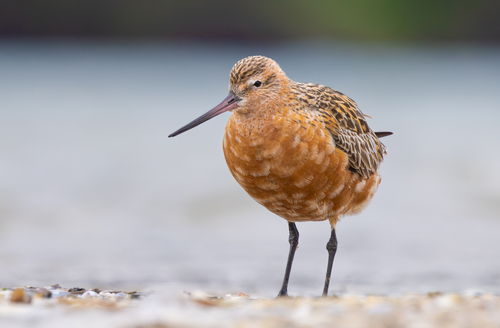
- Whimbrel is smaller with a shorter bill, a striped crown and a rapid seven-note 'tititititi' call. Bar-tailed godwit has a slightly upturned bill.
- Where to see it
- Pennine and Scottish moors in spring; the Wash, Morecambe Bay, the Wadden Sea and Banc d'Arguin (Mauritania) in winter.
- When
- Present on coasts all year; on moorland breeding grounds Mar–Jul
Listen
Looking for field recordings…
Life & habits
- Diet
- Worms, crabs, molluscs and insects; leatherjackets and earthworms inland
- Habitat
- Moorland, rough pasture and wet meadows for breeding; estuaries and mudflats in winter
- Size
- 50–60 cm; wingspan 89–106 cm; 410–1,360 g
- Lifespan
- Often 5–10 years; record over 30
On breeding grounds it rises on fluttering wings and glides down giving its bubbling song.
Where it lives
Recorded sightings
—
geo-referenced records in GBIF, from museums, herbaria and field observers.
Native range
Breeds from Britain and Ireland across northern and central Europe and Central Asia to Siberia; winters on coasts of western Europe, Africa, the Middle East and South Asia
Drag the globe to turn it. Dots are where records exist, not a range map; darker means more records.
In the old herbals & bestiaries
Woodcuts and engravings matched from the Source Library’s scanned books by name. Plates marked “relative” show a close kin rather than this exact species. Click a plate to read the page it came from, with translation.


In the stacks
Searching the stacks…
Every page naming Numenius arquata in the Biodiversity Heritage Library →
Marginalia
W. B. Yeats used its cry as an image of grief in 'He Reproves the Curlew' (1899), and Benjamin Britten's church parable 'Curlew River' (1964) takes its title from the bird.
Curiosity
Its smaller relative the slender-billed curlew was last confirmed in Morocco in 1995, and a 2024 study concluded it is very likely extinct.
Kinship



Fact-checked: 1 correction made to this sheet. Photographs: iNaturalist contributors under the licences shown. Records: GBIF.org. Historical plates: Source Library (CC BY-SA 4.0; originals public domain). Summary text: Nature Library editors and Wikipedia (CC BY-SA). Medicinal and edibility notes are historical and educational, not advice. iNaturalist taxon 3896.