On eBird ↗
Wattled Starling
Live sightings near you, the range map, bar charts of when it is seen, and Macaulay Library photos and recordings.
Wattled Starling
Creatophora cinerea
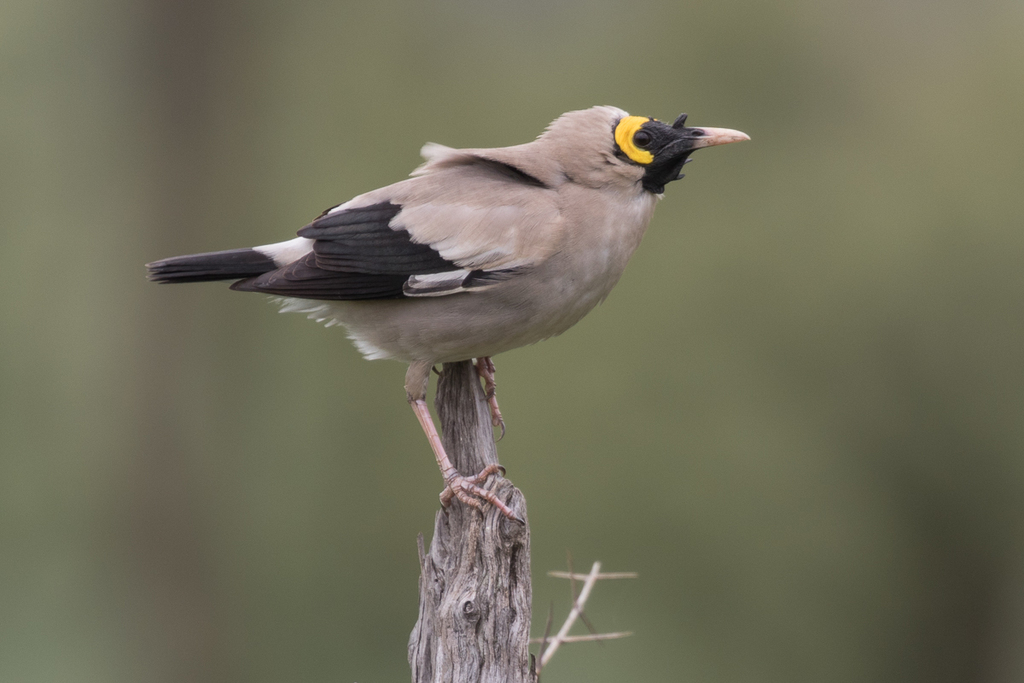
The wattled starling (Creatophora cinerea) is a nomadic resident bird in eastern and southern Africa. It is a species of grassland, open woodland, and cultivation.
This is the only African starling that appears to show affinities with the Asian starlings, particularly the genus Sturnus. Its bare face patches and ability to open-bill feed in grassland are unique amongst African starlings. It is the only member of the genus Creatophora.
From the article Wattled starling on Wikipedia (CC BY-SA), quoted section by section
Description
The wattled starling is 21 cm long, with a short tail and pointed wings. It has mainly grey plumage except for a white rump, and black flight feathers and tail. The breeding male has a white shoulder patch and a distinctive head pattern, with unfeathered yellow skin, and black forehead and throat wattles. The extent to which these seasonal features develop increases with the age of the bird and some old females may show a weaker version of this plumage. The non-breeding male has a feathered head except for a small yellow patch behind the eye. There are no wattles, but there is a black moustachial stripe. The white shoulder patch is much reduced. The female and juvenile plumages are similar to the non-breeding male, but the flight feathers and tail are brown. The black flight and tail feathers and white rump make this species unmistakable in flight. This species has a range of wheezing or grating calls comparable to those of the common starling, but the most familiar is a wheezing ssreeeeo.
What it does
Like other starlings, the wattled starling is an omnivore, taking a wide range of invertebrates seeds and berries, but its diet is mainly insects including many locusts, leading to the local name "locust bird". It will scavenge at rubbish heaps, and frequently perches on livestock, feeding on insects disturbed by the animals and also removing ectoparasites.
Wikipedia: “Feeding”
Listen
Looking for field recordings…
Where it lives
Recorded sightings
—
geo-referenced records in GBIF, from museums, herbaria and field observers.
Drag the globe to turn it. Dots are where records exist, not a range map; darker means more records.
In the stacks
Searching the stacks…
Every page naming Creatophora cinerea in the Biodiversity Heritage Library →
This page is assembled live from iNaturalist, GBIF, Wikipedia, the Source Library and the Internet Archive. It is not yet part of the hand-edited codex. iNaturalist taxon 15032.