On eBird ↗
Greater Blue-eared Starling
Live sightings near you, the range map, bar charts of when it is seen, and Macaulay Library photos and recordings.
Greater Blue-eared Starling
Lamprotornis chalybaeus
The greater blue-eared starling or greater blue-eared glossy-starling (Lamprotornis chalybaeus) is a bird that breeds from Senegal east to Ethiopia and south through eastern Africa to northeastern South Africa and Angola. It is a very common species of open woodland bird, and undertakes some seasonal migration.
From the article Greater blue-eared starling on Wikipedia (CC BY-SA), quoted section by section
Description
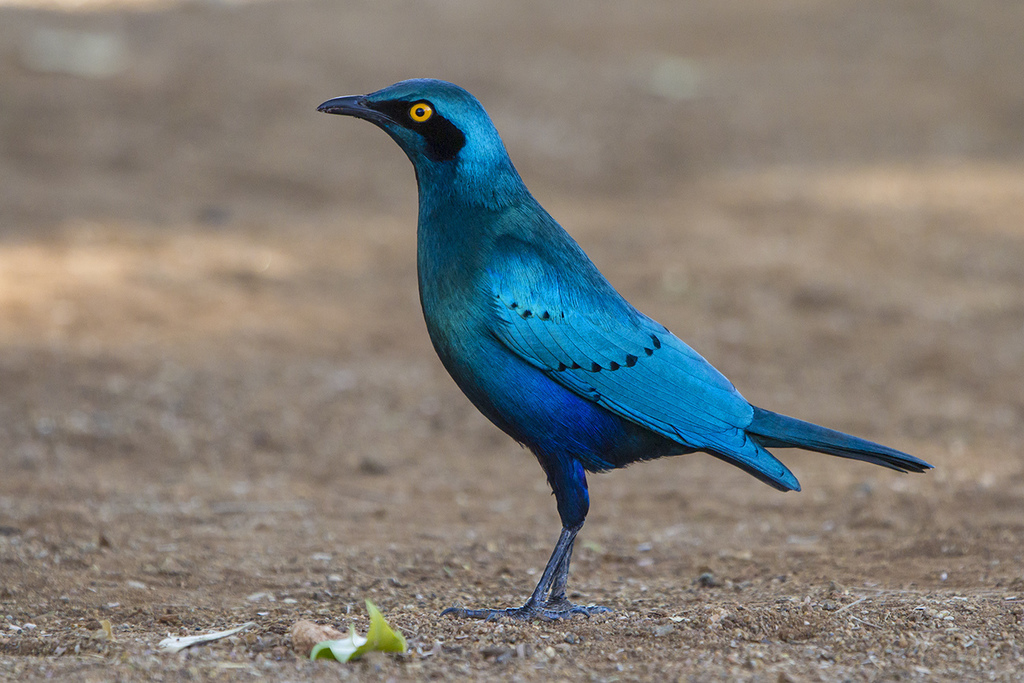
The greater blue-eared starling is a 22 cm long, short tailed bird. This starling is glossy blue-green with a purple-blue belly and blue ear patch. Its iris is bright yellow or orange. The sexes are similar, but the juvenile is duller and has blackish brown underparts. The populations from southern Kenya southwards are smaller than northern birds and are sometimes considered to be a separate subspecies, L. c. sycobius. The lesser blue-eared starling is similar to this species, but the blue of the belly does not extend forward of the legs. The greater blue-eared starling has a range of musical or grating calls, but the most familiar is a nasal squee-ar.
What it does
Like other starlings, the greater blue-eared starling is an omnivore, taking a wide range of invertebrates, seeds, and berries, especially figs, but is diet is mainly insects taken from the ground. It will perch on livestock, feeding on insects disturbing the animals and occasionally removing ectoparasites.
Wikipedia: “Feeding”
Listen
Looking for field recordings…
Where it lives
Recorded sightings
—
geo-referenced records in GBIF, from museums, herbaria and field observers.
Drag the globe to turn it. Dots are where records exist, not a range map; darker means more records.
In the stacks
Searching the stacks…
Every page naming Lamprotornis chalybaeus in the Biodiversity Heritage Library →
This page is assembled live from iNaturalist, GBIF, Wikipedia, the Source Library and the Internet Archive. It is not yet part of the hand-edited codex. iNaturalist taxon 14923.