 NL·0372
Herbarium of the Nature Library
- Name
- Streptopelia turtur
- Family
- Columbidae
- Native to
- Breeds in Europe, North Africa, Turkey, the Middle East and Central Asia to western China; winters in sub-Saharan Africa south of the Sahara
- Habitat
- Farmland, Woodland edge, Scrub
On eBird ↗
European Turtle-Dove
Live sightings near you, the range map, bar charts of when it is seen, and Macaulay Library photos and recordings.
European turtle dove
Streptopelia turtur
Also calledQumri (Arabic) · Qomri (Persian) · Üveyik (Turkish) · Fakhta (Urdu) · Tor (Hebrew) · Turteltaube (German) · Tórtola europea (Spanish)
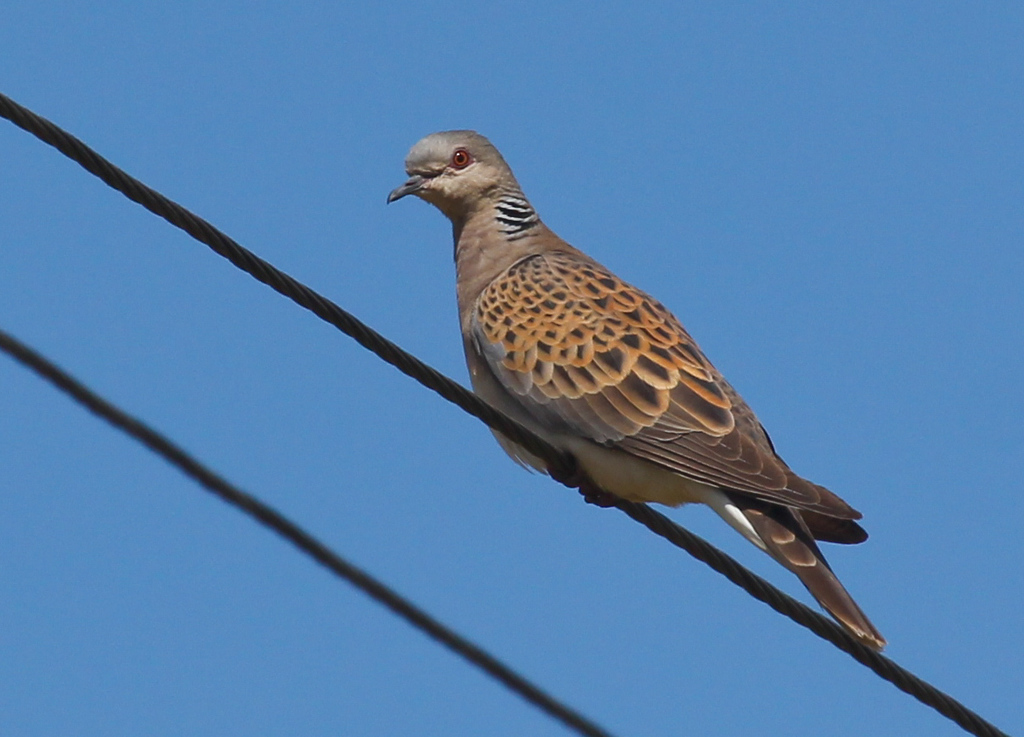
A small, delicately patterned dove whose soft purring song was once a defining sound of European summer. It winters in the Sahel and has declined severely due to habitat loss and hunting on migration.
The European turtle dove is a threatened or vulnerable member of the bird family Columbidae, the doves and pigeons. It breeds over a wide area of the south western Palearctic including north Africa but migrates to northern sub-Saharan Africa in winter. Wikipedia
What it can do
- iOne of the few European doves to make a long-distance migration across the Sahara
- iiLives largely on small seeds of arable weeds such as fumitory
- iiiProduces a soft, purring song rather than cooing
- ivSatellite tracking shows western birds wintering in the Sahel from Senegal to Mali
In the field
Field marks
- aRufous-orange back with black-centred scalloped feathers
- bBlack-and-white striped patch on each side of the neck
- cPinkish breast and blue-grey head
- dDark tail with a white border, obvious in flight
- Voice
- A soft, purring, rolling 'turrr-turrr', repeated drowsily.
- Not to be confused with
- Eurasian collared dove is larger and plain sandy-grey with a single black half-collar. Oriental turtle dove (Siberia, Central Asia) is larger and darker. Laughing dove (Middle East) is smaller and has a speckled breast band.
- Where to see it
- Mediterranean farmland in Spain, Morocco and Turkey; Suffolk and Essex hedgerows in England; heavy passage over Malta and Cyprus.
- When
- Summer visitor Apr–Sep
Listen
Looking for field recordings…
Life & habits
- Diet
- Seeds of weeds and cereals
- Habitat
- Farmland with tall hedges, scrub, woodland edge and orchards
- Size
- 26–28 cm; wingspan 47–53 cm; 100–180 g
- Lifespan
- Typically 2–3 years
Feeds quietly on the ground and flies off fast and low with a flicking wing action.
Where it lives
Recorded sightings
—
geo-referenced records in GBIF, from museums, herbaria and field observers.
Native range
Breeds in Europe, North Africa, Turkey, the Middle East and Central Asia to western China; winters in sub-Saharan Africa south of the Sahara
Drag the globe to turn it. Dots are where records exist, not a range map; darker means more records.
In the old herbals & bestiaries
Woodcuts and engravings matched from the Source Library’s scanned books by name. Plates marked “relative” show a close kin rather than this exact species. Click a plate to read the page it came from, with translation.

Georg Wolfgang Knorr — Deliciae naturae selectae (1771)
Georg Wolfgang Knorr · 1771 · p.361

The natural history of Carolina, Florida, and the Bahama Islands : containing two hundred a...
Catesby, Mark, bioloog, kunstenaar · 1743 · p.129

The natural history of Carolina, Florida, and the Bahama Islands : containing two hundred a...
Catesby, Mark, bioloog, kunstenaar · 1743 · p.126

Garden of Health (Hortus Sanitatis)
Jacob Meydenbach · 1491 · p.602

Unterhaltungen aus der Naturgeschichte
Wilhelm, Gottlieb Tobias · 1792 · p.397

History of Animals, Book I: On Viviparous Quadrupeds
Conrad Gessner · 1554 · p.117

History of Animals, Book II: On Oviparous Quadrupeds
Conrad Gessner · 1586 · p.551

History of Animals, Book II: On Oviparous Quadrupeds
Conrad Gessner · 1586 · p.126

Garden of Health (Hortus Sanitatis)
Jacob Meydenbach · 1491 · p.651

Of the Eggs and Nests of Birds
Giuseppe Zinanni (Ginanni) (1692-1753) · 1737 · p.51
In the stacks
Searching the stacks…
Every page naming Streptopelia turtur in the Biodiversity Heritage Library →
Marginalia
The Song of Songs (2:12) proclaims 'the voice of the turtle is heard in our land', and in Persian and Urdu poetry the qomri or fakhta sings for the cypress tree; 'turtle' comes from Latin 'turtur', an imitation of its purr.
Curiosity
The UK population has fallen by over 90% since 1970, and it was listed globally as Vulnerable in 2015.
Kinship


Photographs: iNaturalist contributors under the licences shown. Records: GBIF.org. Historical plates: Source Library (CC BY-SA 4.0; originals public domain). Summary text: Nature Library editors and Wikipedia (CC BY-SA). Medicinal and edibility notes are historical and educational, not advice. iNaturalist taxon 2938.