 NL·0259
Herbarium of the Nature Library
- Name
- Aix sponsa
- Family
- Anatidae
- Native to
- Eastern North America, the Pacific coast from British Columbia to California, and Cuba
- Habitat
- Swamp forest, Wooded ponds, Rivers, Beaver ponds
On eBird ↗
Wood Duck
Live sightings near you, the range map, bar charts of when it is seen, and Macaulay Library photos and recordings.
Wood duck
Aix sponsa
Also calledPato joyuyo (Spanish) · Huyuyo (Spanish, Cuba) · Canard branchu (French) · Carolina duck (English)
A gaudily patterned duck that nests in tree holes, sometimes many metres up. A day after hatching, the ducklings leap to the ground without opening their wings and walk to water.
The wood duck or Carolina duck is a partially migratory species of perching duck found in North America. The male is one of the most colorful North American waterfowls. Wikipedia
What it can do
- iNests in tree cavities and nest boxes, often in old Pileated Woodpecker holes
- iiDucklings jump from cavities up to about 15 m high without injury
- iiiClaws on its feet let it perch on branches
- ivFemales often lay eggs in each other's nests ('egg dumping')
In the field
Field marks
- aMale: iridescent green-and-purple crested head with white chin straps and red eye
- bMale: chestnut breast flecked white, buff sides, black-and-white bar on shoulder
- cFemale: grey-brown with a white teardrop-shaped eye-ring and a short crest
- dLong, broad tail and short neck in flight
- Voice
- Female gives a loud, squealing, rising 'oo-eek!' when flushed; male a thin, rising whistle 'jeeeb'.
- Not to be confused with
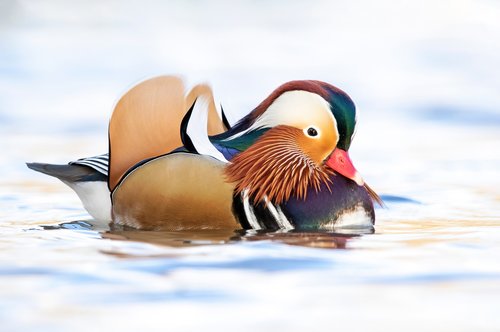
- Mandarin Duck (escaped from collections) has orange 'sails' on the back and whiskery orange cheeks. Hooded Merganser has a thin bill and a fan-shaped white or brown crest.
- Where to see it
- Wooded swamps and park ponds across the eastern US, e.g. the Great Swamp NWR (New Jersey) and Okefenokee; nest-box programmes on many refuges.
- When
- Resident in the southern US; summer visitor in the north, Mar–Nov
Listen
Looking for field recordings…
Life & habits
- Diet
- Acorns, seeds, aquatic plants, insects
- Habitat
- Wooded swamps, beaver ponds, slow rivers and marshes with trees
- Size
- 47–54 cm; 450–880 g
- Lifespan
- Banding record about 22 years
It flies nimbly through flooded forest, often nodding its head in flight.
Where it lives
Recorded sightings
—
geo-referenced records in GBIF, from museums, herbaria and field observers.
Native range
Eastern North America, the Pacific coast from British Columbia to California, and Cuba
Drag the globe to turn it. Dots are where records exist, not a range map; darker means more records.
In the old herbals & bestiaries
Woodcuts and engravings matched from the Source Library’s scanned books by name. Plates marked “relative” show a close kin rather than this exact species. Click a plate to read the page it came from, with translation.

In the stacks
Searching the stacks…
Every page naming Aix sponsa in the Biodiversity Heritage Library →
Marginalia
Hunted almost to extinction by about 1900, it recovered after the 1918 Migratory Bird Treaty Act ended market hunting and nest-box programmes replaced lost tree cavities; Catesby painted it as 'The Summer Duck'.
Curiosity
Linnaeus named it sponsa, Latin for 'betrothed' or 'bride', for the male's 'wedding finery'.
Kinship
Photographs: iNaturalist contributors under the licences shown. Records: GBIF.org. Historical plates: Source Library (CC BY-SA 4.0; originals public domain). Summary text: Nature Library editors and Wikipedia (CC BY-SA). Medicinal and edibility notes are historical and educational, not advice. iNaturalist taxon 7107.