- Fungi Including Lichens
- ›Basidiomycete Fungi
- ›Higher Basidiomycetes
- ›Mushrooms, Bracket Fungi, Puffballs, and Allies
- ›Agaricomycetidae
- ›Common Gilled Mushrooms and Allies
- ›Pleurotineae
- ›Pleurotaceae
- ›Pleurotus
- ›Pleurotus djamor
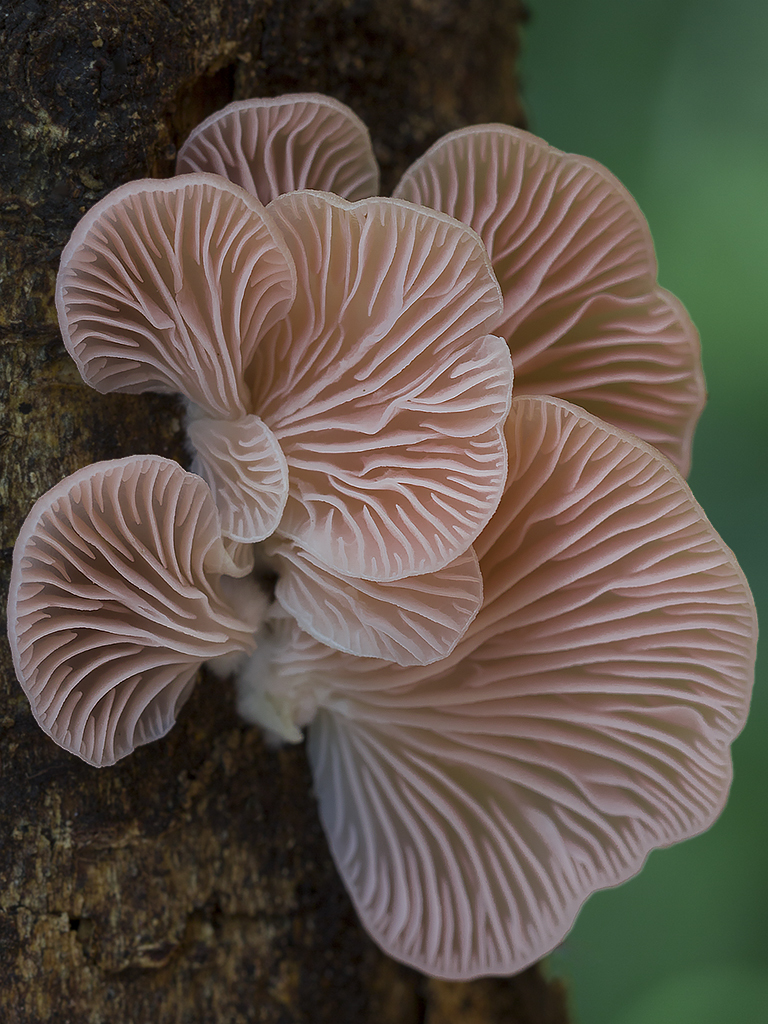
Pink Oyster Mushroom
Pleurotus djamor
Pleurotus djamor, commonly known as the pink oyster mushroom, is a species of fungus in the family Pleurotaceae. It was originally named Agaricus djamor by the German-born botanist Georg Eberhard Rumphius and sanctioned under that name by Elias Magnus Fries in 1821. It was known by many different names before being transferred to the genus Pleurotus by Karel Bernard Boedijn in 1959.
From the article Pleurotus djamor on Wikipedia (CC BY-SA), quoted section by section
Range & habitat
The pink oyster mushroom grows in tropical and subtropical areas, growing as far north as Japan and as far south as New Zealand. In Hawai'i, pink oyster mushrooms often grow on fallen coconuts, and on the stalks of palm fronds, though they can also be found on fallen ōhiʻa branches in the forests of the Hawaiian island Kaua'i.
Wikipedia: “Ecology and distribution”
At the table
Pink oyster mushrooms are best suited for cooked applications such as sautéing, boiling, roasting, or frying. They can be sautéed or stir-fried with other vegetables, added to pasta dishes, sprinkled on top of pizza, added to grain bowls, sautéed with eggs, boiled in soups, chowders, or stews, or cooked into risotto. They can also be sautéed and mixed with cream-based white sauces for added flavor. Due to their meaty texture, these mushrooms require thorough cooking to develop their flavor and an edible consistency. Pink oyster mushrooms are widely cultivated. They require less water spraying during fruiting than the Italian oyster. Pink oyster mushrooms can be grown at relatively warm temperatures of 25-30°C. They can be cultivated on barley straw, sawdust, tea leaves and wheat straw. Pink oyster mushrooms contain high levels of vitamin C and potassium compared to other mushrooms.
Wikipedia: “Uses and benefits”
In human culture
Pink oyster mushrooms are a commonly found specimen in central Mexican communities. It is the most well known mushroom in Tlayacapan, Morelos. The species is collected by families and then often sold at vendors markets. Locals call it a variety of names: "seta", "cazahuate", "orejón", "hongo de pino", "blanco", "oreja de cazahuate". Pink oyster mushrooms are also sold door-to-door by mestizos in mountainous communities, such as San Lorenzo de Atzqueltán and Izolta.
Wikipedia: “Cultural significance”
Where it lives
Recorded sightings
—
geo-referenced records in GBIF, from museums, herbaria and field observers.
Drag the globe to turn it. Dots are where records exist, not a range map; darker means more records.
In the stacks
Searching the stacks…
Every page naming Pleurotus djamor in the Biodiversity Heritage Library →
This page is assembled live from iNaturalist, GBIF, Wikipedia, the Source Library and the Internet Archive. It is not yet part of the hand-edited codex. iNaturalist taxon 328233.