- Fungi Including Lichens
- ›Basidiomycete Fungi
- ›Higher Basidiomycetes
- ›Mushrooms, Bracket Fungi, Puffballs, and Allies
- ›Shelf Fungi
- ›Bracket Fungi
- ›Ganoderma
- ›Ganoderma
- ›Ganoderma lucidum
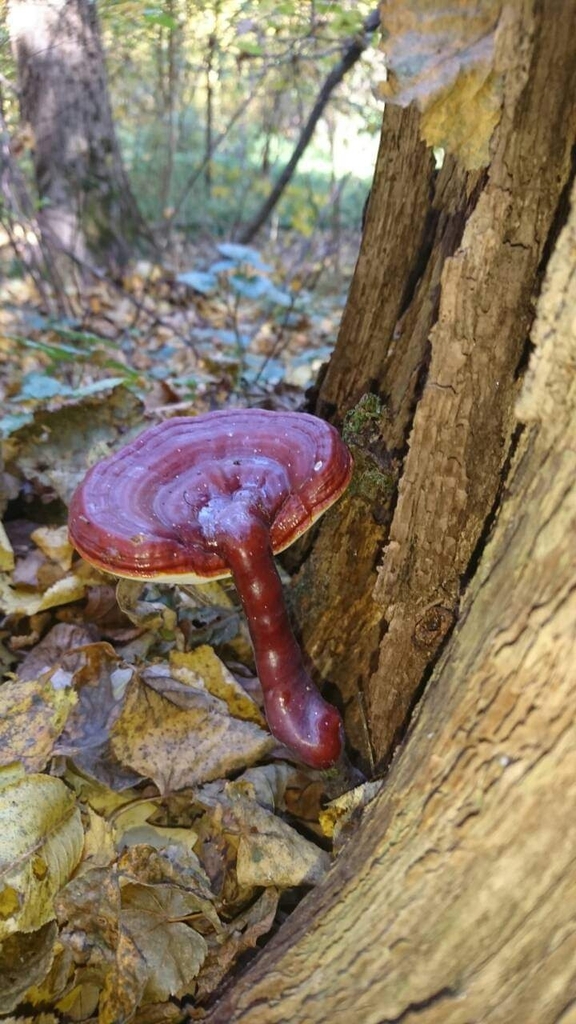
lacquered bracket
Ganoderma lucidum
The lingzhi mushroom or reishi mushroom (traditional Chinese: 靈芝; pinyin: língzhī; Japanese: 霊芝; rōmaji: reishi; Vietnamese: linh chi; literally: "soul/spirit mushroom") is a species complex that encompasses several fungal species of the genus Ganoderma, most commonly the closely related species Ganoderma lucidum, Ganoderma tsugae, and Ganoderma lingzhi. G. lingzhi enjoys special veneration in East Asia, where it has been used as a medicinal mushroom in traditional Chinese medicine for more than 2,000 years, making it one...
From the article Ganoderma lucidum on Wikipedia (CC BY-SA), quoted section by section
Description
Reishi is a purple-brown mushroom with a long stalk, brown spores, and a fan-shaped cap with a shiny appearance, and may have six colors. It grows on decaying tree stumps mainly of plum or oak. Native to China, Japan, and North America, it is commonly cultivated throughout Asia. The caps can grow up to 35 centimetres (14 in) across. The fruiting body almost always has a stipe present, which is tawny to russet colored and 1.5 times the diameter of the cap. Context tissue (sterile tissue inside the fruiting body between the pileus crust and the initiation of the tubes) is pink-buff to cinnamon-buff and corky, showing concentric growth zones and no resinous or melanoid deposits. The hymenium displays 4–5 pores per millimetre. Chlamydospores are absent. Basidiospores are 8.2–12.1 μm (average 10.7 μm) long and 4.8–8.9 μm (average 7.1 μm) wide, with a spore shape index of 66.2.
Phytochemicals. G. lucidum phytochemicals include diverse polysaccharides, triterpenes, ganoderic acid, alkaloids, flavonoids, and saponins.
Range & habitat
The species is widely distributed in tropical and subtropical rainforest regions in Asia, Africa, and the United States. It has been used for food and traditional medicine over centuries in China, Vietnam, and India. It is cultivated using intensive cultivation technology in Japan, Korea, and China, and is cultivated in some South American countries. In the southern region of Vietnam, it can be seen growing on dầu lim trees on Phú Quốc. Wild populations found in the U.S. states of California and Utah were likely introduced anthropogenically and naturalized. This species is the favored food of the large North American pleasing fungus beetle Megalodacne fasciata.
Wikipedia: “Distribution and ecology”
At the table
The species is inedible and rock-hard when dried, but is used to make a bitter-tasting tea. Due to the poor quality of clinical research, there is no good evidence for the use of G. lucidum in treating cardiovascular diseases in people with type 2 diabetes or any other medical condition. It has safety concerns and moderate interactions with certain medications and dietary supplements.
Products. The confusion surrounding the taxonomy of Ganoderma species has persisted, causing confusion and inaccuracies when labeling folklore products containing Ganoderma species, as well as "grow your own" (GYO) kits and other tissue samples sold for cultivation of Ganoderma species. Products typically carry a label of G. lucidum, using the words "reishi" and "lingzhi/ling chih" (which most typically refer to Asian Ganoderma species used in traditional medicine, such as G. sichuanense and Ganoderma sinense) merely because they contain a laccate Ganoderma species. These products and GYO kits sold as Ganoderma lucidum may not contain G. lucidum: one study showed through DNA analysis that 93% of GYO kits and half of the dried mushroom products studied that were labeled "G. lucidum" contained G. sichuanense in actuality, an inaccurate labeling. The study also found that no manufactured reishi product and only one GYO kit actually contained G. lucidum. …
Wikipedia: “Uses”
How it is grown
A 2020 study indicated ways to cultivate it in different types of side-streams and waste, but this species does not usually produce fruiting bodies as well as in other woods, such as aspen, probably because softwoods contain compounds which are toxic to several fungi, including Ganoderma spp. However, recent studies found that G. lucidum is still able to degrade Pinus sylvestris wood, causing a wood delignification but keeping proportion of carbohydrates high, opening new doors to softwoods in their utilization in G. lucidum cultivation.
Wikipedia: “Cultivation”
In human culture
The scientific name, Ganoderma lucidum, uses the genus name, Ganoderma (derived from Greek ganos/γάνος 'brightness, sheen', hence 'shining' and derma/δέρμα 'skin') combined with lucidum from Latin lucidus 'light, bright, clear'.
Wikipedia: “Etymology”
Where it lives
Recorded sightings
—
geo-referenced records in GBIF, from museums, herbaria and field observers.
Drag the globe to turn it. Dots are where records exist, not a range map; darker means more records.
In the old herbals & bestiaries


In the stacks
Searching the stacks…
Every page naming Ganoderma lucidum in the Biodiversity Heritage Library →
This page is assembled live from iNaturalist, GBIF, Wikipedia, the Source Library and the Internet Archive. It is not yet part of the hand-edited codex. iNaturalist taxon 125932.