- Plants
- ›Vascular Plants
- ›Ferns
- ›Leptosporangiate Ferns
- ›Polypod Ferns
- ›eupolypods I
- ›polypody family
- ›Polypodioideae
- ›Pleopeltis
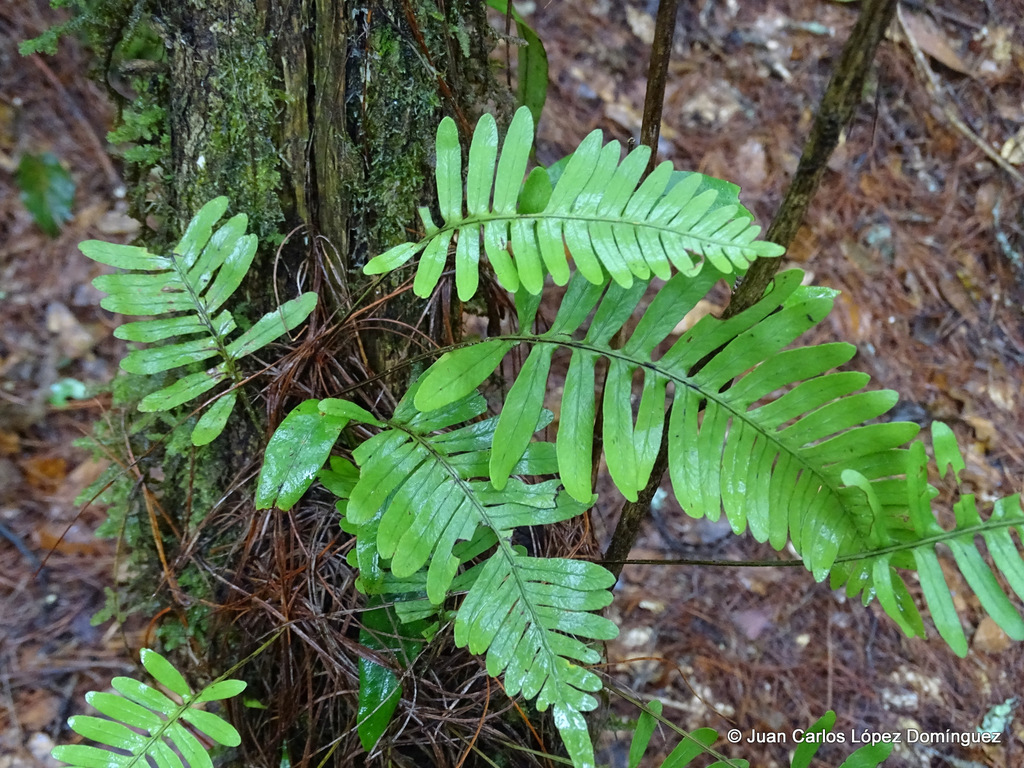
tropical resurrection fern
Pleopeltis polypodioides
Pleopeltis polypodioides (syn. Polypodium polypodioides), also known as the resurrection fern, is a species of creeping, coarse-textured fern native to the Americas and Africa.
From the article Pleopeltis polypodioides on Wikipedia (CC BY-SA), quoted section by section
Description
The evergreen fronds of Pleopeltis polypodioides are 25 cm high by 5 cm wide and monomorphic. The leathery, yellow-green pinnae (leaflets) are deeply pinnatifid, oblong to narrowly lanceolate, usually widest near middle, occasionally at or near base. It attaches to the limbs of its host plant with a branching, creeping, slender rhizome, which grows to 2 mm in diameter. The scales are lanceolate, with light brown base and margins, and having a dark central stripe.
The gametophytes (the haploid gamete producers) develop from very small spores that float in the air and are deposited on moist tree branches. These spores are produced in sporangia that develop on the leaves of the fern's sporophyte. The fern can also reproduce by the division of its rhizomes. On the underside of the blades, the sori (reproductive clusters) are round, discrete, and sunken. Their outline can be seen as raised dimples on the upper surface. They are typically near the outer edge, and occur on all but the lowest pinnae of fertile fronds. Indusia are absent. Sporangia are yellow to brown at maturity. Spores are produced from summer to fall.
Range & habitat
Pleopeltis polypodioides resides in the hardwood forests of southeastern United States in areas including Delaware, Maryland, the Carolinas, Virginia, West Virginia, Illinois, Ohio, Alabama, Georgia, Florida, Mississippi, Arkansas, Texas and Oklahoma. Four clades exist: African, South America-Caribbean basin, Central America-Mexico, and North America. Out of these 4 clades there are 6 major varieties, native to southeastern United States, Mexico, and even Africa.
var. michauxiana var. knoblochianum var. acicularis var. polypodioides var. burchellii var. minus [1] This fern is an epiphyte, or air plant, which means it attaches itself to other plants and gets its nutrients from the air and from water and nutrients that collect on the outer surface of bark. The resurrection fern lives on the branches of large trees such as cypresses and can often be seen carpeting the shady areas on limbs of large oak trees repeatedly exposed to rainfall. However, it is known to grow on the surfaces of rocks and dead logs as well. It is often found in the company of other epiphytic plants, such as Spanish moss.
Wikipedia: “Distribution and habitat”
What it does
The fern has spores on the bottom of the fronds, contained in sori. Sori can be found aligned in rows on the underside of fertile fronds. They start as yellow, but as they mature, they turn brown and split. The fern sporulates in summer and early fall. Rhizome sections are also viable offspring and can root themselves in new medium.
Wikipedia: “Reproduction”
Where it lives
Recorded sightings
—
geo-referenced records in GBIF, from museums, herbaria and field observers.
Drag the globe to turn it. Dots are where records exist, not a range map; darker means more records.
In the stacks
Searching the stacks…
Every page naming Pleopeltis polypodioides in the Biodiversity Heritage Library →
This page is assembled live from iNaturalist, GBIF, Wikipedia, the Source Library and the Internet Archive. It is not yet part of the hand-edited codex. iNaturalist taxon 782079.