- Plants
- ›Vascular Plants
- ›Ferns
- ›Leptosporangiate Ferns
- ›Polypod Ferns
- ›Pteridineae
- ›brake family
- ›Ceratopteridoideae
- ›Ceratopteris
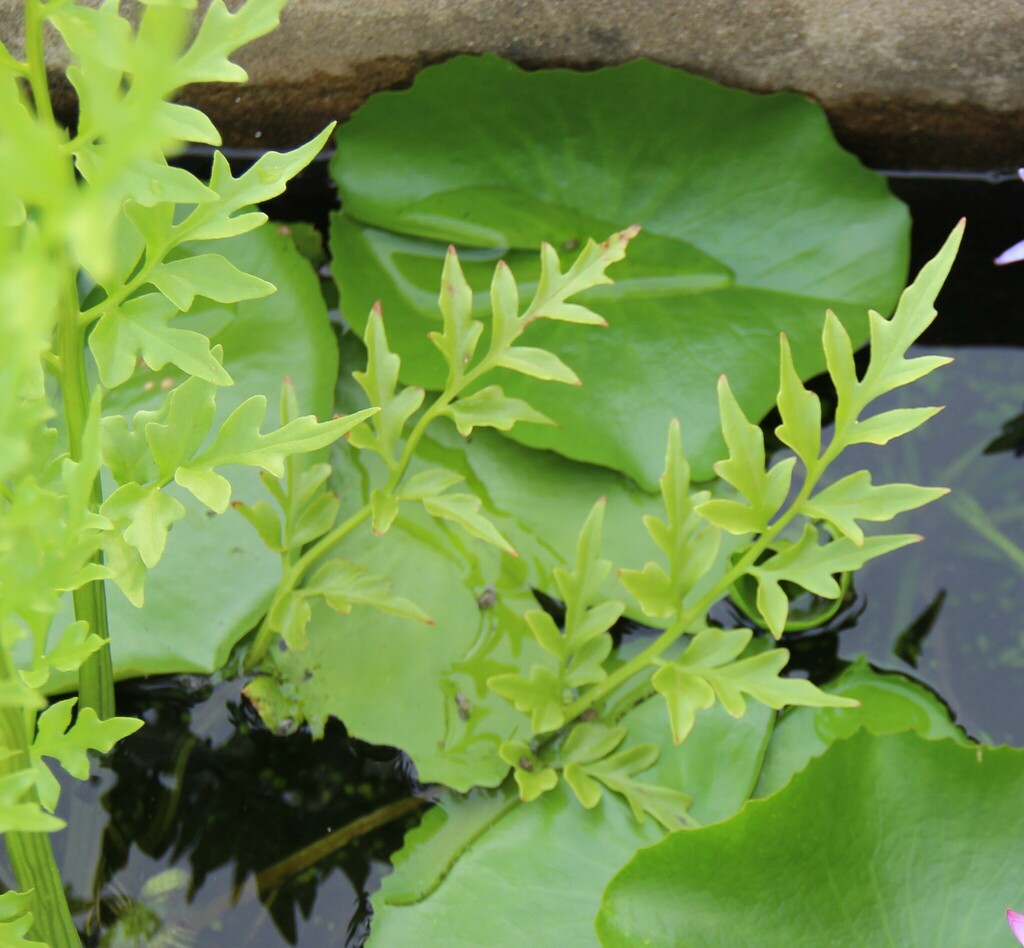
Water Fern
Ceratopteris thalictroides
The species Ceratopteris thalictroides is a fern species belonging to the genus Ceratopteris, one of only two genera of the Ceratopteridoideae subfamily of the family Pteridaceae.
From the article Ceratopteris thalictroides on Wikipedia (CC BY-SA), quoted section by section
Description
Rooted in mud, Ceratopteris thalictroides plants vary in size and appearance. The stipes of mature plants are 3–15 mm in diameter, spongy, and air-filled with 4–60 centimeters (1.6–23.6 in) long including its stipe. Pale green, brown when matured, fertile fronds are 15–100 centimeters (5.9–39.4 in) or more, including the stipe, to 40 centimeters (16 in) long. Proliferous or dormant buds with their overlapping dark scales, present in the axils of fertile pinnae, are winged. Pinnae are deeply incised with segments 2–15 mm x 10–30 mm and the fertile segments 1–2 mm x 10–80 mm.
Range & habitat
Ceratopteris thalictroides is widespread across the tropical and subtropical regions of the world, occurring as far north as Korea and as far south as western Australia.
Wikipedia: “Distribution”
What it does
Ceratopteris thalictroides is often found near stagnant water or in still pockets along slow flowing rivers in swampy areas, swamp forests, sago swamps, marshes, natural and man-made ponds. The plant thrives in full sun to moderate shade, from sea level to 1,300 meters (4,300 ft) altitude, but mostly below 500 meters (1,600 ft). C. thalictroides is often massed on or around logs or other floating vegetation. The plant was once recorded in a fresh-water mangrove (Sonneratia) growing among the finger-like pneumatophores. In some areas, Ceratopteris exhibits a degree of seasonality, reaching maturity and shedding spores during the dry season; plants have lost nearly all sterile fronds by this stage. The species has been reported to be functionally an annual, repopulating from spores the next season, but it is of indefinite lifespan in cultivation. It can reach full maturity in 29 days.
Wikipedia: “Ecology”
At the table
The fronds are cooked and eaten as a vegetable in Madagascar and Swaziland, New Guinea, Nepal, and Vietnam, and other parts of Asia. It has been used similarly to watercress. In Malaysia and Japan, uncurled fronds have been used in salads. Some ferns are potentially carcinogenic when eaten; this may be the case in Ceratopteris thalictroides.
Wikipedia: “Culinary”
How it is grown
It grows best in soil with a pH reading of 5-9 and in very high amounts of light. It usually grows quickly. C. thalictroides can benefit (like all aquatic plants) from the addition of CO2. The plant's reproductive technique is similar to other ferns. Small adventitious plantlets are grown on the mother plant and are then released when ready. It can provide useful shade to shyer fish and small fry. The dense roots are said to take nutrients out of the water, helping to prevent the growth of algae.
Wikipedia: “Cultivation”
Where it lives
Recorded sightings
—
geo-referenced records in GBIF, from museums, herbaria and field observers.
Drag the globe to turn it. Dots are where records exist, not a range map; darker means more records.
In the old herbals & bestiaries

In the stacks
Searching the stacks…
Every page naming Ceratopteris thalictroides in the Biodiversity Heritage Library →
This page is assembled live from iNaturalist, GBIF, Wikipedia, the Source Library and the Internet Archive. It is not yet part of the hand-edited codex. iNaturalist taxon 160357.