- Plants
- ›Vascular Plants
- ›flowering plants
- ›monocots
- ›grasses, sedges, cattails, and allies
- ›grasses
- ›Pooideae
- ›Bromeae
- ›Bromus
- ›Ceratochloa
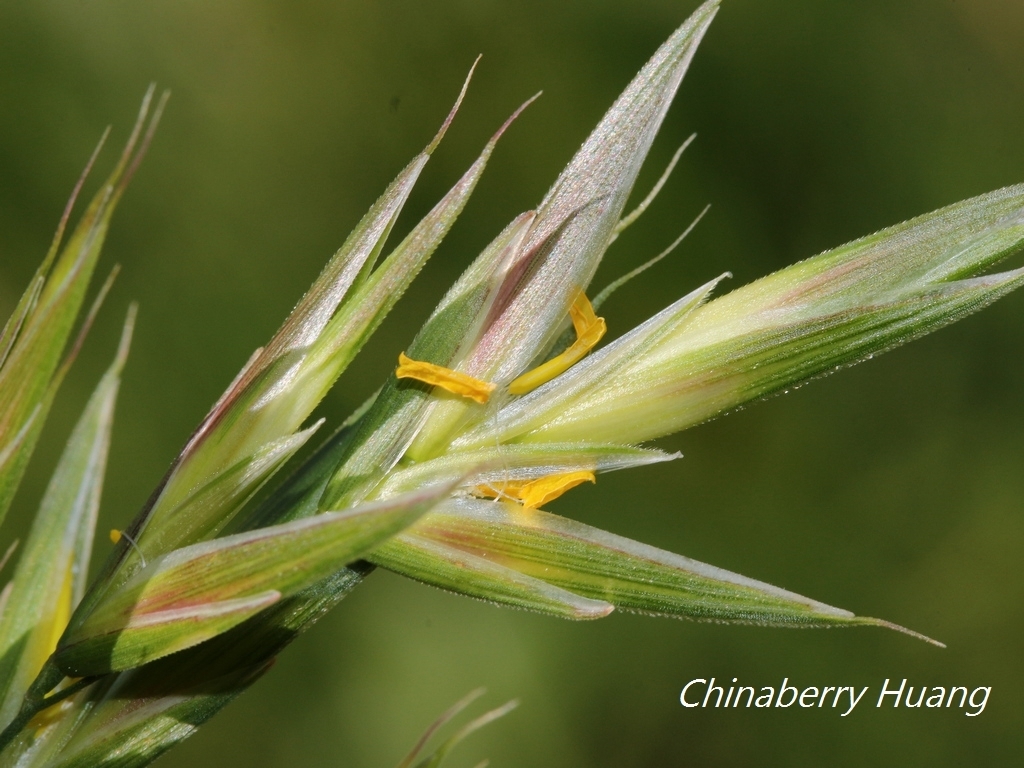
Rescue Brome
Bromus catharticus
Bromus catharticus is a species of brome grass known by the common names rescue grass (America), prairie grass (New Zealand), and Schrader's bromegrass in English, and cebadilla criolla and cebadilla in Spanish.
It is the most common and most well-known of several species in the Bromus catharticus complex within the Bromus section Ceratochloa, all of which are hexaploids with the chromosome count 2n=42.
From the article Bromus catharticus on Wikipedia (CC BY-SA), quoted section by section
Description
Bromus catharticus is a coarse winter annual or biennial grass, growing 0.2–1 m (7.9 in – 3 ft 3.4 in) in height. The culms of the grass are glabrous and 2–4 mm (0.079–0.157 in) thick. The sheaths are densely hairy. The grass lacks auricles and the glabrous ligule is 1–4 mm (0.039–0.157 in) long. The leaf blades are 4–30 cm (1.6–11.8 in) long and 3–10 mm (0.12–0.39 in) wide and are glabrous or pubescent. The erect or nodding panicles are 9–28 cm (3.5–11.0 in) long. The upper spikelets are erect and the lower spikelets are nodding or drooping. Each flat and pointed spikelet is 20–40 mm (0.79–1.57 in) long and has four to twelve florets. The glumes are smooth or occasionally slightly scabrous. The lower glume is fie to seven-veined and 7–12 mm (0.28–0.47 in) long, and the upper glume is seven to nine-veined and 9–17 mm (0.35–0.67 in) long. The lemmas are scabrous or nearly glabrous and lack awns or possess very short awns 2 mm (0.079 in) in length. The lemmas are 11–20 mm (0.43–0.79 in) long. The palea is over half the length of the lemma. The anthers are 0.5–5 mm (0.020–0.197 in) long. Bromus catharticus is part of Bromus section Ceratochloa, which are separated from other Bromus sections by their strongly keeled (folded, like the keel of a boat) lemmas, which make the spikelets laterally-compressed.
Similar species. B. catharticus is likely to be confused with B. cebadilla, B. …
Range & habitat
Bromus catharticus is native to most of South America (Venezuela, Brazil, Bolivia, Colombia, Ecuador, Peru, Argentina, Chile, Paraguay, and Uruguay). It is widely introduced and naturalised in:
Africa (Algeria, Egypt, Ethiopia, Lesotho, Morrocco, Namibia, South Africa, Tunisia, and Zimbabwe) Australasian (Australia, New Caledonia, and New Zealand) Asia (Azerbaijan, Bhutan, China, Cyprus, Georgia, India, Indonesia, Iran, Israel, Japan, Jordan, North and South Korea, Nepal, Pakistan, Saudi Arabia, Russia, Sri Lanka, Syria, and Taiwan) Caribbean (the Dominican Republic, Jamaica, Haiti, and Trinidad and Tobago) Central America (Costa Rica, El Salvador, Guatemala, and Panama) Europe (Austria, Belgium, Croatia, Great Britain, France, Germany, Greece, Italy, Switzerland, Russia, and Ukraine) and North America (Canada, Mexico, and the United States (including Hawaii)
Wikipedia: “Distribution”
At the table
Bromus catharticus is commonly used as a pasture grass in areas with warm and temperate climate.
Wikipedia: “Uses”
In human culture
Bromus - from the Greek bromos (oat), out of broma (food). catharticus - from the Latin catharticus, meaning to purge. This refers to the plant having emetic properties.
Wikipedia: “Etymology”
Where it lives
Recorded sightings
—
geo-referenced records in GBIF, from museums, herbaria and field observers.
Drag the globe to turn it. Dots are where records exist, not a range map; darker means more records.
In the stacks
Searching the stacks…
Every page naming Bromus catharticus in the Biodiversity Heritage Library →
This page is assembled live from iNaturalist, GBIF, Wikipedia, the Source Library and the Internet Archive. It is not yet part of the hand-edited codex. iNaturalist taxon 60276.