- Plants
- ›Vascular Plants
- ›flowering plants
- ›monocots
- ›grasses, sedges, cattails, and allies
- ›grasses
- ›Pooideae
- ›Poeae
- ›bluegrasses, timothies, foxtails, and allies
- ›Poa
- ›Micrantherae
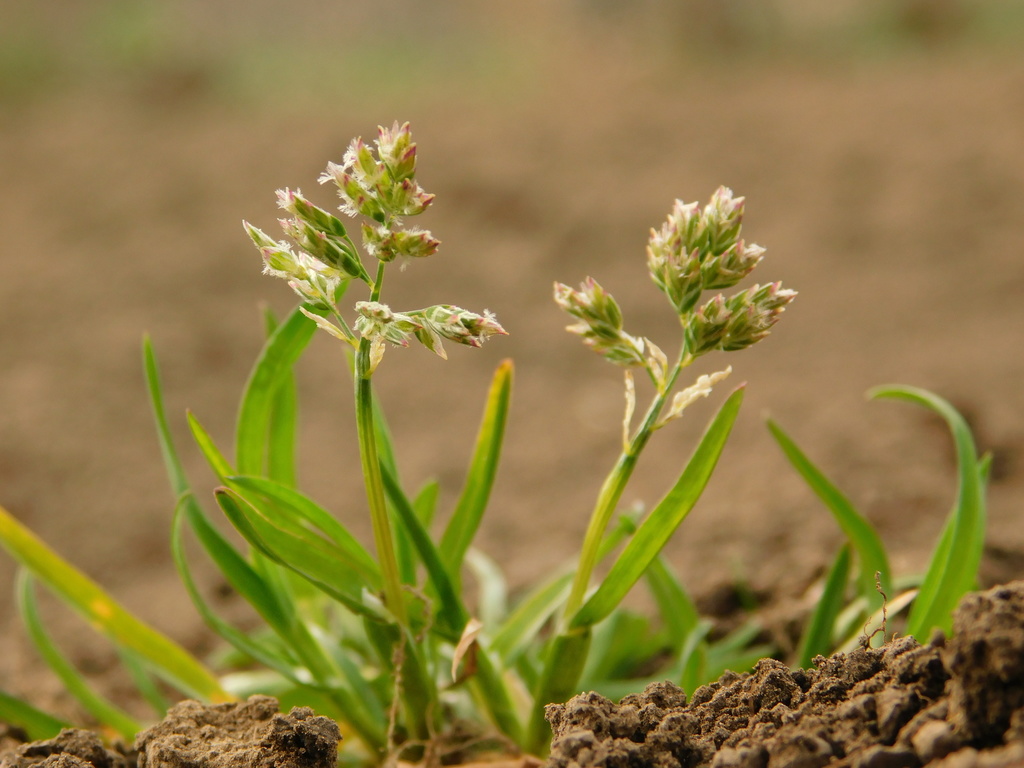
Annual Meadow-grass
Poa annua
Poa annua, or annual meadow grass (known in America more commonly as annual bluegrass or simply poa), is a widespread low-growing turfgrass in temperate climates. Though P. annua is commonly considered a solely annual plant due to its name, perennial bio-types do exist. Poa (πόα) is Greek for "fodder". It is one of the sweetest grasses for green fodder, but less useful than hay. This grass may have originated as a hybrid between Poa supina and...
From the article Poa annua on Wikipedia (CC BY-SA), quoted section by section
Description
It has a slightly creeping, fibrous rootstock. The stem grows from 15–25 cm (6–10 in) high. It is slightly flattened, due to being folded rather than rolled. The panicle is open and triangular shaped, 5–7.5 cm (2–3 in) long. The spikelets are stalked, awnless, 1–2 cm (0.4–0.8 in) long when flowering, and loosely arranged on delicate paired or spreading branches. Sometimes they are tinged purple. The vivid green leaves are short and blunt at the tips, shaped like the prow of a small canoe. They are soft and drooping. Long sheaths clasp the stem. The leaves are smooth above and below, with finely serrated edges. Occasionally the leaves are serrated transversely. The ligule is pointed and silvery, in comparison to common meadowgrass (Poa pratensis), which has a squared ligule, and Poa trivialis, which has a pointed but less silvery ligule. The leaves are smooth above and below, with finely serrated edges. Occasionally the leaves are serrated transversely. It is in flower all year around except for severe winters. The seeds ripen and are deposited 8 months of the year. The plant grows rapidly from seed, flowering within 6 weeks, seeding and then dying.
Range & habitat
It is a common weed of cultivation, known in the Americas as annual bluegrass. It occurs as a common constituent of lawns, where it is also often treated as a weed, and grows on waste ground. Many golf putting greens, including the Oakmont Country Club greens, are annual bluegrass, although many courses have converted to creeping bentgrass (Agrostis stolonifera). It has appeared on King George Island in the Antarctic South Shetland Islands as an invasive species, as well as on Australia's subantarctic Heard and Macquarie Islands.
Wikipedia: “Distribution and habitat”
In human culture
Poa - derived from the Greek name πόα for a type of fodder grass. annua - Latin, meaning 'annual' or 'lasting a year'.
Wikipedia: “Etymology”
Where it lives
Recorded sightings
—
geo-referenced records in GBIF, from museums, herbaria and field observers.
Drag the globe to turn it. Dots are where records exist, not a range map; darker means more records.
In the stacks
Searching the stacks…
Every page naming Poa annua in the Biodiversity Heritage Library →
This page is assembled live from iNaturalist, GBIF, Wikipedia, the Source Library and the Internet Archive. It is not yet part of the hand-edited codex. iNaturalist taxon 52808.